Why Experienced Professionals Get Screened Out of Government Jobs
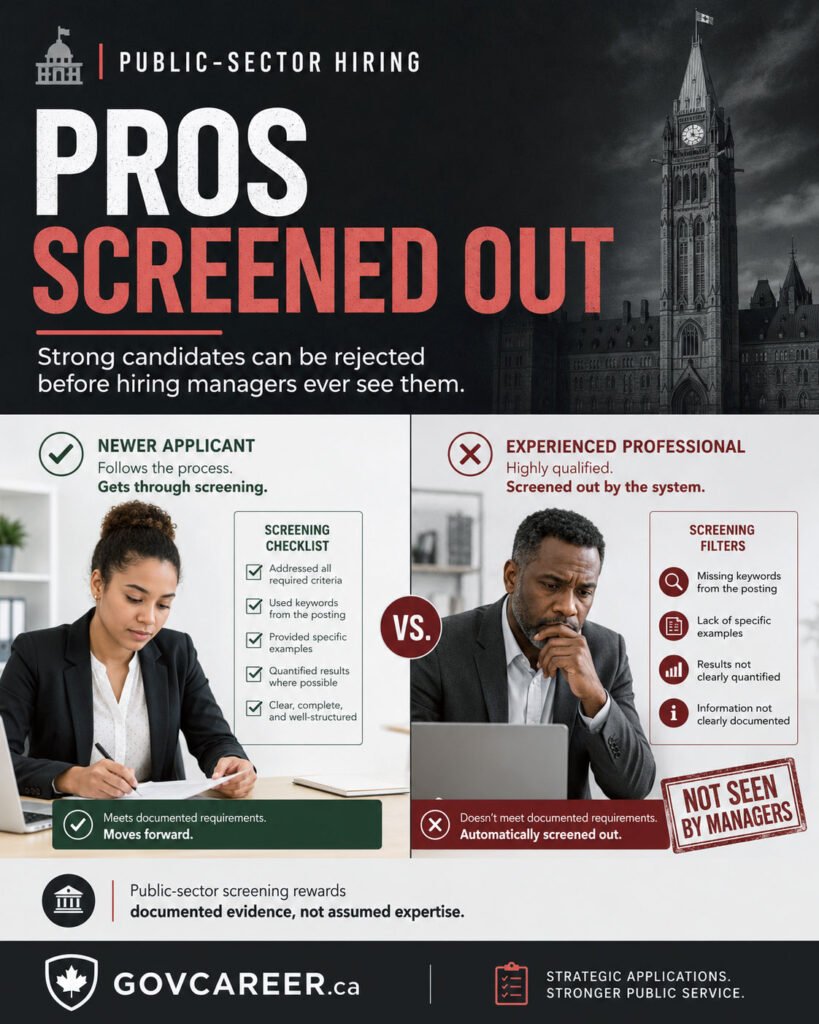
Experienced professionals applying for government jobs can be screened out even when they could perform the work because structured screening evaluates the evidence presented in the application, not the experience a reviewer might infer from senior titles, credentials or career history. To advance, applicants must connect their experience directly to the qualifications stated in the job posting.
This creates a frustrating contradiction in public-sector hiring.
A hiring manager may struggle to find strong candidates for a position. At the same time, capable professionals may already be present in the applicant pool. Their applications simply do not demonstrate the required qualifications clearly enough to survive the screening stage.
The problem is not always a shortage of professional talent.
Sometimes, it is a failure of translation between the candidate’s career and the government application process.
A senior professional may reasonably believe that years of progressively responsible work, respected employers, professional designations and successful projects should make their competence obvious. In a structured hiring process, however, “obvious” experience can remain unproven experience.
That distinction is one of the most important principles of building a resume for government jobs in Canada.
Why do experienced professionals get screened out of government jobs?
Experienced professionals are often screened out because they rely on professional credibility instead of application-specific evidence. They describe their overall career well but do not clearly show how, where and when they performed each required type of work.
This does not mean that government employers disregard senior experience.
It means that the application must give the reviewer enough information to recognize that experience against the criteria being assessed.
Several patterns commonly create the problem:
- The applicant assumes a senior title proves the required skills.
- A certification is presented as proof of practical experience.
- Broad accomplishments replace evidence of specific duties.
- Transferable private-sector experience is described in language that does not match the posting.
- Basic or repetitive screening questions receive short answers.
- The applicant expects the reviewer to search the entire resume and assemble the evidence.
- Important details are implied rather than stated.
An experienced business analyst may write that they have led enterprise transformation projects, advised executives and managed complex stakeholder relationships.
That may be impressive.
But if the posting asks for experience preparing business requirements, facilitating requirements-gathering sessions and developing process documentation, the application must demonstrate those activities directly.
The reviewer may not be permitted—or may simply not have enough information—to conclude that broad transformation experience necessarily included all three requirements.
The candidate knows the connection.
The application has to make that connection visible to someone else.
Seniority is not a substitute for evidence when Experienced Professionals Applying for Government Jobs
A senior title provides context, but it does not automatically prove every qualification attached to the position.
Titles are inconsistent across organizations. A director in one company may perform work similar to a manager elsewhere. A project manager may lead teams and budgets in one role but primarily coordinate schedules in another. A business analyst may specialize in technology, operations, policy, finance or organizational change.
The title cannot tell the reviewer the full story.
Consider a posting that requires experience with:
- project planning
- budget monitoring
- stakeholder consultation
- risk management
- written recommendations to senior leadership
An applicant who writes “Senior Project Manager responsible for complex corporate initiatives” has made a broad claim. The statement may be accurate, but it does not clearly demonstrate all five requirements.
A stronger application would explain the relevant work through specific responsibilities and examples:
- developed project plans, schedules and implementation milestones
- monitored a defined operating or capital budget
- consulted internal divisions, external organizations or members of the public
- identified project risks and implemented mitigation measures
- prepared briefing materials, decision documents or recommendations for executives
This is not unnecessary repetition.
It is evidence mapping.
The reviewer should not have to infer that managing a complex project must have involved budgets, consultations, risks and executive communication. Those activities should be visible in the resume or screening answers wherever the application instructions require them.
This is also why understanding how government resumes are screened matters more than relying on a prestigious title or polished general profile.

Why experienced applicants may resist detailed screening questions
Experienced candidates sometimes view detailed application questions as an insult to their professional level.
A senior analyst may wonder why an employer asks about Microsoft Word.
An experienced manager may be frustrated by a question about preparing reports.
A certified project professional may consider it unnecessary to explain whether they have experience developing project schedules.
The reaction is understandable. After years of advanced work, describing basic capabilities can feel reductive.
But the application question is not necessarily making a judgment about the candidate’s status. It is asking for evidence connected to a stated qualification.
For federal public-service applications, the Government of Canada instructs applicants to read screening questions carefully and provide details or examples, rather than simply stating that they possess the experience or directing the reviewer to another part of the resume.
The practical lesson applies more broadly, although application systems and screening procedures vary across government and public-sector employers.
If the employer asks about a qualification, answer it.
Do not reject the question because the skill seems obvious, basic or beneath your professional level.
A short answer such as “Yes, I have used Microsoft Word throughout my career” may still be inadequate when the application requests the context, duration, scope or level of use.
A stronger answer might explain that the candidate used the software to prepare executive reports, briefing notes, technical documents, correspondence, templates or tracked revisions across multi-author documents.
The purpose is not to prove that the candidate can open a document.
It is to demonstrate the relevant application of the skill.
Credentials do not automatically prove practical experience
Education, certifications and professional designations can be important requirements. They can also strengthen an application.
They do not automatically prove every related type of experience.
A Project Management Professional designation does not, by itself, show:
- the size or complexity of projects managed
- the candidate’s specific role
- whether the candidate managed budgets
- whether the candidate supervised staff
- which project methodologies were used
- whether the candidate worked with public-sector stakeholders
- what outcomes the candidate achieved
Similarly, a business-analysis certification does not automatically demonstrate experience developing business cases, documenting workflows, facilitating consultations or translating operational needs into technical requirements.
Credentials establish education, professional development or recognized knowledge.
Experience evidence establishes what the applicant actually did.
Government job applications may assess both, but candidates should not treat them as interchangeable.
This is one reason being qualified is not always enough to get shortlisted. The application must show the relationship between the candidate’s qualifications and the work required by the position.
Broad professional summaries create hidden evidence
Many experienced candidates have resumes built for networking, executive recruitment or private-sector opportunities.
Those resumes often emphasize:
- leadership identity
- career progression
- strategic impact
- major accomplishments
- industry reputation
- organizational scope
- high-level professional branding
That approach may work well when a recruiter already understands the candidate’s occupation and is evaluating overall market value.
Structured government screening can require a different level of precision.
Suppose an applicant writes:
“Accomplished business analyst and certified project-management professional with extensive experience leading strategic transformation initiatives.”
The statement sounds credible, but it leaves important questions unanswered:
- What kind of analysis did the candidate perform?
- Which project-management responsibilities did they personally handle?
- What methods or tools did they use?
- Which stakeholders did they consult?
- What documents did they produce?
- What was the scale of the initiatives?
- When and where did this experience occur?
- Which stated screening criteria does the experience demonstrate?
A professional summary should introduce the candidate’s value.
It should not carry the entire burden of proof.
The detailed evidence must appear in the employment history, screening-question responses, cover letter or other application components identified by the employer.
The reviewer cannot award credit for your entire career
Experienced applicants sometimes approach an application as if the reviewer is assessing the total value of their career.
That is usually the wrong mental model.
The reviewer is more likely to be asking a narrower question:
Does this application demonstrate the qualifications being screened at this stage?
A candidate may possess many strengths that are valuable but irrelevant to the initial screening decision.
For example, the candidate may have:
- twenty years of experience
- a graduate degree
- international assignments
- senior leadership exposure
- several professional certifications
- extensive industry knowledge
- a record of successful projects
Those accomplishments may matter later or help distinguish the candidate at another assessment stage.
But they do not compensate for missing evidence of a required qualification.
If the posting requires experience conducting procurement activities and the application never demonstrates procurement work, the candidate’s unrelated achievements cannot fill that gap.
This is how a highly capable professional can be screened out while a less senior applicant advances.
The less senior applicant may not have a stronger career.
They may simply have submitted a stronger application against the stated criteria.
Government applications do not reward modesty or implication
Some professionals deliberately avoid repeating information because they do not want to sound boastful.
Others believe concise writing is inherently stronger.
Conciseness is valuable when it removes unnecessary wording. It becomes harmful when it removes assessable evidence.
A government application should not be inflated, repetitive or filled with unsupported claims. It should still state the candidate’s role clearly.
Use “I” where the application asks what you personally did.
Distinguish your contribution from the work of the team.
Identify the action, context and result where relevant.
For example:
Weak:
“Worked with the team to improve reporting.”
Stronger:
“Analyzed reporting requirements from five operational units, developed a standardized monthly reporting template and presented implementation recommendations to the director.”
The stronger version allows the reviewer to identify:
- the candidate’s personal action
- the scope of the work
- the stakeholders involved
- the document or product created
- the level at which the work was communicated
The candidate is not exaggerating.
The candidate is making the evidence assessable.
How should experienced professionals answer government screening questions?
Experienced professionals should answer each screening question as an independent evidence requirement. The response should identify where and when the experience was acquired, what the candidate personally did, the scope or complexity of the work and the result where relevant.
A useful response structure is:
1. Confirm the relevant experience
Begin with a direct statement that answers the question.
Example:
“I have more than six years of experience developing and implementing project plans for technology and business-transformation initiatives.”
2. Identify where and when you gained it
Name the employer, position and approximate period.
Example:
“I gained this experience as a Senior Business Analyst with ABC Corporation from 2018 to 2024.”
3. Explain what you personally did
Describe actions rather than relying on the team’s overall work.
Example:
“I developed project scopes, work-breakdown structures, schedules, risk registers and implementation plans for initiatives involving finance, operations and information technology.”
4. Establish scope or complexity
Add details that help the reviewer understand the level of experience.
Useful details may include:
- number of projects
- project duration
- budget responsibility
- number or type of stakeholders
- size of the team
- geographic scope
- operational impact
- regulatory or technical complexity
- level of management supported
5. State the result where useful
Results help demonstrate that the experience was substantive.
Examples include:
- completed implementation within an approved timeline
- improved reporting consistency
- reduced processing time
- supported an executive decision
- resolved a recurring operational issue
- introduced a new procedure
- met a regulatory or service requirement
The answer does not need to become an autobiography.
It needs enough detail to prove the criterion.

Pay close attention to “and” in a requirement
One small word can determine whether an answer is complete.
When a screening question asks whether you have experience performing activity A and activity B, the answer should demonstrate both.
The Government of Canada’s application guidance explicitly tells federal applicants that when a screening question uses “and,” they must demonstrate all the stated skills or experiences.
For example:
“Do you have experience developing and implementing organizational policies?”
An incomplete answer may describe policy development in detail but say nothing about implementation.
The candidate may have done both. The written response proves only one.
The answer should separately establish:
- how the candidate developed policies
- how the candidate implemented those policies
Experienced professionals often lose evidence because they respond to the general idea of the question rather than each component of its wording.
Read the qualification literally before deciding what evidence to use.
Transferable private-sector experience must be translated
Private-sector experience can be highly relevant to government and public-sector jobs.
The problem is not where the experience was acquired.
The problem is whether the application explains its relevance in language the reviewer can assess.
Private-sector resumes may use terms such as:
- client success
- revenue growth
- account ownership
- commercial strategy
- product delivery
- market expansion
- operational excellence
Government postings may describe related work through terms such as:
- stakeholder engagement
- program delivery
- policy implementation
- service improvement
- operational planning
- briefing materials
- financial administration
- public accountability
Candidates should not falsely replace one concept with another. They should identify the genuine connection.
For example, “client management” may involve stakeholder consultation, issue resolution, written communication and service delivery. The application should explain those activities instead of assuming the reviewer will translate the private-sector title or terminology.
Transferable experience becomes persuasive when the underlying work is visible.
Could the hiring manager have wanted the screened-out candidate?
Yes. A candidate who fails initial screening may still have possessed capabilities that would have interested the hiring manager.
That does not mean every screened-out candidate was wrongly rejected.
It means that capability and demonstrated qualification are not identical.
Government hiring processes commonly involve several stages. For federal public-service jobs, official guidance explains that candidates who are screened in may proceed to testing or interviews, followed by references and security screening where applicable. The exact order and process can vary. Candidates can review the Government of Canada’s explanation of what to expect when applying for federal jobs.
The application is what gives the candidate access to the later assessment stages.
If the written evidence does not establish the screening criteria, the hiring manager may never have an opportunity to evaluate the candidate through an interview, test or professional conversation.
This is the practical consequence of why qualified candidates get screened out of government job applications.
The resume does not merely describe the candidate.
It determines whether the candidate’s experience becomes visible inside the hiring process.
A practical application audit for experienced professionals
Before submitting a government or public-sector application, review it from the perspective of someone who does not know your career.
Ask:
- Did I address every required qualification?
- Did I demonstrate every component of requirements containing “and”?
- Did I identify where and when I gained the experience?
- Did I explain what I personally did?
- Did I provide sufficient scope, context or complexity?
- Did I use terminology that accurately connects my experience to the posting?
- Did I rely on a title, credential or employer name instead of evidence?
- Did I dismiss any requirement because it seemed too basic?
- Did I hide important evidence inside a broad professional summary?
- Could a reviewer confirm the requirement without making assumptions?
Then perform a second review.
Remove your name, senior title and professional identity from the application in your mind.
Would the evidence still prove that the applicant meets the criteria?
That is the test.
Frequently Asked Questions
Why was I screened out of a government job when I met the requirements?
You may have met the requirements but failed to demonstrate them clearly enough in the application. Review the job posting, screening questions and your submitted evidence to determine whether each qualification was supported with specific, relevant details. Employer procedures vary, so a screening decision should not automatically be interpreted as proof that you lacked the capability.
Do government employers accept private-sector experience?
Government and public-sector employers can recognize relevant private-sector experience when it satisfies the stated qualifications. The application should translate that experience into clear duties, scope, examples and outcomes connected to the job posting rather than relying on private-sector titles alone.
Do government employers accept private-sector experience?
Government and public-sector employers can recognize relevant private-sector experience when it satisfies the stated qualifications. The application should translate that experience into clear duties, scope, examples and outcomes connected to the job posting rather than relying on private-sector titles alone.
Is a senior title enough to prove that I meet a qualification?
No. A senior title provides useful context but does not establish every required type of experience. Titles vary between employers, so the resume or screening response should explain the work performed and its connection to the qualification.
How detailed should a government screening answer be?
A screening answer should contain enough detail for the reviewer to understand where and when you gained the experience, what you personally did, the scope of the work and the result where relevant. The required length and format depend on the employer’s instructions and the complexity of the question.
Should I answer a basic skills question if I am an experienced professional?
Yes. If the employer asks about a skill, provide the requested evidence even when the skill seems obvious or elementary. Explain how you used it in a relevant professional context rather than offering only a one-word confirmation.
Can certifications replace experience examples?
Usually not when the posting separately requires practical experience. A certification may prove training, education or professional standing, while examples demonstrate how you applied that knowledge in real work. Follow the wording of the specific posting to determine what evidence is required.
Your experience has to become visible
Experienced professionals applying for government jobs do not necessarily fail because they lack ability. They often fail because their applications expect the screening process to recognize ability that has not been demonstrated clearly.
Your title may be senior.
Your credentials may be strong.
Your accomplishments may be substantial.
But the person reviewing the application still needs direct evidence against the stated qualifications.
Do not treat detailed requirements as beneath you. Do not make the reviewer reconstruct your career. Do not assume professional credibility will fill an evidence gap.
The detail that seems too obvious to explain may be the detail that allows your experience to be recognized.