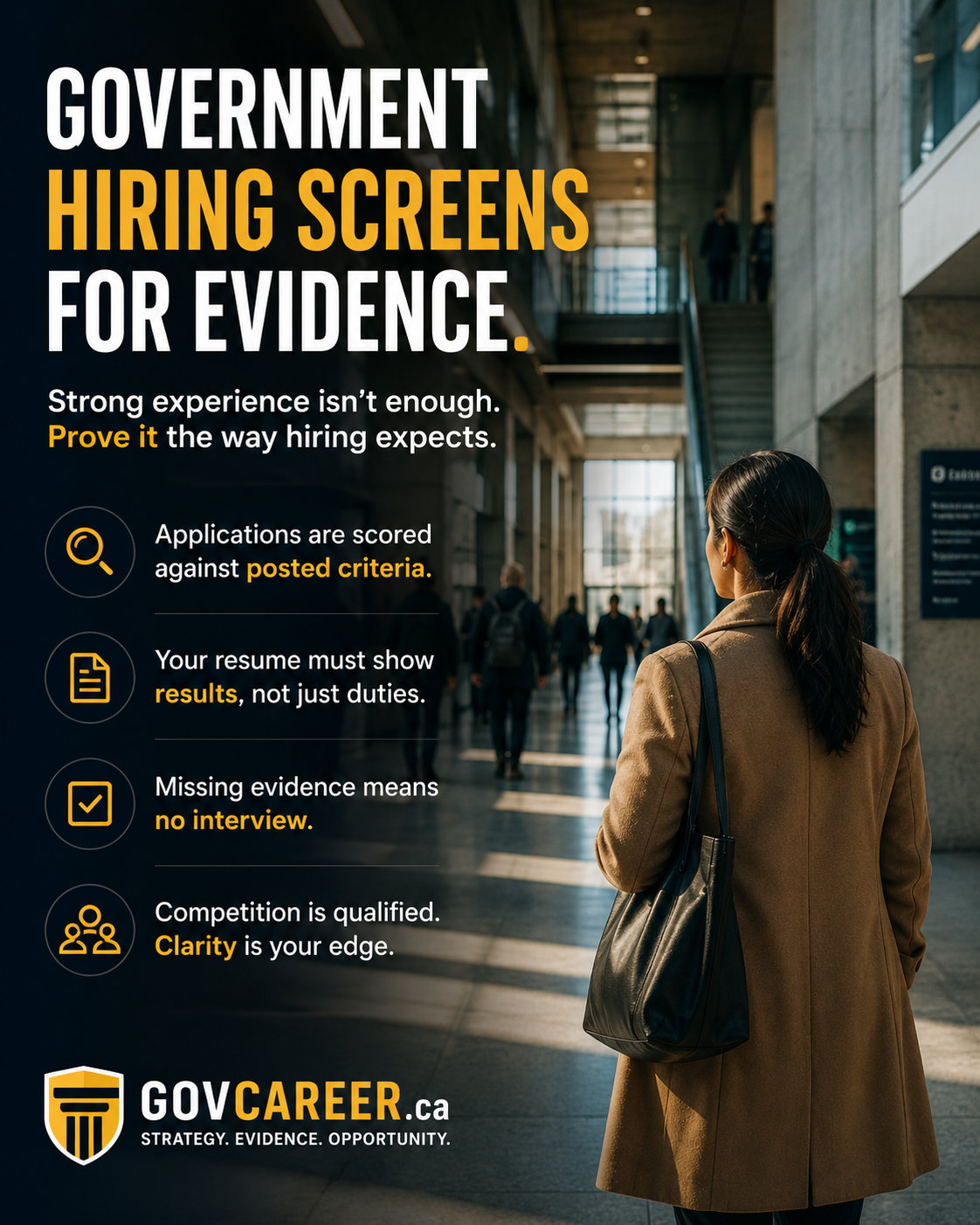
ATS Resume for Government Jobs: Why Passing the System Is Not Enough
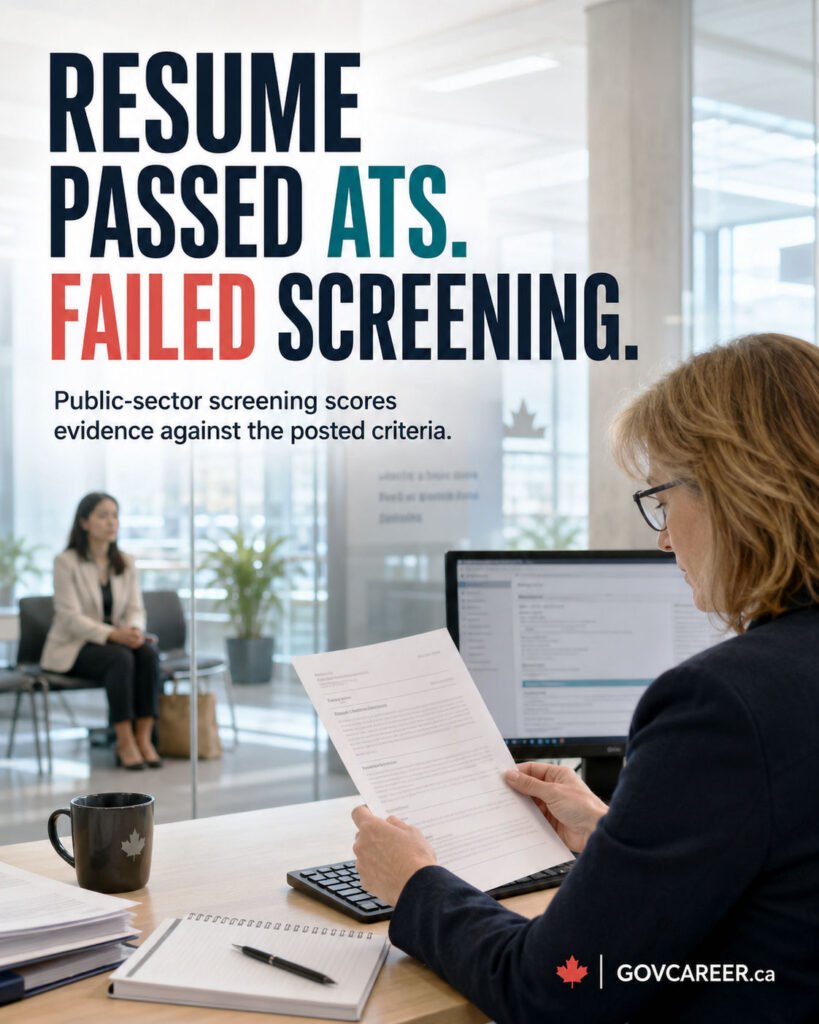
How government resumes are screened depends on the employer and competition, but the central test is usually the same: whether your application provides clear evidence that you meet the posted qualifications. Passing an applicant-tracking system only means your resume was accepted or processed technically. It does not prove that your experience is relevant, sufficiently detailed, or easy for a reviewer to assess.
Many applicants prepare for the software and neglect the human decision that follows.
They focus on keywords, file format, headings, fonts, and ATS compatibility. Those elements matter, but they solve only the first problem. The harder task is showing exactly what you did, where and when you did it, the scope of your responsibility, and how that experience connects to the screening criteria.
A resume can be technically perfect and still give the screener too little evidence to justify moving the application forward.
The resume may look polished. The titles may sound impressive. The candidate may have attended a respected university or worked for a well-known organization. None of those facts automatically demonstrates a specific screening criterion.
In structured hiring, evidence matters more than prestige that the reviewer is expected to interpret.
For a broader explanation of how government applications should be structured around qualifications, begin with this guide to writing a resume for government jobs in Canada.
What Does an Applicant-Tracking System Do? How Government Resumes Are Screened?
An applicant-tracking system, commonly called an ATS, is software used to receive, organize, store and manage employment applications.
The exact functions vary by employer and software platform. Depending on the system, it may:
- collect resumes, cover letters and application forms
- extract information from uploaded documents
- organize candidates by competition or requisition
- support keyword searches or filters
- record application status
- present candidate information to recruiters or hiring teams
- store answers to eligibility or screening questions
- help manage communication and later assessment stages
Applicants often imagine a single automated machine that reads every resume, assigns a secret score and independently decides who advances.
That description is too broad to apply to every government or public-sector employer.
Some systems may support automated filtering. Others primarily collect and organize information. Some competitions rely heavily on screening-question responses. Others use resumes, cover letters, application forms or combinations of these materials.
The correct assumption is that the technology and screening method vary by employer.
Your application therefore needs to survive two different tests:
- technical usability
- qualification-based assessment
A technically readable resume can still fail the second test.
Does the Government Use ATS Software to Screen Resumes?
How Government Resumes Are Screened? Many government and public-sector employers use online recruitment systems, but applicants should not assume that every employer uses the same ATS functions or automated decision rules.
The presence of an online application portal does not prove that software makes the final screening decision.
A system may parse or store the resume while a person later evaluates the application against the advertised requirements. In other competitions, screening questions may become the primary evidence used during the initial review.
For federal opportunities, the Government of Canada advises applicants to maintain an unformatted resume for GC Jobs because much formatting may be removed when information is pasted into the online profile. It also instructs applicants to tailor the resume for each job. The same Government of Canada application guidance tells candidates answering screening questions to provide details and examples rather than merely claiming that they possess the required experience.
This distinction is critical.
The software may capture your words.
The screening process determines whether those words demonstrate the qualification.
How Government Resumes Are Screened

Government resume screening is the review of an application to determine whether the applicant demonstrates the qualifications selected for the initial screening stage.
The exact method varies by employer, jurisdiction, occupation and competition. Screening may consider factors such as:
- area of selection or applicant eligibility
- required education
- specific types of experience
- licences or professional credentials
- language requirements
- employment conditions
- required application documents
- answers to screening questions
- evidence contained in the resume or cover letter
- essential and asset qualifications
The Canadian Institutes of Health Research explains that initial screening reviews applications against requirements identified in the job poster, including education, experience and area of selection. Only applications that clearly demonstrate the screening requirements proceed to further assessment. Its selection-process guidance is one official example of how a federal organization describes this stage.
That does not mean every government employer uses the same procedure.
Some employers use a basic pass-or-fail assessment of essential qualifications. Others may rate applications, apply asset qualifications or compare the strength of evidence when deciding which candidates to invite.
The job posting and application instructions control the process. General advice must always be adjusted to the specific competition.
Why Is Public-Sector Screening Structured Around Posted Criteria?
Structured screening helps employers evaluate applications against requirements connected to the position rather than relying only on broad personal impressions.
This serves several practical purposes.
It creates a documented basis for decisions. It helps different reviewers apply the same qualification framework. It also gives applicants a clearer opportunity to demonstrate how their education and experience relate to the advertised role.
Fairness does not mean every applicant receives an interview.
It means applicants should be assessed through a process connected to the stated requirements and applicable employment rules.
The practical consequence for the candidate is straightforward: the screener should not have to reward an application based primarily on the prestige of a title, employer or school.
A senior title may suggest complex experience. It does not prove what the person actually did.
A famous employer may suggest high standards. It does not identify the candidate’s responsibilities.
A respected university may establish education. It does not automatically demonstrate years of specialized work experience.
Your application must convert background into assessable evidence.
Why Can an ATS-Friendly Resume Still Be Screened Out?
An ATS-friendly resume can still be screened out because technical compatibility and qualification evidence are separate issues.
A resume may parse perfectly and still fail because it:
- does not address an essential qualification
- uses broad claims without supporting examples
- omits dates needed to establish duration
- relies on job titles that do not explain the work
- lists duties without showing scope or complexity
- uses private-sector terminology the reviewer may not recognize
- includes keywords without demonstrating the corresponding experience
- leaves relevant transferable experience unexplained
- assumes the screener will infer qualifications from reputation
- emphasizes irrelevant achievements while giving little space to required experience
This is one of the most important differences between keyword inclusion and evidence.
Suppose a posting requires experience coordinating recruitment activities.
A weak resume might say:
“Experienced HR professional with expertise in full-cycle recruitment.”
That statement includes useful terminology, but it remains a claim.
A stronger version might say:
“Coordinated recruitment for administrative and technical vacancies by preparing postings, reviewing applications, scheduling interviews, communicating with candidates and maintaining applicant records in the organization’s ATS.”
The second version gives the reviewer something concrete to assess.
It identifies the function, the work performed, the employment context and the connection to the criterion.
What Evidence Should a Government Resume Provide?
How Government Resumes Are Screened? Public-sector resume should provide enough context for a reviewer to understand what you did, where you did it, when you did it and how the experience relates to the posted qualification.
Strong evidence commonly answers several questions.
What did you personally do?
Describe your own responsibility rather than only the mandate of the team or organization.
Weak:
“Responsible for stakeholder relations.”
Stronger:
“Advised program managers and community partners on service requirements, responded to operational concerns and coordinated follow-up with internal departments.”
Where and in what role did you gain the experience?
Include the employer, position and organizational context.
Job titles alone can be misleading. “Coordinator,” “advisor,” “analyst” and “manager” can represent very different responsibilities across organizations.
When and for how long did you perform the work?
Dates can matter when the posting requires a minimum period of experience.
Use clear employment dates. Where useful, include months as well as years. Do not force the reviewer to estimate duration from incomplete information.
What was the scope or complexity?
Scope may include:
- number of files or cases
- size of a team
- range of stakeholders
- value of a budget
- geographic coverage
- regulatory environment
- level of decision-making
- sensitivity of information
- frequency of the activity
- complexity of the issues handled
Scope helps distinguish occasional exposure from substantial responsibility.
What resulted from your work?
Results are valuable when they clarify effectiveness, but not every bullet needs a dramatic numerical achievement.
Relevant outcomes may include:
- improved turnaround time
- resolved complaints
- completed projects
- reduced errors
- maintained compliance
- supported service delivery
- improved documentation
- trained staff
- implemented a process
- provided analysis used in a decision
The result should strengthen the evidence rather than turn every resume bullet into forced marketing language.
Why Are Job Titles and Prestigious Employers Not Enough?
Job titles and recognizable employers provide context, but screeners cannot safely assume that everyone with the same title performed the same work.
Consider two people called “HR Coordinator.”
One may primarily schedule interviews and maintain records.
Another may manage recruitment campaigns, support labour-relations matters, interpret policy, coordinate onboarding and advise managers.
The title is identical. The evidence is different.
The same problem applies to seniority.
A director-level candidate may have substantial leadership experience but provide almost no detail about a required operational function. A less senior candidate may describe direct, recent and highly relevant experience more clearly.
The second candidate may be easier to screen in because the application demonstrates the requirement directly.
This does not mean seniority has no value.
It means seniority must be translated into relevant evidence.
Can Keywords Help a Government Resume Pass Screening?
Keywords help when they identify genuine experience and connect the resume to the language of the posting. Keywords alone do not establish that the applicant meets a qualification.
The best approach is to use the employer’s terminology where it accurately describes your background.
For example, if the posting uses “stakeholder consultation” and you performed that work, use the phrase naturally. Then explain:
- who the stakeholders were
- what you consulted them about
- what your responsibility involved
- what decision, service or project the consultation supported
Do not copy large sections of the job advertisement into the resume.
The Ontario Public Service’s cover letter and resume writing guide states that applications are evaluated against the qualifications in the advertisement. It also warns that merely listing skills or copying wording from the job advertisement does not adequately demonstrate how the applicant used those skills.
The principle is simple:
Use the keyword to identify the qualification.
Use evidence to prove it.
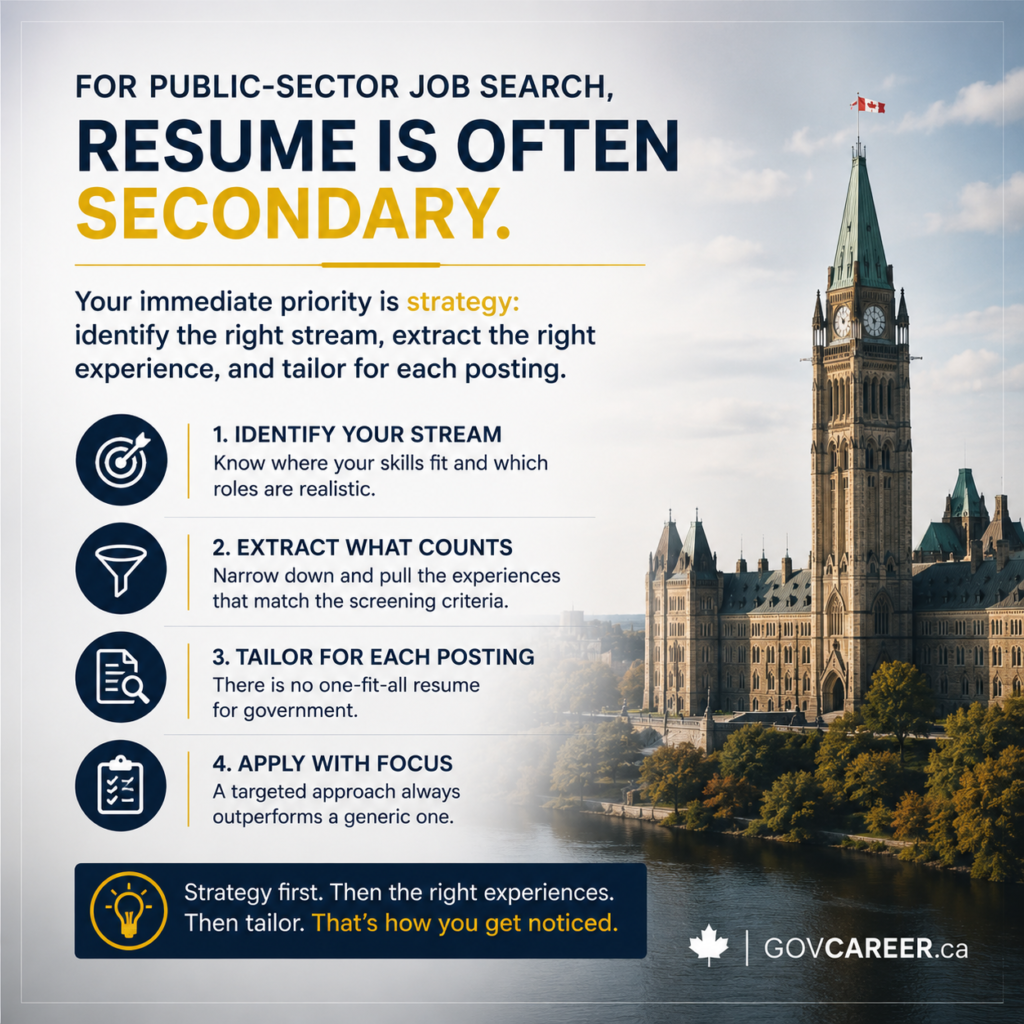
How Should You Tailor an ATS Resume for Government Jobs?
Tailoring should begin with the screening criteria, not with cosmetic rewriting.
1. Separate essential qualifications from supporting information
Read the entire posting and identify:
- essential education
- essential experience
- knowledge requirements
- competencies
- asset qualifications
- licences or certifications
- language requirements
- eligibility conditions
- application instructions
Do not give every sentence in the posting equal weight.
Determine what is likely to be assessed during the initial application review and what may be tested later.
2. Build an evidence map
Create a simple working table before writing the resume.
For each qualification, record:
- the exact requirement
- the strongest example from your experience
- the role and employer
- dates or duration
- scope
- result
- where the evidence will appear in the application
This prevents one qualification from receiving extensive attention while another is missed.
3. Choose the strongest relevant evidence
Your most senior experience is not always your most relevant experience.
A previous role, volunteer position, contract assignment or project may provide clearer evidence for a specific qualification.
Use the experience that best proves the criterion.
4. Rewrite bullets around demonstrated work
Avoid generic duty lists.
A strong bullet should usually identify an action, context and relevant result or purpose.
Weak:
“Responsible for reports and presentations.”
Stronger:
“Prepared monthly operational reports and executive presentations by analyzing service data, identifying performance issues and summarizing recommendations for senior management.”
5. Make transferable experience recognizable
Applicants changing sectors frequently possess relevant experience that is described in unfamiliar language.
Translate private-sector terminology into plain functional language without misrepresenting the work.
For example:
“Managed high-value customer escalations” may demonstrate:
- complaint resolution
- conflict management
- policy application
- written communication
- stakeholder service
- judgement under pressure
The resume must make that connection visible.
6. Check the technical format
After strengthening the evidence, confirm that the document remains easy to process.
Use:
- clear section headings
- standard fonts
- consistent dates
- straightforward bullet formatting
- ordinary document structure
- accessible file formats permitted by the employer
- concise wording
- limited decorative elements
Follow the application instructions even when they differ from general ATS advice.
If the employer asks you to paste an unformatted resume into a profile, use that method. If a specific file format or page limit is required, follow it.
Does Public-Sector Screening Guarantee Equal Treatment?
No hiring process can guarantee that every decision will be perfect or that every organization will use identical methods.
Structured criteria, documented requirements and common assessment methods can support consistency and fairness. They do not eliminate human judgement, differences among employers or the possibility of error.
Applicants should also distinguish between several concepts:
- eligibility to apply
- meeting the minimum qualifications
- being screened into the next stage
- being among the strongest applicants
- succeeding in later assessments
- receiving an offer
Meeting the minimum qualifications does not always guarantee an interview, especially when an employer receives many qualified applications or applies asset criteria and comparative assessment.
The Ontario Public Service guide explains that applicants whose materials best demonstrate the advertised qualifications may be invited to continue. It also notes that applicant pools differ across competitions.
This is why two similar applications can produce different results in different competitions.
The evidence may be the same.
The posting, applicant pool, screening approach or organizational needs may differ.
Common ATS and Government Resume Mistakes
Treating an ATS score as proof of quality
Online resume checkers may identify formatting or keyword issues. They do not know the employer’s actual screening plan, interpretation of the criteria or applicant pool.
Adding keywords without evidence
Repeating “project management,” “stakeholder engagement” or “policy analysis” does not prove that you performed those functions.
Writing for a general recruiter instead of the specific posting
A broad career summary may sound impressive but fail to answer the employer’s actual requirements.
Assuming the reviewer understands your employer
Explain unfamiliar organizations, programs, technical terms and internal titles when context is necessary.
Hiding relevant work under vague language
“Supported operations” tells the screener almost nothing.
Identify the work, responsibility and scope.
Including everything from your career
More information does not automatically create stronger evidence.
Irrelevant detail can bury the qualifications the reviewer needs to find.
Depending on a flashy design
Strong visual presentation can improve readability, but decorative design cannot replace evidence. Complex formatting may also create technical problems in some systems.
A Practical Final Review Before Submitting
Before submitting an ATS resume for government jobs, ask:
- Can the file be opened and read in the required system?
- Did I follow every application instruction?
- Have I addressed every essential qualification?
- Does each major claim include evidence?
- Are my dates and duration clear?
- Have I explained unfamiliar titles or terminology?
- Does the resume show my personal contribution?
- Is the most relevant information easy to find?
- Have I used the posting’s terminology accurately?
- Did I remove information that distracts from the criteria?
- Do my screening-question answers align with my resume?
- Could a reviewer justify screening me in using only what I submitted?
The last question is the most important.
Do not evaluate the resume as the person who lived the experience.
Evaluate it as a stranger who has only the posting, the screening criteria and the application in front of them.
Frequently Asked Questions
Can an ATS automatically reject my government resume?

It may be possible for some recruitment systems to filter applications, but the exact technology and rules vary by employer. Do not assume that every government portal uses automated resume scoring. Follow the application instructions, use a readable format and provide clear evidence against the stated qualifications.
How do government employers screen resumes?

Government employers commonly screen applications against qualifications identified in the job posting, but methods vary. The review may consider screening questions, resumes, cover letters, education, experience, eligibility and other requirements selected for the initial stage.
Should I copy keywords from a government job posting?
Use relevant terminology from the posting when it accurately describes your experience, but do not merely copy the advertisement. Explain where, when and how you demonstrated the qualification.
Do prestigious schools or companies help with government applications?
They may provide useful context, but they do not replace evidence of the required qualifications. The application should show the work you performed, your level of responsibility and how the experience connects to the posting.
Why was I screened out when I met the qualifications?
You may have been screened out because the application did not demonstrate the qualifications clearly enough, because another requirement was missed or because the employer used comparative or asset-based shortlisting. The exact reason depends on the competition, and applicants may need to request feedback where the employer provides it.
Is an ATS-friendly resume different from a government resume?
The concepts overlap, but they are not identical. An ATS-friendly resume is technically structured for electronic processing. A strong government resume also provides detailed, relevant evidence against the qualifications and follows the employer’s specific application process.
How Government Resumes Are Screened? Passing the ATS Is Only the Beginning
An ATS resume for government jobs needs clean formatting, appropriate terminology and technical readability. Those elements help the application enter and move through the recruitment system.
They do not prove that you meet the requirements.
The harder task is presenting your experience so that another person can assess it fairly, consistently and without filling in missing information for you.
Your title may be impressive. Your employer may be respected. Your education may be strong.
The screening decision still depends on what the application demonstrates.
Make the evidence visible.