The Best Public-Sector Resume Tip: Make the Shortlist Decision Easy to Defend

Your public-sector resume has one critical job: give the person screening it a clear, documented reason to move you forward.
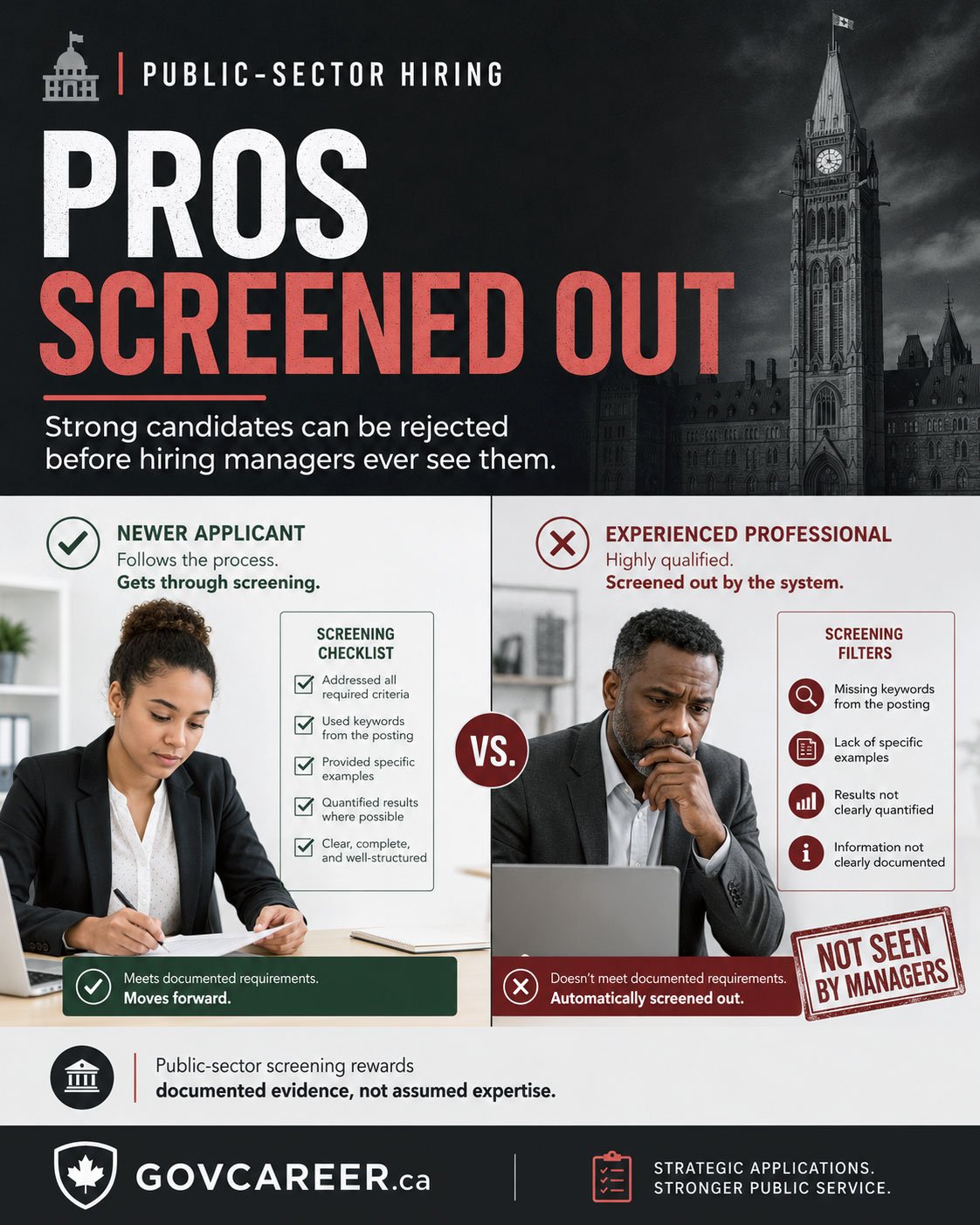
A strong public-sector resume does more than contain the right keywords or pass an applicant-tracking system. It presents your experience so clearly against the screening criteria and job posting requirements that the person reviewing the application can justify the shortlist decision point by point. In government jobs and other structured hiring environments, the candidate who looks strongest on paper often advances before the candidate whose real ability is harder to recognize.
Many applicants focus heavily on the first technical stage of the process.
They worry about parsers, applicant-tracking systems, keywords, formatting, phrasing, and whether artificial intelligence can optimize a resume well enough to survive initial screening.
Those issues matter.
They are also becoming easier to address.
Modern resume tools and AI systems can help identify repeated terminology, compare a resume with a posting, improve wording, reorganize information, and incorporate relevant keywords. They can help an applicant avoid obvious mismatches between the language of the resume and the language used in the posting.
The harder problem begins after that.
Eventually, a person reads the application.
That person needs to decide whether the resume contains enough evidence to justify moving the candidate forward.
For a broader explanation of how these systems work, start with this guide to government job search in Canada. The central principle is simple: government and public-sector hiring is usually built around stated requirements, screening criteria, documented decisions, and structured interviews. Your application must make your qualifications recognizable inside that system.
The person screening your resume may not be a full-time recruiter
Applicants often imagine a polished corporate recruiter or dedicated talent-acquisition professional carefully studying every line of every resume.
That is not always how public-sector hiring works.
Depending on the organization and competition, the initial review or shortlist process may involve:
- a section supervisor
- a program manager
- a team leader
- a technical specialist
- a subject-matter expert
- a hiring manager
- a panel member supporting the competition
- a human-resources professional working with operational management
These people may be highly experienced in their field while having limited time for recruitment.
They may also be handling the competition in addition to their normal responsibilities.
A supervisor may be managing staff, responding to operational issues, preparing reports, dealing with service demands, attending meetings, resolving workplace problems, and trying to keep projects moving. Recruitment is important, but it may still be one more major task added to an already full workload.
That affects how applications are read.
A busy screener is unlikely to spend significant time reconstructing your background, interpreting vague language, researching unfamiliar private-sector titles, or searching through several pages for evidence you may have included somewhere.
The reviewer needs clarity.
They need to see that you meet the stated requirements without having to build the argument for you.
Public-sector screening requires a defensible decision
Government and broader public-sector hiring is usually expected to follow established processes.
The exact procedures vary by employer, jurisdiction, bargaining environment, competition type, and role. However, structured and merit-based hiring generally requires decisions to be connected to the qualifications and criteria established for the position.
For example, the official guidance on how to apply for Government of Canada jobs emphasizes the importance of demonstrating clearly how applicants meet the essential qualifications. Federal processes can be highly explicit: candidates may be asked to explain where, when, and how they acquired required experience.
Provincial and municipal processes can differ in format, but the underlying issue remains familiar.
The people responsible for screening need a basis for their decision.
They should be able to point to the application and explain:
- which requirement the applicant met
- where the supporting evidence appeared
- whether the experience was relevant
- whether the level and scope were sufficient
- why the applicant was moved forward
- why another applicant was screened out
That does not mean every competition becomes a formal investigation.
It means the decision should survive reasonable scrutiny.
The hiring team should not need to say, “We assumed this person probably had the experience.”
They should be able to say, “The resume shows the required experience here, here, and here.”
That is the standard your resume should be built to meet.
The best candidate and the best-supported candidate are not always the same person
A candidate may genuinely be excellent.
They may have strong judgement, technical knowledge, leadership ability, institutional awareness, and years of transferable experience.
None of that guarantees that the resume communicates those qualifications effectively.
Another applicant may have less overall ability but present a clearer case against the requirements.
That candidate may advance.
This is one of the hardest realities for experienced professionals to accept.
They often assume their career history should speak for itself.
It usually does not.
Job titles vary between sectors. Responsibilities hidden inside one title may be obvious to insiders but unclear to someone outside that organization. A private-sector role may involve work equivalent to a public-sector requirement, but the connection may not be visible.
Consider a posting that asks for experience coordinating complex projects involving multiple stakeholders.
A candidate might write:
“Managed major client accounts and supported operational delivery.”
That statement may describe substantial coordination work.
It does not prove it.
A stronger version would clarify:
- the type of projects coordinated
- the number or range of stakeholders involved
- the applicant’s specific responsibilities
- the complexity or scale of the work
- the decisions made
- the outcomes achieved
The purpose is not to inflate the experience.
The purpose is to expose it.
Keywords can open the door, but evidence gets you shortlisted
Keywords matter in government job applications.
The wording used in the posting gives you valuable information about how the employer defines the role and what the screening process may prioritize.
If a posting repeatedly refers to stakeholder consultation, policy analysis, contract administration, financial reporting, regulatory compliance, conflict resolution, or program delivery, your resume should use accurate language that makes relevant experience easy to identify.
AI can help with this stage.
It can compare wording, identify missing terminology, suggest stronger verbs, and reorganize content.
However, keyword insertion has limits.
A resume that repeats the phrase “stakeholder management” several times does not automatically demonstrate stakeholder-management experience.
A resume that includes “project management” does not prove the candidate planned, coordinated, monitored, and completed complex projects.
A resume that says “leadership” does not show what the person led, under what conditions, or with what degree of responsibility.
Screening criteria require substance.
The reviewer needs evidence that the candidate performed work connected to the requirement.
That is why resume tailoring should move beyond word matching.
The question is not only:
“Did I use the same terminology as the posting?”
The more important questions are:
- Did I show where I used this skill?
- Did I describe the actual responsibility?
- Did I make the scope visible?
- Did I demonstrate the required level?
- Did I include enough context for the reader to recognize the match?
- Could the screener justify giving me credit for this qualification?
Write for the posting, not for your autobiography
Many resumes are written as historical records.
They list positions, duties, software, projects, and accomplishments in roughly chronological order.
That structure may be accurate, but it does not necessarily support the screening decision.
A public-sector resume should still reflect your real career history. It should not distort dates, responsibilities, titles, or achievements.
But the emphasis must be controlled by the target position.
The job posting tells you which parts of your background deserve the most visibility.
For instance, if you are applying to an Ontario Public Service role involving program coordination, the most relevant experience may include:
- coordinating deliverables
- working across business units
- preparing briefing materials
- tracking risks and issues
- supporting implementation
- managing stakeholders
- analyzing information
- maintaining records
- reporting progress
- interpreting policy or operational requirements
Those elements should not be buried beneath less relevant information.
Applicants considering opportunities through the Ontario Public Service jobs portal should treat each posting as a separate assessment problem. A general resume may provide a base, but the evidence must be reorganized and emphasized according to the specific requirements of the competition.
The same principle applies to federal government jobs, municipal jobs, Crown corporations, healthcare organizations, educational institutions, and regulated public bodies.
Make each required qualification easy to find
A screener should not need to guess where the evidence is.
If the posting asks for several years of experience in a specific function, the resume should make the duration and relevance reasonably clear.
If the posting asks for supervisory experience, the resume should show:
- who or what you supervised
- the approximate scope
- the responsibilities you carried
- whether you assigned, reviewed, coached, scheduled, evaluated, or directed work
- the context in which the supervision occurred
If the posting asks for experience preparing reports for senior management, the resume should identify:
- the type of reports
- the audience
- the purpose
- the information analyzed
- the decisions the reports supported
If the posting asks for experience working with legislation, regulations, policies, standards, or procedures, the resume should state what you interpreted or applied and how it affected your work.
This is what point-by-point defensibility looks like.
The resume does not need to copy the posting mechanically.
It needs to answer it.
Scope and level matter
One of the most common weaknesses in resume writing is the failure to show level.
Applicants often describe the type of work they performed without explaining its complexity, authority, or scope.
Compare these two statements:
“Responded to customer concerns.”
“Resolved escalated service complaints involving policy interpretation, competing stakeholder expectations, and time-sensitive operational decisions.”
Both may be true.
The second statement gives the screener more information about the level of judgement involved.
Scope can be demonstrated through details such as:
- size of budget
- number of projects
- number of employees
- number or type of stakeholders
- geographic area
- service volume
- regulatory environment
- organizational level
- degree of independence
- complexity of decisions
- financial, operational, or reputational consequences
These details should be used selectively.
A resume should not become a warehouse of numbers.
Use scope indicators where they help the reviewer understand why the experience meets the requirement.
Translate private-sector experience into recognizable public-sector evidence
Private-sector professionals frequently have relevant experience for public service careers.
The difficulty lies in translation.
A private-sector resume may emphasize growth, revenue, clients, competition, market performance, speed, and commercial results.
A public-sector posting may emphasize accountability, policy compliance, service delivery, stakeholder consultation, documentation, transparency, risk control, procedural fairness, and responsible use of resources.
The work may overlap more than the language suggests.
For example:
- client management may involve stakeholder relationship management
- account operations may involve service coordination
- quality assurance may involve compliance monitoring
- commercial reporting may involve performance analysis
- contract delivery may involve vendor management
- customer escalation work may involve conflict resolution
- process improvement may involve operational policy implementation
- business analysis may involve requirements gathering and program support
The resume should use accurate language that makes those connections visible.
Do not erase the commercial nature of your experience.
Reframe the parts that match the public-sector role.
Do not rely on the screener to infer transferable experience
Applicants often write statements that are technically true but strategically weak.
Examples include:
- “Responsible for daily operations”
- “Worked with different departments”
- “Handled complex issues”
- “Managed multiple priorities”
- “Provided excellent customer service”
- “Supported senior leaders”
- “Participated in projects”
These statements create possibilities.
They do not establish evidence.
A screener may wonder:
- What operations?
- Which departments?
- What made the issues complex?
- How many priorities?
- What type of customers or service users?
- What support was provided?
- What role did the applicant play in the projects?
A stronger resume answers enough of these questions to support the qualification.
The reviewer should not have to interview you in their head before deciding whether to interview you in reality.
The screener is not looking for literary quality
Applicants sometimes overinvest in polished language.
They want every bullet to sound impressive.
They add corporate expressions, strategic vocabulary, elaborate verbs, and ambitious claims.
This can make the resume less useful.
Public-sector resume writing should prioritize precision over performance.
The language should be strong, but it should also be concrete.
A hiring team does not need dramatic prose.
It needs recognizable evidence.
Compare:
“Championed transformative cross-functional initiatives to deliver enterprise-wide value.”
With:
“Led a cross-departmental process-improvement project involving finance, operations, and customer service, reducing application-processing delays by 18%.”
The second version is easier to evaluate.
It identifies the action, context, stakeholders, and result.
The first version sounds senior but remains difficult to verify.
A busy reviewer rewards clarity
The reality of workload matters.
A person screening applications may be reading dozens or hundreds of documents.
They may be working through a scoring guide, screening matrix, checklist, or set of essential qualifications.
They may be trying to complete the process while maintaining normal operations.
That does not mean they are careless.
It means clarity has practical value.
A clear resume reduces cognitive effort.
It allows the reviewer to:
- recognize the relevant experience quickly
- connect the evidence to the criteria
- record the screening decision
- compare candidates consistently
- reduce uncertainty
- avoid unsupported assumptions
- complete the shortlist efficiently
Your application should help them do that.
The easier it is to evaluate your qualifications accurately, the stronger your position becomes.
What a defensible public-sector resume should show
A strong application should make several things visible.
1. The required experience appears directly
The resume should use wording that accurately reflects the qualification.
When the posting asks for experience developing policies, administering contracts, supervising staff, coordinating projects, preparing reports, or consulting stakeholders, the relevant experience should be stated explicitly.
Do not force the reviewer to derive it from unrelated wording.
2. The context is understandable
The screener should know where and how the experience was gained.
That may include:
- employer type
- department or function
- project environment
- service setting
- regulatory context
- client or stakeholder group
- geographic area
- organizational level
Context helps the reader determine relevance.
3. The applicant’s personal contribution is clear
Team achievements can be valuable, but the resume must distinguish what you personally did.
Weak:
“Project successfully delivered on time.”
Stronger:
“Coordinated the project schedule, tracked risks, resolved cross-team dependencies, and prepared weekly progress reports, supporting delivery within the approved timeline.”
4. The level of responsibility is visible
The resume should show whether you supported, coordinated, managed, supervised, led, advised, approved, analyzed, or decided.
Those words are not interchangeable.
Use the verb that accurately describes your level.
5. Examples support broad claims
If you claim leadership, analysis, judgement, communication, or problem-solving, include examples that reveal those qualities.
The resume should not merely label you.
It should demonstrate what you did.
6. Results are included when they strengthen the evidence
Results can show effectiveness.
Relevant results may include:
- reduced delays
- improved compliance
- resolved escalations
- increased service capacity
- completed projects
- lowered risk
- improved reporting
- met regulatory requirements
- supported successful audits
- implemented new procedures
- improved stakeholder satisfaction
- delivered work within budget
Not every bullet needs a numerical result.
The result must be credible and connected to the work.
7. The evidence is located where the reviewer expects it
Important qualifications should not be hidden in a summary while absent from the employment history.
The strongest evidence usually belongs under the position in which the work occurred.
That makes the timeline and context easier to validate.
Why generic resumes fail in structured hiring
A generic resume tries to appeal broadly.
It may be useful for networking or as a master document, but it often performs poorly in structured hiring because it does not establish a direct relationship with the target criteria.
A generic resume may contain impressive material that is irrelevant to the specific posting.
It may also omit less glamorous experience that is highly relevant.
For example, a senior applicant may emphasize strategy and leadership while underplaying:
- records management
- procedural compliance
- report preparation
- operational coordination
- detailed stakeholder follow-up
- case documentation
- issue tracking
- policy implementation
If the posting screens for those functions, the omitted details matter more than broad executive language.
Resume tailoring is the process of choosing, organizing, and articulating evidence according to the job posting requirements.
It is not simply replacing a few keywords.
Federal, provincial, and municipal applications may require different emphasis
The broader principle remains the same, but application formats differ.
Federal competitions may require detailed screening-question responses in addition to a resume. The Government of Canada also explains what applicants can expect during the federal hiring process, including assessment stages that can extend beyond the initial application.
Municipal employers may rely more heavily on the resume and cover letter during early screening.
For example, candidates applying through City of Toronto job opportunities or the City of Ottawa jobs portal should still assume that their application must make each required qualification easy to identify. The exact internal process may differ, but vague evidence remains risky.
Provincial government jobs may use screening questions, application forms, resumes, cover letters, tests, assignments, or structured interviews.
Across these systems, the central question remains:
Can the hiring team point to clear evidence that you meet the stated requirement?
AI can help prepare the resume, but it cannot own the decision
AI is becoming part of normal resume writing.
That is not inherently a problem.
It can help applicants:
- compare job descriptions with existing resumes
- identify repeated terms
- improve grammar
- reduce repetition
- reorganize information
- generate possible phrasing
- create a first draft
- test alternative structures
- identify areas that need more detail
The danger begins when the applicant assumes polished language equals strong evidence.
AI often produces statements that sound competent but remain generic.
It may also:
- exaggerate responsibilities
- imply experience the applicant did not have
- create polished but empty claims
- overuse corporate language
- repeat the posting without proving the match
- flatten important differences between roles
- remove context that made the experience credible
- emphasize keywords over substance
The applicant must remain responsible for accuracy, relevance, and strategic judgement.
A resume should never contain invented accomplishments, fabricated metrics, false duties, or experience reconstructed by software without verification.
The shortlist test
Before submitting a government job application, review every major requirement and ask:
“Could a busy screener point to my resume and explain why I meet this?”
If the answer is no, the evidence may be too vague, too hidden, or missing entirely.
Use this checklist:
- Is the qualification stated clearly?
- Is there a concrete example?
- Is the relevant job and timeframe identifiable?
- Is my personal role clear?
- Is the scope visible?
- Does the wording match the level of responsibility?
- Does the evidence address the posting directly?
- Could the reviewer record a defensible reason to award credit?
- Have I avoided unsupported assumptions?
- Have I removed unrelated material that distracts from the case?
This exercise is more valuable than asking whether the resume “sounds professional.”
Professional wording matters.
Defensible evidence matters more.
Your resume is the official version of your candidacy
The hiring team does not initially evaluate the full person.
It evaluates the application.
The screener cannot credit experience that exists only in your memory, your LinkedIn profile, your confidence, or your ability to explain yourself later.
At the shortlist stage, the paper version of you is the version that counts.
That does not mean presentation is more important than substance.
It means substance must be presented.
The strongest candidate in reality can lose to the candidate whose qualifications are documented more clearly.
That outcome may feel unfair, but it often reflects the limits of structured assessment.
The hiring team must work with the evidence provided.
The real purpose of a public-sector resume
The purpose of a public-sector resume is not to impress everyone.
It is not to tell your complete professional story.
It is not to use the most sophisticated language possible.
It is not to prove that you are generally talented.
Its immediate purpose is to establish a clear case that you meet the specific requirements of the position.
That case should be:
- accurate
- relevant
- visible
- specific
- easy to evaluate
- supported by examples
- aligned with the posting
- defensible within the hiring process
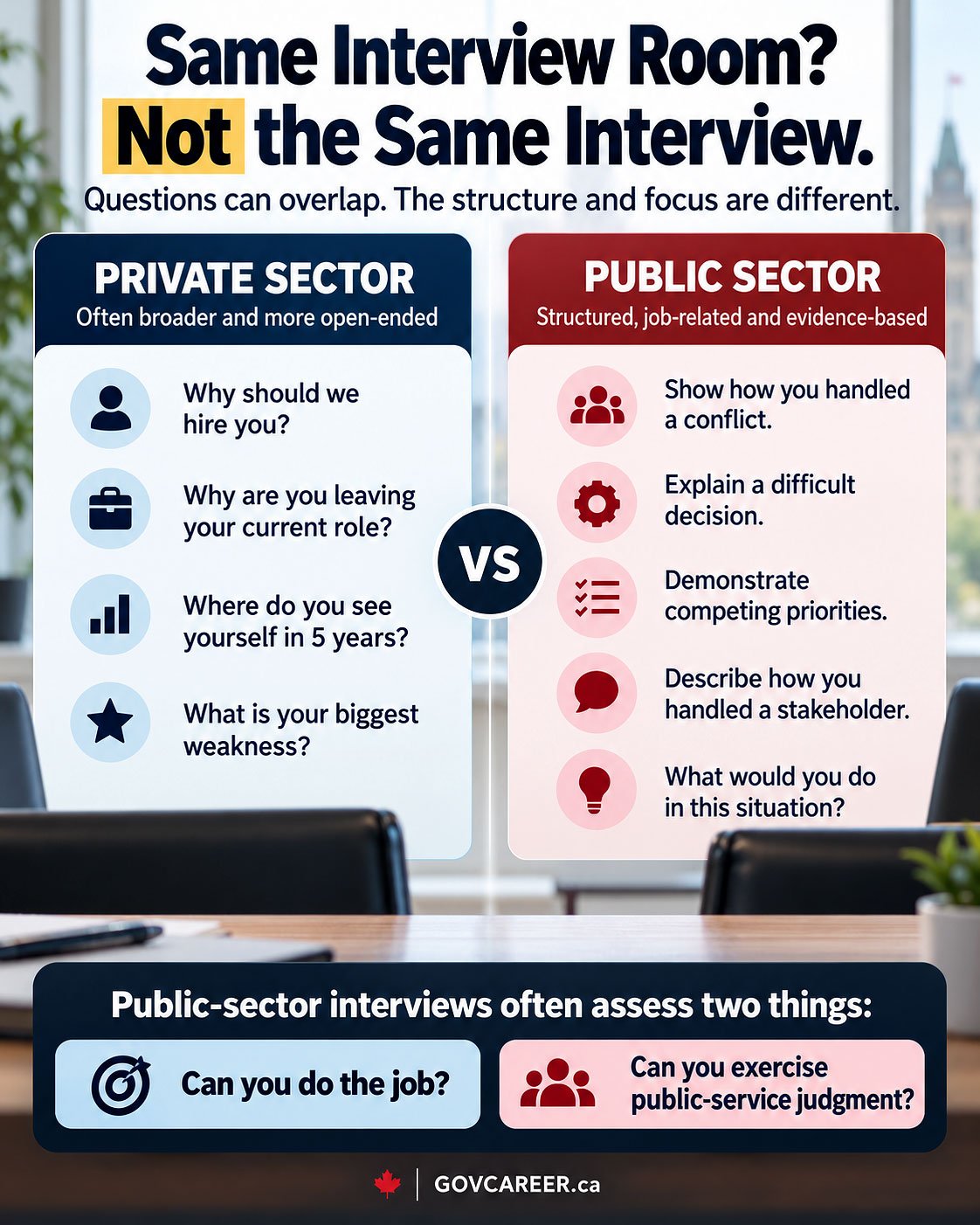
Once you reach the interview, the assessment changes.
Structured interviews may evaluate your judgement, behaviour, communication, technical knowledge, decision-making, and ability to apply experience.
But first you must get there.
The resume creates the bridge between your background and the shortlist.
Final takeaway
The best public-sector resume tip is not simply to add keywords, beat a parser, or improve the formatting.
Make the shortlist decision easy to defend.
Write the resume so the person screening it can identify the required experience without investigation, interpretation, or guesswork.
Show the qualification.
Show where you gained it.
Show what you personally did.
Show the scope and level.
Show enough evidence that the hiring team can point to the application and say:
“This is why this candidate moved forward.”
In structured hiring, the best candidate on paper is the candidate the process can recognize.
For questions about government jobs, public sector jobs, resume tailoring, government job applications, screening criteria, or interview preparation in Canada, Ontario, Toronto, the GTA, or Ottawa, contact GOVCAREER.ca.