The Hiring Manager Didn’t Reject You. The Paper Trail Did.
In private-sector hiring, the manager often has real influence.
They can override a weak first impression. They can push for someone they believe in. They can hire on instinct if the conversation went well, the chemistry was strong, or the person seemed like the right fit for the team.
Government and public-sector hiring managers usually do not have that luxury.
They are not simply deciding who they like best. They are documenting who demonstrated the strongest match against the posted criteria.
That difference matters more than most applicants realize.
In structured government and public-sector hiring, the process is designed to be defensible. If a hiring decision is questioned later by HR, a union grievance, an audit, a competition review, or an internal challenge, there needs to be a paper trail that explains why one candidate moved forward and another did not.
That paper trail is not built around personality.
It is built around evidence.
The job posting identifies the criteria. The resume is screened against those criteria. The interview questions are tied to competencies, duties, knowledge, experience, or behavioural indicators. The panel scores answers against a rubric. The final decision must be supported by documented reasons.
That changes everything about how a candidate needs to show up.
Private-sector logic does not always work in public-sector hiring
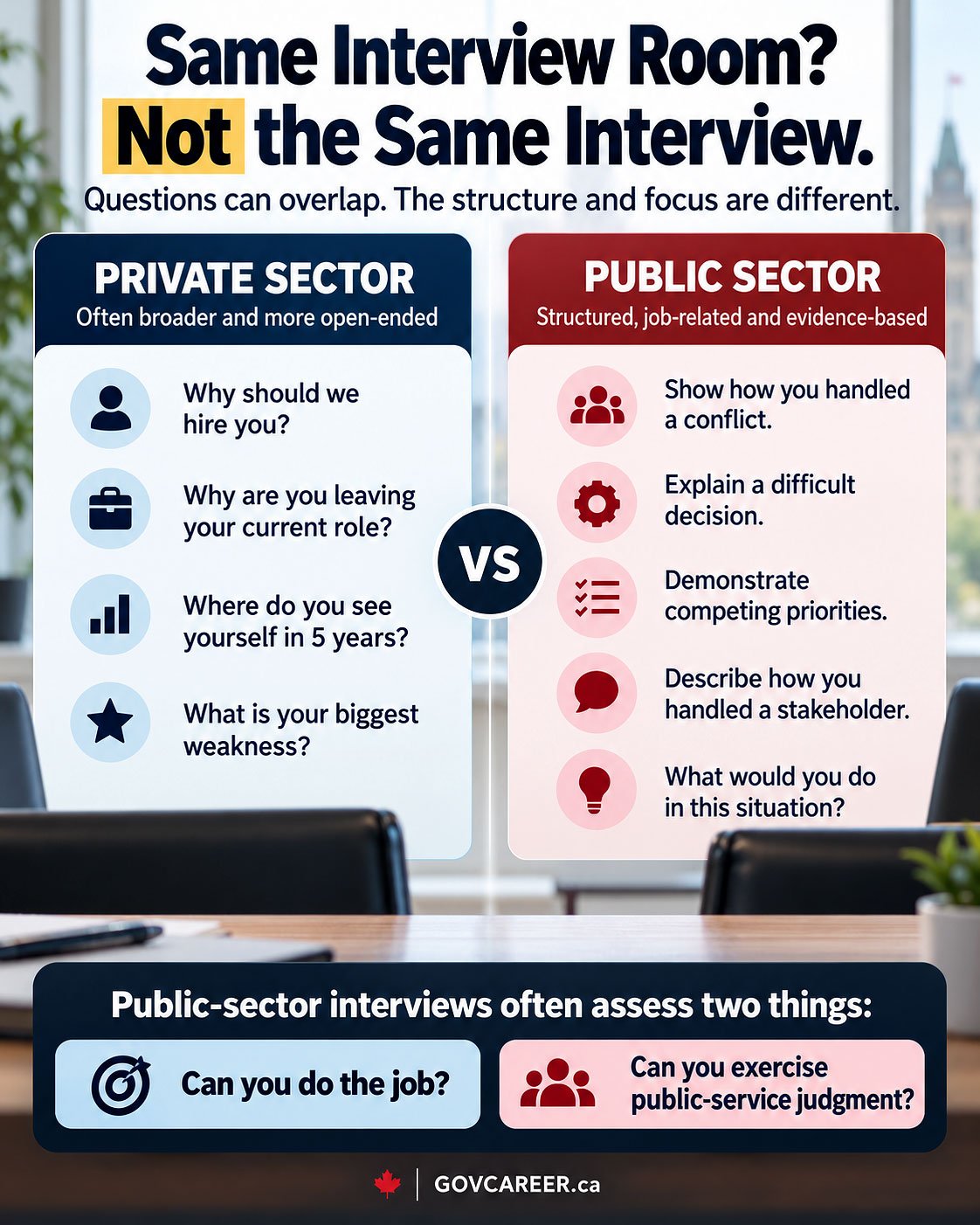
In private-sector interviews, a strong connection can carry a lot of weight.
A hiring manager may respond well to confidence, energy, storytelling, culture fit, executive presence, or a strong personal impression. A candidate who is memorable may have an advantage, even if the process is informal.
That does not mean private-sector hiring is careless. It means managers often have more discretion.
Government and public-sector hiring operate differently.
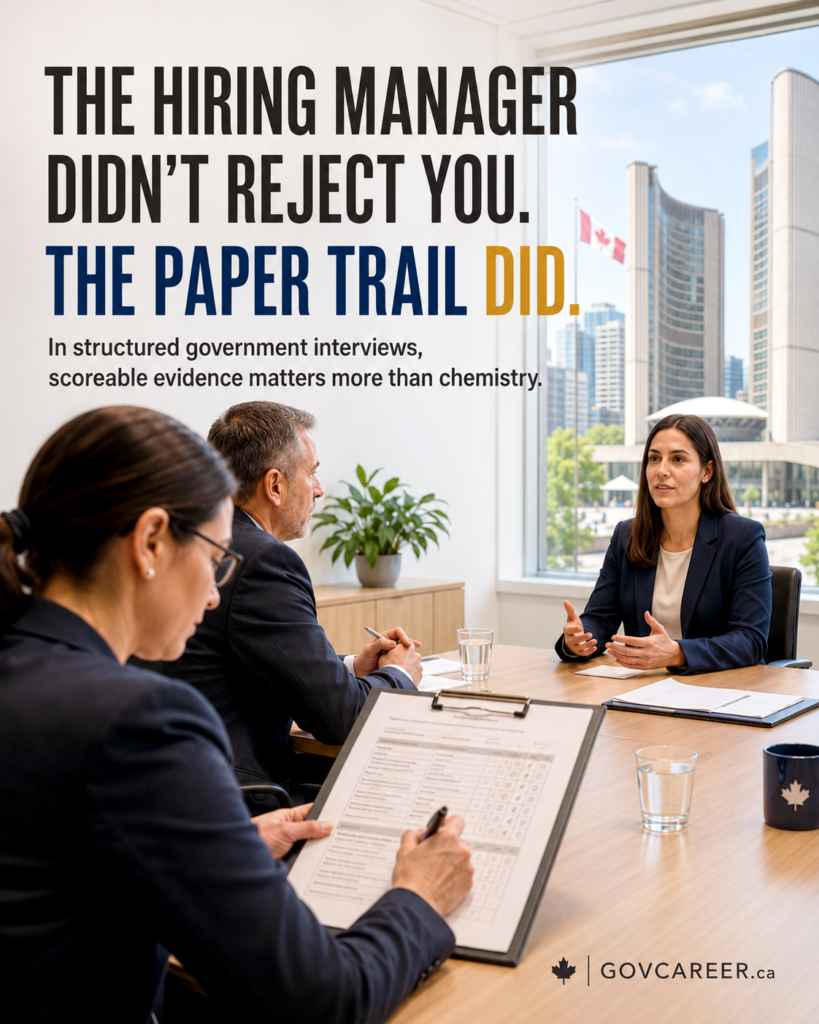
In a structured interview, the manager is not just listening for whether they like the answer. They are filling out a scoring sheet. They are checking whether the answer demonstrated the competency being assessed. They are documenting what evidence the candidate gave.
A strong story may still fail if it does not answer the question.
A confident answer may still score poorly if it does not include the right evidence.
A candidate may seem capable, professional, and personable, but still not provide enough information for the panel to award the score.
That is where many qualified applicants lose.
Not because they are bad candidates.
Because their qualifications were not translated into evidence the process could recognize.
Being qualified is not the same as proving qualification

This is one of the biggest misunderstandings in government applications.
Candidates often assume that if they have the background, the screener will see it.
They assume the panel will understand the transferability.
They assume their title, employer, education, or years of experience will speak for itself.
That is a dangerous assumption.
In structured hiring, the screener is not supposed to guess. The panel is not supposed to fill in gaps. The hiring manager is not supposed to rebuild your argument for you.
Your application has to make the match visible.
If the posting asks for experience with records, reporting, stakeholder communication, policy support, financial reconciliation, client service, project coordination, regulatory compliance, data analysis, procurement, case management, or program administration, your resume has to show that evidence clearly.
Not vaguely.
Not buried under a generic job description.
Not implied.
Clearly.
The same applies in the interview.
If the panel asks for an example of managing competing deadlines, resolving a difficult client issue, applying policy, improving a process, handling confidential information, or working with multiple stakeholders, they are not asking for a casual story. They are looking for evidence that can be scored.
What was the situation?
What was your role?
What action did you take?
What judgment did you use?
What result did you produce?
What did your answer demonstrate against the competency?
That is what goes into the scoring record.
Why government applications fail invisibly
This is why public-sector rejection often feels confusing.
The candidate was qualified.
The resume seemed professional.
The interview felt fine.
Nothing went obviously wrong.
But the application still did not move forward.
From the candidate’s point of view, the process feels opaque. From the panel’s point of view, the issue may be simple: there was not enough scoreable evidence.
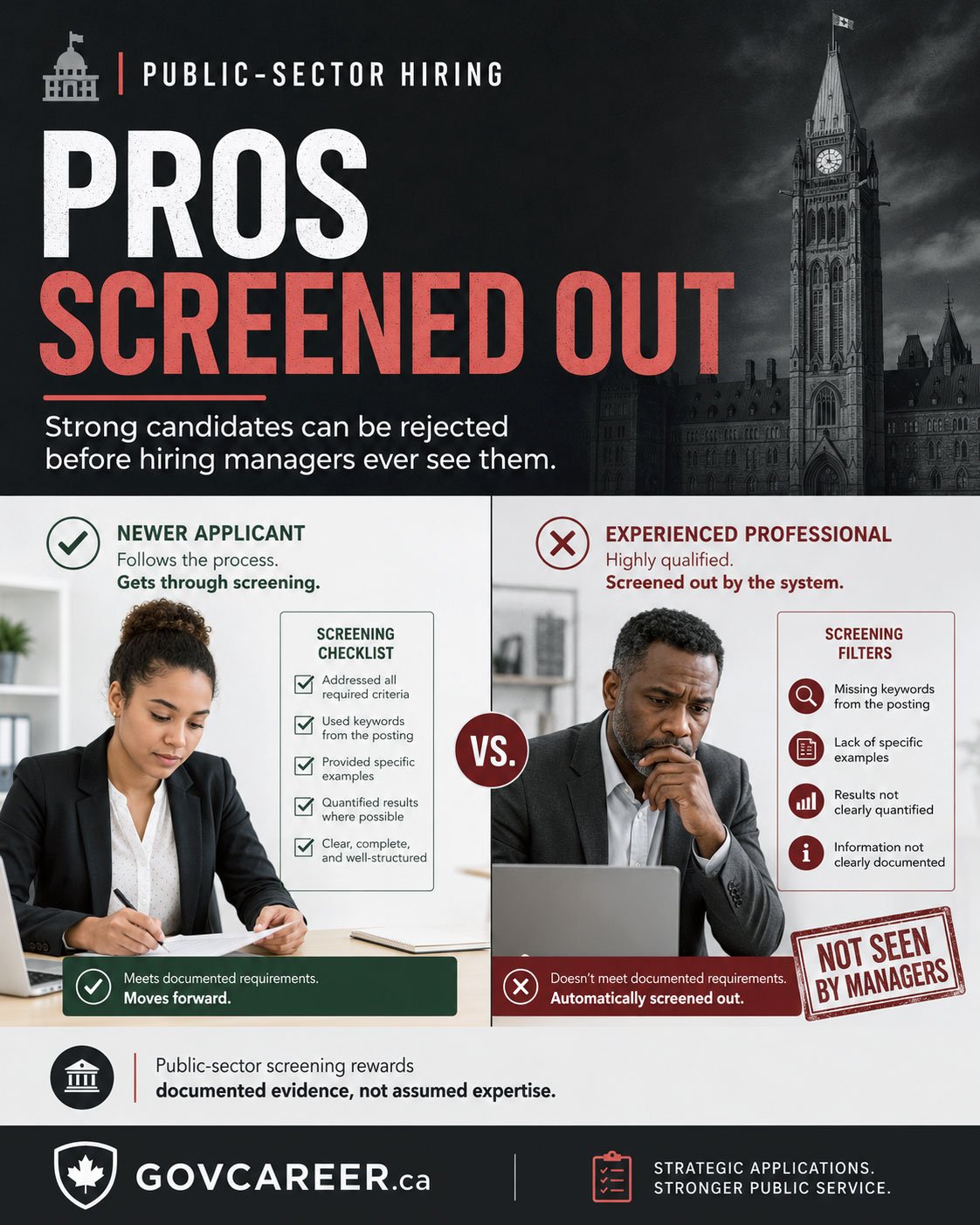
The resume did not clearly map experience to the posted criteria.
The cover letter repeated interest instead of proving alignment.
The interview answers were polished but not structured.
The examples were interesting but did not show the competency being assessed.
The panel may have liked the candidate, but liking the candidate is not enough if the documentation does not support the score.
That is the part many applicants miss.
The hiring manager may not be rejecting you personally.
The process may simply not have enough defensible evidence to move you forward.
The paper trail matters
In government and public-sector hiring, the final decision has to make sense on paper.
That does not mean the process is perfect. It does not mean every competition is easy to understand from the outside. It does not mean every outcome will feel fair to every applicant.
But the system is built around documentation.
A candidate cannot rely only on being capable. The application has to show capability in a way that matches the evaluation process.
A candidate cannot rely only on having done similar work. The resume has to connect that work to the language and requirements of the posting.
A candidate cannot rely only on interview confidence. The answers have to provide enough evidence for the panel to score.
A candidate cannot rely on the hiring manager “getting it.” The hiring manager needs something concrete to put in the box.
This is why generic resumes underperform in government applications.
This is why private-sector resumes often miss public-sector screening criteria.
This is why AI-polished applications can still fail if the content is not aligned to the posting.
This is why interview answers that sound impressive can still lose marks.
The process does not reward polish by itself.
It rewards demonstrated qualification.
What candidates should do differently
If you are applying to government or public-sector roles, stop treating the posting as a general advertisement.
Treat it as the evaluation map.
The duties tell you what the role actually does.
The qualifications tell you what the screener is looking for.
The asset criteria tell you what may strengthen your application.
The competencies tell you what the interview may assess.
The language of the posting tells you how your experience needs to be framed.
Your resume should not simply describe your past jobs. It should show evidence against the requirements of the role.
Your cover letter should not simply express interest. It should help connect your background to the posted criteria.
Your interview preparation should not focus only on sounding confident. It should prepare examples that demonstrate the competencies likely to be scored.
The goal is not to game the process.
The goal is to make your experience clear enough that the process can recognize it.
That is the difference between applying like a private-sector candidate and competing in a structured hiring system.
The real lesson
You may not have lost because someone was more charismatic.
You may not have lost because the panel disliked you.
You may not have lost because your background was irrelevant.
You may have lost because your evidence was not visible enough.
In government and public-sector hiring, the strongest candidate is not always the person who sounds best in the room. It is the person whose resume and interview answers make the strongest documented case against the stated criteria.
The hiring manager did not reject you.
The paper trail did.
And once you understand that, you can start applying differently.