Public Sector Interview vs Private Sector Interview: What Changes in Government Hiring?
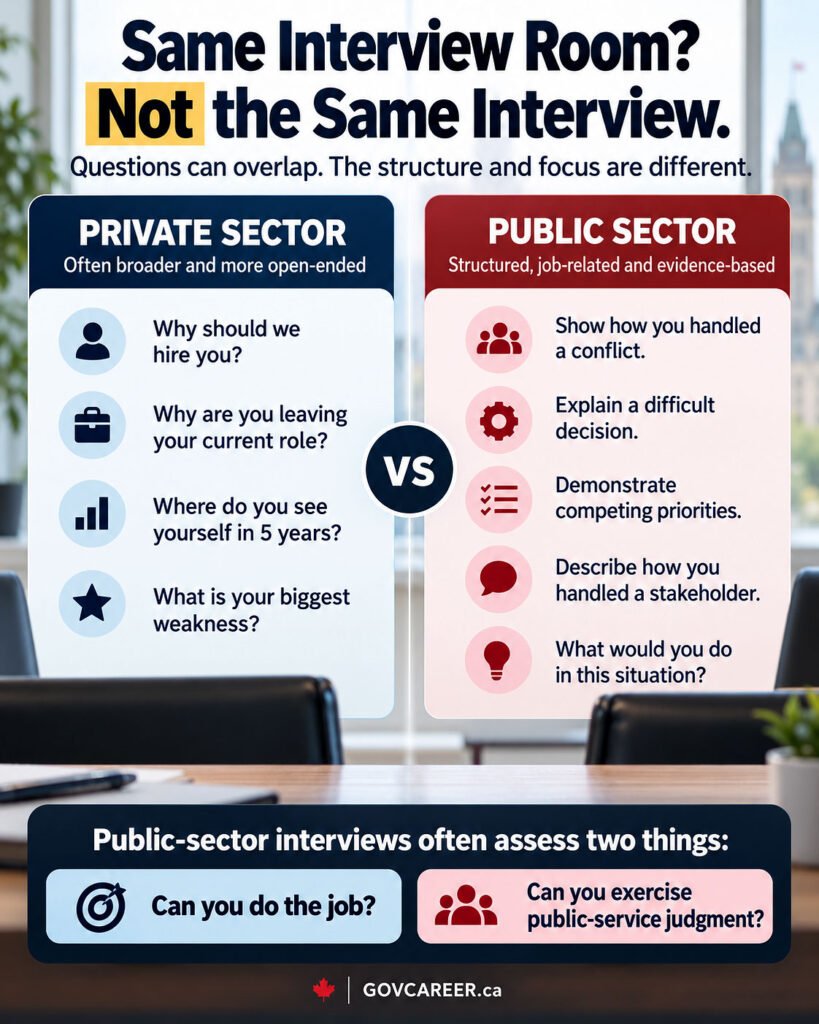
A public sector interview vs private sector interview comparison is not simply a comparison between two different lists of interview questions. Many of the same questions can appear in both. The more important difference is often how structured the assessment is, what evidence the employer needs from your answers, and whether you can demonstrate not only that you can perform the job but that you can exercise appropriate judgment in the role’s public-service context.
If you are preparing for government interview questions in Canada, that distinction matters.
Generic interview advice usually starts with a list:
- Why should we hire you?
- Tell me about yourself.
- What is your greatest weakness?
- Tell me about a difficult situation.
- Why do you want this position?
- Where do you see yourself in five years?
Some of those questions can appear in government or public-sector hiring.
Others may be much less important than the questions candidates expect from generic private-sector interview advice.
The mistake is assuming that preparing a polished answer to the “10 most common interview questions” means you are prepared for a structured public-sector assessment.
It may not.
Public-Sector and Private-Sector Interviews Can Ask Similar Questions
There is no clean dividing line where one sector asks one set of questions and the other asks something completely different.
Private employers can use highly structured interviews.
Public-sector employers can also use general introductory questions.
A government panel might ask why you are interested in the role.
A private employer might ask a detailed behavioural question and score it against a competency framework.
A hospital, university, bank, consulting firm or large corporation may use a structured assessment process that looks more like a government competition than an informal private-company interview.
So the useful distinction is not:
Private sector = informal questions.
Public sector = structured questions.
That is too simplistic.
The useful distinction is:
What is this particular interview designed to assess, and how will the employer evaluate the evidence I provide?
That is where public-sector candidates often need to change their preparation.
Public Sector Interview vs Private Sector Interview: What Actually Changes?
In a highly structured interview, the conversation is not being created spontaneously as you speak.
For the federal public service, the Public Service Commission of Canada’s structured-interview guidance describes highly structured interviews in which questions are linked to job-relevant criteria, candidates receive the same questions, and responses are assessed using a predetermined rating scheme.
Current federal assessment guidance also emphasizes standardization of instructions, assessment content, administration and rating methods while preserving appropriate flexibility and accommodation.
Ontario provides an even more concrete candidate-facing example.
The Ontario Public Service hiring-process guidance states that panel interviews are the typical OPS format, interview questions receive predetermined weights, responses are compared with established expected responses, and candidates are asked the same set of questions and scored using the same rating system.
That does not establish one universal Canadian public-sector interview process.
Federal departments, provinces, municipalities, agencies, Crown corporations, healthcare organizations, school boards, universities and other public bodies may use different assessment methods.
But it illustrates why some public-sector interviews feel very different from a conversational hiring-manager interview.
The panel may not be asking:
“Do I generally like this candidate?”
It may need to answer questions such as:
- Did the candidate demonstrate the required knowledge?
- Did the answer show the competency being assessed?
- Was the candidate’s own role clear?
- Did the candidate explain the reasoning behind the decision?
- Did the candidate recognize relevant risks?
- Did the candidate work within appropriate authority?
- Did the answer demonstrate service, judgment or accountability where relevant?
- Was enough evidence provided to meet the required rating?
That changes preparation.
The First Question: Can You Demonstrate That You Can Do the Job?
Every interview ultimately needs evidence that you can perform the work.
That sounds obvious.
Yet experienced candidates often assume their resume, title or career history has already proved it.
The interview is a new assessment.
If a question is testing project management, the panel needs evidence of project-management capability.
If it is testing technical knowledge, you need to demonstrate the relevant technical knowledge.
If it is testing stakeholder management, describing an impressive project without explaining how you actually managed stakeholders may not answer the question strongly.
The candidate therefore needs to distinguish between:
having experience
and
demonstrating the required evidence from that experience.
For example, imagine a candidate says:
I managed a major system implementation involving several departments and delivered it successfully.
That sounds positive.
But what does it demonstrate?
The panel may still need to understand:
- What responsibility did you personally hold?
- What made the assignment difficult?
- What decisions did you make?
- What did you do when priorities conflicted?
- How did you coordinate the departments?
- What risks did you identify?
- What was the measurable result?
- What does the example prove about the qualification being assessed?
The experience may be excellent.
The interview answer can still be incomplete.
That is one reason understanding government interview scoring matters.
A panel cannot reliably assess evidence that remains inside your head.
The Second Question: Can You Exercise Sound Judgment as a Public Servant in This Role?
This is where the comparison becomes more interesting.
Depending on the position and the qualification being assessed, demonstrating technical capability may not be enough.
The candidate may also need to show how they would exercise that capability within the responsibilities and constraints of the public organization.
That can include considerations such as:
- appropriate use of authority;
- accountability;
- fairness;
- service to the public or other clients;
- governance;
- privacy or confidentiality;
- responsible use of resources;
- consultation;
- documentation;
- accessibility;
- risk;
- procedural requirements;
- competing stakeholder interests;
- escalation;
- transparency;
- implementation and follow-up.
Not every question assesses all of these.
Do not mechanically insert “public-service values” into every answer.
The point is different.
A strong answer should recognize the complete professional obligation contained in the situation.
Consider a technical manager asked how they would respond to an urgent service problem.
A technically capable answer might be:
I would determine the cause, develop the technical solution and arrange for the repair.
That may demonstrate technical knowledge.
But imagine the problem affects residents, another department controls part of the response, there is uncertainty about risk and the candidate does not have authority to make every required decision.
Now the professional problem is larger.
The answer may also need to show how the candidate would:
- determine the immediate public impact;
- identify risk;
- clarify authority;
- consult appropriate people;
- coordinate with another unit;
- communicate with affected parties;
- follow applicable requirements;
- document decisions;
- escalate when required;
- confirm that the response actually solved the problem.
The technical solution remains essential.
But the role may require more than technical competence.
It may require technical competence exercised responsibly within a public organization.
Public-Service Judgment Is Not a Collection of Buzzwords
Candidates sometimes hear this idea and respond by adding words such as:
“integrity”
“accountability”
“fairness”
“transparency”
“collaboration”
to every interview answer.
That is not the objective.
A value becomes meaningful when it changes what you actually do.
For example, accountability may appear when you:
- acknowledge an error;
- document a decision;
- recognize the limits of your authority;
- report a problem appropriately;
- follow through on a commitment.
Fairness may appear when you:
- apply a requirement consistently;
- consider competing interests;
- avoid granting an advantage simply because someone is more demanding;
- recognize a barrier that affects access to a service or process.
Integrity may appear when you:
- refuse to conceal a problem;
- disclose a conflict;
- protect confidential information;
- avoid making a promise you cannot authorize.
Service may appear when you:
- identify the actual need;
- communicate accurately;
- explain constraints clearly;
- manage expectations;
- follow the issue through to resolution.
The panel does not necessarily need you to announce the value.
It needs to hear the judgment.
Why Some Popular Private-Sector Interview Questions Matter Less
Generic interview guides often devote significant attention to questions such as:
- What are your salary expectations?
- Where do you see yourself in five years?
- Why are you leaving your current role?
- What is your greatest weakness?
- Why should we hire you?
There is nothing inherently wrong with these questions, and some can appear in public-sector recruitment.
But a candidate should not assume that this is the centre of government interview preparation.
In many structured processes, the more important preparation work is connected directly to the qualifications of the position.
Ontario’s candidate guidance, for example, tells applicants that interview questions are based on the job advertisement and its qualifications. Its guidance identifies general, technical or job-specific, situational and behavioural questions.
The federal PSC similarly identifies situational, behavioural and job-knowledge questions among common structured-interview formats.
This leads to a more useful preparation question:
What qualifications is this employer likely to assess, and what evidence do I have for each one?
That is more useful than memorizing a clever answer to every question circulating on LinkedIn.
Behavioural Questions: Show What You Actually Did
Behavioural questions ask about past behaviour.
They may sound like:
- Tell us about a time you resolved a serious conflict.
- Describe a situation where you had competing priorities.
- Give us an example of a difficult decision you made.
- Tell us about a time you had to influence a resistant stakeholder.
These questions require real evidence.
Your answer should make clear:
- the situation;
- your responsibility;
- what you personally did;
- your reasoning;
- the people or constraints involved;
- what happened;
- what the example demonstrates.
The STAR method for government interviews can help organize this type of answer.
But STAR is only structure.
It does not determine whether you chose the right example or whether your example actually demonstrates the qualification.
A polished STAR answer can still score poorly if the evidence is weak.
Situational Questions: Show How You Would Think and Act
Situational questions give you a hypothetical problem.
They may ask:
- What would you do if two urgent priorities conflicted?
- How would you respond if a client demanded something outside your authority?
- What would you do if you discovered a serious error shortly before a deadline?
- How would you handle disagreement between two stakeholder groups?
The candidate now needs to make the decision process visible.
A good situational answer may explain:
- what you would clarify;
- what your immediate objective would be;
- what risks matter;
- which requirements may apply;
- who needs to be involved;
- what authority you have;
- what options you would consider;
- what you would decide;
- why;
- how you would communicate;
- what you would document;
- how you would follow up.
For a deeper treatment of the distinction, see GOVCAREER’s guide to situational vs behavioural interview questions.
The important point is that behavioural and situational questions use different forms of evidence.
Do not force every question into the same memorized answer structure.

Job-Knowledge Questions: Know the Work, Not Just Interview Technique
Government and public-sector interviews can also assess technical or job-specific knowledge.
This is where candidates who spend all their time practising behavioural stories can become vulnerable.
A policy role may require policy knowledge.
An engineering role may test engineering judgment.
A financial role may test budgeting, controls or analysis.
A procurement role may assess procurement processes or relevant requirements.
A communications role may assess public communications, issues management or stakeholder strategy.
An administrative role may test procedures, organization, information management or service delivery.
Interview technique cannot replace occupational knowledge.
If the role requires technical expertise, demonstrate it.
But again, do not assume the technical answer exists in isolation.
Depending on the question, the panel may also need to understand how you would apply that expertise within the organization.
Why Private-Sector Success Stories Sometimes Need Translation
This issue becomes particularly important for candidates moving from private-sector organizations into government or broader public service.
Your experience may transfer extremely well.
But the way you normally describe success may not automatically communicate everything the public-sector panel needs.
Suppose your private-sector example emphasizes:
- increased revenue;
- faster execution;
- aggressive cost reduction;
- individual decision-making;
- winning a client;
- beating a competitor;
- rapid organizational change.
Those can all represent legitimate accomplishments.
Do not hide them.
But ask what the target public-sector role actually requires.
A panel may also need to understand:
- governance;
- consultation;
- public impact;
- responsible authority;
- fairness;
- policy or statutory constraints;
- documentation;
- transparency;
- risk;
- stewardship of resources;
- service obligations.
The strongest approach is not to make your private-sector experience sound governmental.
It is to identify the genuinely transferable capability and explain the evidence in terms relevant to the role.
This becomes particularly important at senior levels, where candidates may benefit from GOVCAREER’s guide to public-sector executive interview preparation.
Do Public-Sector Interviews Care Less About Personality?
Not necessarily.
This is another comparison that can easily become misleading.
Communication, interpersonal skill and professional presence can matter in either sector.
The federal PSC structured-interview guide itself identifies interpersonal relations, oral communication and other applied social skills as qualifications that may be assessed through interviews.
What changes in a structured process is that rapport should not be treated as a substitute for evidence.
A pleasant conversation does not necessarily demonstrate:
- judgment;
- technical competence;
- leadership;
- analytical ability;
- service orientation;
- conflict management;
- accountability.
Likewise, a candidate who is less naturally conversational may still provide excellent evidence.
So the preparation objective is not:
“Personality does not matter in government.”
It is:
“Do not rely on personality to carry evidence that your answer never provided.”
Why Panel Note-Taking Can Feel Strange
Candidates accustomed to conversational interviews are sometimes unsettled when panel members spend much of the interview writing or typing.
They interpret limited eye contact as a negative reaction.
That can be a mistake.
The OPS explicitly tells candidates that panel members record responses so they can refer to them when evaluating answers.
Federal PSC structured-interview guidance also discusses detailed note-taking as part of standardized interviewing.
The practical lesson is simple:
Do not allow note-taking to change your confidence or cause you to rush.
Speak clearly.
Organize your answer.
Make your important evidence explicit.
Allow the assessors to capture it.
Stop Preparing Only Around Questions
A candidate can collect fifty interview questions and still be poorly prepared.
A stronger preparation process starts with the position.
Review:
- the job posting;
- required qualifications;
- competencies;
- duties;
- employer information;
- interview invitation;
- assessment instructions;
- any information explaining the process.
Then build an evidence inventory.
For each important qualification, ask:
- What genuine example proves I can do this?
- What was my personal responsibility?
- What decisions did I make?
- What did I actually do?
- What result did I achieve?
- What did I learn?
- What public-service considerations may be relevant to this role?
- Where is my evidence weak?
This is very different from starting with:
“How should I answer ‘What is your biggest weakness?’”
The first approach prepares you for the position.
The second prepares you for a question list.
A Two-Question Preparation Test
Before a government or public-sector interview, I would keep two questions in front of me.
1. Can I demonstrate that I can do this job?
Not:
“Do I know that I can do it?”
Not:
“Does my resume prove that I am experienced?”
Ask whether your interview answers will actually demonstrate the qualifications.
2. Can I demonstrate that I can exercise sound judgment as a public servant in this role?
This does not mean adding government terminology to every answer.
It means recognizing where the role requires you to demonstrate more than a technical solution.
Where relevant, can you show how you would:
- use authority responsibly;
- serve people fairly;
- account for competing interests;
- consult appropriately;
- recognize risk;
- work within requirements;
- communicate decisions;
- protect sensitive information;
- document what matters;
- follow through?
If the answer is yes to both questions, your preparation is moving beyond generic interview coaching.
It is becoming role-specific.
Common Mistakes When Moving From Private-Sector to Public-Sector Interviews
Preparing polished answers instead of evidence
Memorized answers can sound impressive but fail to address the actual qualification.
Prepare evidence first.
Assuming the panel will infer your capability
Do not expect the panel to translate your title, employer or achievement into the competency for you.
Explain the connection.
Talking too much about “we”
Teamwork matters, but the panel also needs to know what you personally contributed.
Distinguish your actions from the team’s actions.
Giving technical answers without organizational judgment
A technically correct solution may still be incomplete when the question also involves people, authority, risk, service or accountability.
Reciting public-service values
Do not turn every answer into a speech about integrity or service.
Show the values through decisions and actions when they are genuinely relevant.
Treating every question as STAR
STAR is useful for behavioural evidence.
It is not the universal answer format for every technical, knowledge-based or situational question.
Trying to guess the hidden score sheet
You normally do not know the exact rating guide.
Use the information you actually have: the posting, qualifications, employer guidance and interview instructions.
Your job is to provide strong, relevant evidence—not reverse-engineer confidential scoring material.
Frequently Asked Questions
Are public-sector interviews different from private-sector interviews?
They can be, particularly when the public-sector employer uses a highly structured assessment process. However, the distinction is not absolute because many private employers also use structured interviews. The practical difference is often the degree of standardization and the emphasis placed on evidence against defined job-related criteria.
Are government interviews always structured?
No. Hiring practices vary by jurisdiction, employer, position and competition. Federal Public Service Commission guidance describes structured interviewing practices for the federal system, while the Ontario Public Service provides its own specific interview and scoring procedures. Candidates should follow the process established by the employer conducting the competition.
Are all candidates asked the same questions in government interviews?
Not universally across every public-sector employer. In highly structured federal interviews, PSC guidance describes candidates receiving the same questions. The Ontario Public Service also states that candidates are asked the same set of questions and scored using the same rating system. Other employers may use different procedures.
Are public-sector interview questions always behavioural?
No. Public-sector interviews may use behavioural, situational, technical, knowledge-based, general or other question formats depending on what the employer needs to assess. The Ontario Public Service and federal PSC guidance both identify multiple interview-question types.
Do government interviews assess public-service judgment?
They may assess qualifications involving judgment, accountability, service, ethics, communication, use of authority or other role-relevant responsibilities. Candidates should not assume every question assesses a generic concept called “public-service judgment.” Identify the actual qualification and demonstrate the considerations genuinely relevant to the role.
Should I answer government interview questions differently if I come from the private sector?
Do not change genuine experience or manufacture government examples. Instead, make the transferable evidence clear. Explain your actions and reasoning, and where relevant show that you understand the governance, accountability, service, stakeholder, risk or authority considerations of the target public-sector role.
Is confidence enough to perform well in a public-sector interview?
Confidence helps communication, but it does not replace evidence. In a structured assessment, the panel may need specific information demonstrating the qualification being evaluated. A confident but incomplete answer can therefore be weaker than a less polished answer containing clearer evidence.
Conclusion
The most useful public sector interview vs private sector interview distinction is not that one sector has an entirely different list of questions.
Questions overlap.
Structured interviewing exists in both sectors.
The real preparation difference appears when the employer expects your answers to produce clear evidence against defined job-related requirements and, where relevant, demonstrate how you would exercise professional judgment within a public-service environment.
So prepare for more than the familiar interview questions.
Ask yourself:
Can I demonstrate that I can do this job?
And:
Can I demonstrate that I can exercise sound judgment as a public servant in this role?
Then build your answers around genuine evidence.
Your experience matters.
But in a structured interview, the panel still needs to hear enough of that experience—and enough of your judgment—to assess it.