The Real Goal of a Resume Is Not to Get the Job
Most people judge their resume by the wrong outcome.
A resume does not get you the job. In government jobs, public sector jobs, and other structured hiring environments, the first job of your resume is much narrower: it has to get you to the next stage.
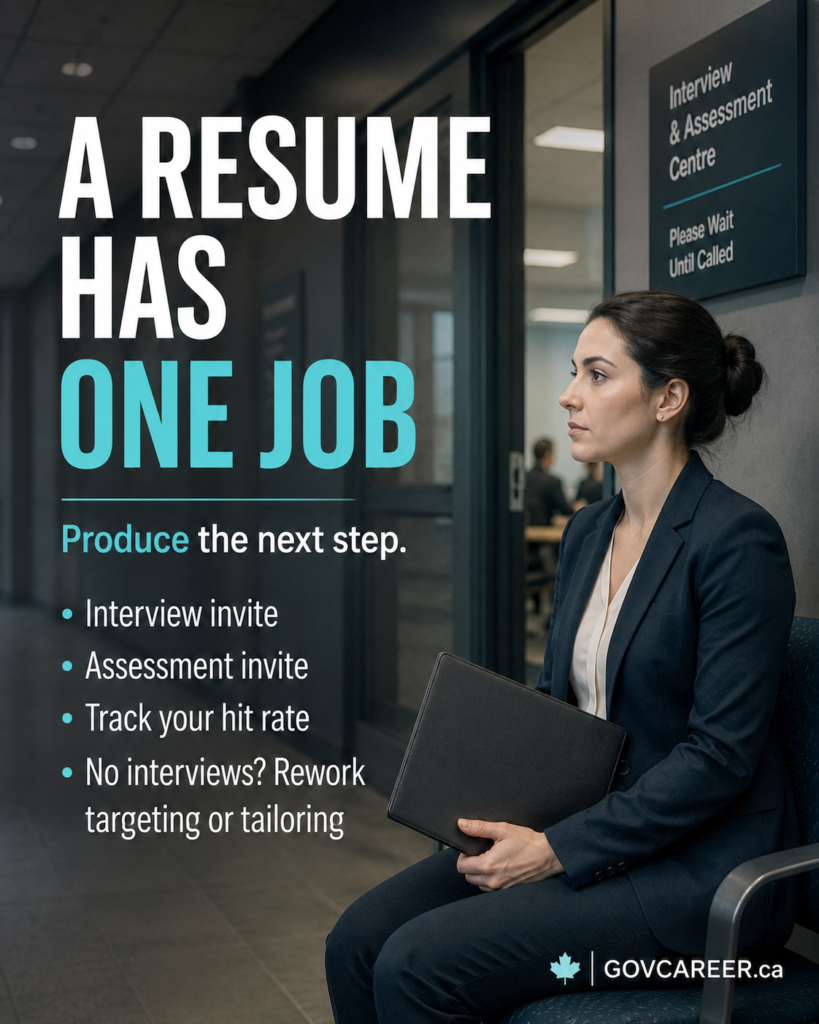
The real goal of a resume is to produce an interview, assessment invite, screening call, written exercise, or panel invitation. If your government job applications are not producing interviews, the problem usually starts with either role targeting or resume tailoring. You may be applying to postings where you do not clearly meet the job posting requirements, or your resume may not be making the match visible enough against the screening criteria.
A Resume Does Not Get You Hired
A lot of job seekers treat the resume as if it is supposed to win the entire competition.
That creates confusion.
A resume usually does not prove that you are the best candidate. It does not prove that you will be the final choice. It does not replace the interview. It does not replace reference checks, assessments, written exercises, technical testing, security screening, or internal approval.
The resume has a smaller but critical job.
It needs to move you from applicant to candidate.
That distinction matters because it changes how you should evaluate the document. A resume that sounds polished but does not produce interviews is not working. A resume that looks modern but does not show the required experience is not working. A resume that lists impressive experience but does not connect that experience to the posting is not working.
For a broader overview of how the Canadian public-sector job search works, start with this guide to government job search in Canada. The principle is simple: in structured hiring, the application must be built around the requirements being assessed, not around what the applicant personally finds most impressive.
That is especially important in Canada, Ontario, Toronto, the GTA, Ottawa, and other competitive public-sector markets where many applicants may have relevant education, transferable experience, or strong general backgrounds. Being capable is not enough. Your resume has to make the match clear.
The Immediate Goal Is the Next Stage
The immediate goal of a resume submission is not employment.
The immediate goal is movement.
Depending on the organization and hiring process, that next step may be:
• an interview
• an assessment invite
• a screening call
• a written test
• a technical exercise
• a panel interview
• a pool qualification stage
• a request for additional information
Different sectors use different process steps. A municipal job may move from resume screening to a panel interview. A federal government job may include several stages. A public agency may include testing, structured interviews, and written assessments. A large hospital, college, Crown corporation, or regulated institution may use its own version of structured hiring.
But the resume’s first measurable job remains the same.
It must get you past screening.
That means your resume has to show enough relevant evidence for the reviewer to justify moving you forward.
This is why vague resume advice often fails. Telling candidates to “make the resume stand out” is not enough. Stand out for what? Against which posting? Against which criteria? For which classification, job family, department, or level?
In public-sector hiring, the better question is not “does this resume sound impressive?”
The better question is “does this resume clearly demonstrate the required match?”
Structured Hiring Changes the Resume’s Job
Government and public-sector hiring is usually more structured than many private-sector hiring processes.
That does not mean every process is perfect. It does not mean every decision is mechanical. It does not mean bias, internal candidates, timing, budget issues, or organizational politics never matter.
But for most applicants, the most useful starting assumption is this: the posting defines the assessment framework.
The job posting tells you what the employer is likely to screen for. It usually identifies education, experience, technical skills, certifications, competencies, duties, responsibilities, and sometimes preferred assets.
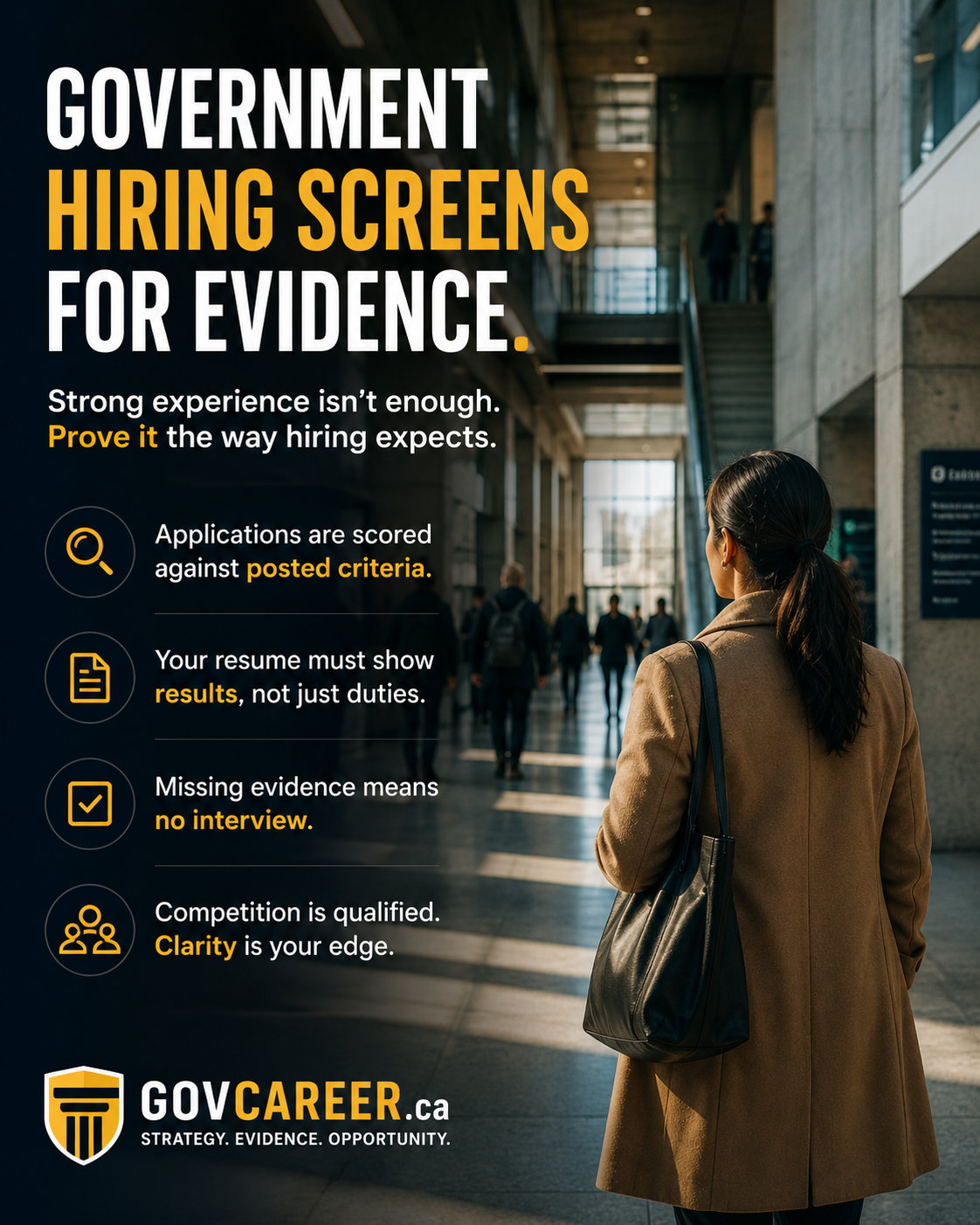
Screeners then review applications against those requirements. They are not reading your resume as a life story. They are not trying to understand every possible way your experience might transfer. They are checking whether your application demonstrates enough of what the posting asks for.
That is why resume tailoring matters.
A generic resume asks the reviewer to do the work.
A tailored resume does the work for the reviewer.
If a posting asks for contract administration, stakeholder communication, data analysis, inspection experience, policy support, financial administration, case management, customer service, project coordination, public engagement, or occupational health and safety experience, your resume needs to show that evidence clearly.
Not vaguely.
Not buried.
Not implied.
Clearly.
For federal government jobs, applicants can review official Government of Canada job opportunities through the Government of Canada jobs portal. For Ontario jobs, the Ontario Public Service jobs site shows how public-sector postings often define specific experience and qualification requirements. Municipal job boards, such as City of Toronto jobs and City of Ottawa jobs, also show how structured postings communicate duties, requirements, and preferred qualifications.
The resume must be built around that reality.
The Only Useful Resume Metric Is Whether It Produces Interviews
There is one metric many job seekers do not track seriously enough.
Are your submissions producing interviews?
Not whether you “feel good” about the resume.
Not whether a friend said it looks strong.
Not whether it has the right design.
Not whether it includes enough keywords.
Not whether an AI tool made it sound more polished.
The practical metric is simple:
How many serious applications did you submit, and how many moved forward?
If you are submitting government job applications and receiving interviews or assessment invites, your resume is doing at least part of its job. You may still need interview preparation. You may still need better role targeting. You may still need stronger examples. But the resume is producing movement.
If you are applying again and again and almost never receiving interviews, something needs to be examined.
That pattern usually points to one of two problems:
• You are applying to postings where you do not clearly meet the requirements.
• Your resume is not showing the match clearly enough.
Those are different problems.
They require different fixes.
If the issue is targeting, stronger wording will not solve it. You may need to choose better-fit roles, levels, departments, classifications, or job families.
If the issue is tailoring, applying to more jobs with the same resume will not solve it. You may need to rewrite the resume around the posting’s actual screening criteria.
This is why tracking matters.
Without tracking, applicants often blame the wrong thing.
“I Applied Everywhere” Is Not a Strategy
Many applicants say some version of this:
“I applied everywhere and heard nothing.”
That may be true, but it is not yet useful.
The next question is: what did you apply to?
A person may apply to 50 government jobs and still have no useful data if most of those postings were poor matches. Volume alone does not prove that the resume is failing. It may prove that the targeting is too loose.
Government job applications are not lottery tickets.
If you are applying to roles where the required experience is not present, not transferable, or not clearly demonstrated, the application is unlikely to move forward. That is not always unfair. Sometimes the match is simply not there.
This is especially common when applicants apply across too many unrelated job families.
For example, one person may apply to administrative assistant roles, policy analyst roles, project coordinator roles, by-law roles, health and safety roles, procurement roles, municipal infrastructure roles, and program officer roles using the same general resume.
That approach may feel productive.
It is usually not precise enough.
Each role has its own screening logic. Each posting asks for different evidence. Each job family values different experience. A resume that is too broad can become weak for every specific competition.
The better question is not “how many jobs did I apply to?”
The better question is “how many serious matches did I apply to with a tailored resume?”
Track Applications Like Evidence, Not Emotion
A simple tracking system can expose the real problem.
You do not need complicated software. A spreadsheet is enough.
Track:
• job title
• employer
• sector: federal, provincial, municipal, agency, healthcare, education, Crown corporation, or other public sector
• location
• closing date
• required qualifications
• preferred qualifications
• whether you clearly met the required qualifications
• whether the resume was tailored
• whether you submitted a cover letter
• whether you received an interview, assessment, screening call, or no response
• date of employer response
• final result
This gives you a basic interview-production record.
After 10 to 20 serious applications, patterns usually begin to appear.
If you applied to strong-fit postings with tailored resumes and received several interviews, the resume is probably doing its job. The next bottleneck may be interview performance, assessment performance, competition strength, or final ranking.
If you applied to many postings and received no interviews, review the match quality first.
Were you actually qualified?
Did the resume show the required experience?
Did you address the key duties?
Did you show public-sector-relevant evidence?
Did you adapt the resume for each posting?
Did you bury important experience under generic job descriptions?
Did the resume emphasize responsibilities that matter to you but not to the posting?
This is where the drawing board becomes useful.
Not as self-criticism.
As diagnosis.
Targeting Problems and Tailoring Problems Are Not the Same
One of the biggest mistakes in job searching is treating all application failure as a resume-writing problem.
Sometimes the resume is not the main issue.
Sometimes the person is applying to the wrong level.
Sometimes the person is applying to roles that require direct experience they do not yet have.
Sometimes the person is applying to specialized public-sector roles without understanding the required classification, legislation, tools, technical knowledge, or sector context.
Sometimes the person is trying to jump too far in one move.
Sometimes the person’s background is transferable, but not to the roles they are choosing.
That is a targeting problem.
Resume tailoring can help only when there is something real to tailor.
A resume cannot responsibly manufacture experience. It cannot turn a weak match into a strong match. It cannot make a person qualified for a role requiring specific credentials, licenses, designations, tools, legislation, or years of direct experience if those requirements are not met.
On the other hand, many qualified people do not get shortlisted because they fail to present their experience in the language and structure of the posting.
That is a tailoring problem.
They may have the experience, but the resume does not make it easy to see.
The reviewer should not have to guess.
What a Targeting Problem Looks Like
A targeting problem often looks like activity without traction.
The applicant submits many applications but does not seem to have a consistent role direction. They may be applying across unrelated categories or at levels that do not match their current evidence.
Signs of a targeting problem include:
• you often meet only a few of the required qualifications
• you rely heavily on “I could learn this”
• your experience is interesting but not clearly related to the posting
• you apply to many job families with the same resume
• you keep applying to senior roles without enough directly relevant evidence
• you ignore required certifications, licenses, or technical requirements
• your applications depend mostly on motivation rather than demonstrated experience
• you cannot explain why your background fits the posting beyond general interest
If this is the issue, the next step is not simply rewriting the resume.
The next step is role selection.
You may need to identify a better entry point. That could mean municipal coordinator roles instead of analyst roles. Administrative or program support roles instead of specialist roles. Project assistant roles instead of project manager roles. Operational roles before policy roles. Internal advancement later.
This is not lowering ambition.
It is sequencing.
Public service careers often develop through credible steps. Getting into the right environment can matter more than chasing the most attractive title immediately.
What a Tailoring Problem Looks Like
A tailoring problem looks different.
The applicant may be applying to reasonable postings but still not getting interviews. The background has relevant experience, but the resume does not connect that experience clearly to the job posting requirements.
Signs of a tailoring problem include:
• the resume reads like a general career history
• bullets describe duties but not relevance
• important experience is buried too low
• the same resume is used for very different postings
• the resume emphasizes old or unrelated work more than current relevant evidence
• the posting asks for specific experience that appears only indirectly in the resume
• technical terms from the posting are missing even when the experience exists
• achievements are listed, but screening requirements are not clearly addressed
• the resume sounds polished but does not map to the criteria
This is common with private-sector professionals trying to move into public-sector jobs.
They may have transferable experience in operations, compliance, safety, administration, stakeholder relations, procurement, finance, engineering, customer service, social services, project coordination, or program delivery. But their resume may describe that work in private-sector language that does not align with public-sector screening.
For example, “managed vendor issues” may need to become clearer evidence of contract coordination, service delivery, documentation, issue resolution, compliance follow-up, or stakeholder communication, depending on the posting.
The point is not to stuff the resume with keywords.
The point is to translate experience into recognizable evidence.
Keywords Are Not Enough

Resume tailoring is often misunderstood as keyword insertion.
Keywords matter, but they are not the whole strategy.
A resume that repeats terms from the posting without evidence can still fail. A reviewer needs to see what you actually did, in what context, using what skills, with what level of responsibility, and with what result or purpose.
For example, suppose a public-sector posting asks for stakeholder communication.
Weak evidence:
“Excellent communication skills.”
Better evidence:
“Coordinated communication with internal departments, contractors, and residents to resolve service issues, clarify project timelines, and document follow-up actions.”
The second version does more than use a keyword. It shows context, audience, action, and relevance.
The same principle applies to structured interviews. A candidate who says “I have leadership skills” is weaker than a candidate who can describe a specific situation involving judgment, competing priorities, conflict, service impact, and outcome.
Good resume writing prepares the ground for interview preparation.
The resume gets you to the room.
The interview proves how you think, act, communicate, and make decisions.
Government Resume Screening Is Usually About Evidence
A strong government resume is not only a list of jobs.
It is a structured evidence document.
The resume should help the reviewer answer questions such as:
• Does this person meet the required education or equivalent experience?
• Does this person have the required years or type of experience?
• Has this person performed similar duties?
• Is the experience recent enough, relevant enough, and clear enough?
• Does the person show the required technical, administrative, communication, or analytical skills?
• Does the person understand the environment enough to be considered?
• Is there enough evidence to justify moving the application forward?
That last question matters.
In many structured hiring environments, moving a candidate forward has to be defensible. The person screening the application needs to see the match. They cannot rely only on broad impressions.
This is why capable people get screened out.
Not always because they lack ability.
Often because the resume does not present the evidence clearly enough.
The Resume Should Reduce the Screener’s Work
A good public-sector resume does not make the screener search.
It creates a clear path.
If the posting asks for experience preparing reports, coordinating projects, maintaining records, supporting procurement, handling client inquiries, applying legislation, conducting inspections, managing data, or supporting program delivery, the resume should make those connections easy to find.
The best resume structure depends on the posting, but the general principle is consistent.
Lead with the most relevant evidence.
Use role descriptions that reflect the target.
Group related experience logically.
Avoid burying public-sector-relevant work under generic tasks.
Translate private-sector experience without exaggerating it.
Use language that is close enough to the posting to be recognizable, but not so copied that it looks artificial.
This is where many applicants fail. They write a resume that is accurate but not strategically organized.
Accuracy matters.
Visibility matters too.
Public-Sector Resumes Need Role-Specific Judgment
There is no single perfect government resume.
A resume for a municipal project coordinator role should not be identical to a resume for a policy analyst role. A resume for an OHS Advisor role should not be identical to a resume for a program assistant role. A resume for engineering technologist roles should not be identical to a resume for administrative support roles.
The same person may need different versions depending on the target.
For example:
• a municipal infrastructure resume may emphasize construction coordination, inspections, contracts, drawings, field work, documentation, and communication with contractors or departments
• a public-sector OHS resume may emphasize inspections, hazard identification, training, incident follow-up, policy support, contractor safety, and compliance documentation
• an administrative public-sector resume may emphasize records, service delivery, correspondence, scheduling, data entry, customer service, and internal coordination
• a policy or program resume may emphasize research, briefing materials, stakeholder engagement, analysis, reporting, and program support
The work may overlap, but the resume emphasis changes.
That is why the same general resume often underperforms.
It was not built for the competition in front of it.
Interview Production Is a Businesslike Way to Judge the Resume
Job searching can become emotional quickly.
That is understandable. People invest time, hope, and energy into applications. Rejection or silence feels personal. After enough silence, many applicants conclude that the whole system is closed, random, fake, or impossible.
Sometimes the system is frustrating.
Sometimes postings are highly competitive.
Sometimes internal candidates exist.
Sometimes hiring timelines are slow.
Sometimes a candidate is close but not close enough.
But before blaming external forces, examine the part you can control.
Is your resume producing interviews?
If not, are you applying to the right postings?
If yes, does your resume clearly show the match?
This is a more useful way to think because it leads to action.
Blaming the system may feel accurate, but it often does not improve the next application.
Reviewing the posting and resume can.
What to Do if You Are Getting Interviews
If your resume is producing interviews, do not immediately rebuild everything.
That may sound obvious, but many job seekers keep changing the resume even when the resume is already doing its job.
If you are getting interviews or assessments, your next bottleneck may be after screening.
You may need to focus on:
• structured interview preparation
• stronger examples
• better STAR or CAR story development
• clearer judgment and decision-making evidence
• assessment preparation
• technical readiness
• understanding public-sector values and service context
• improving how you explain transferable experience verbally
In this situation, the resume is not necessarily the weak point.
Track what happens after the interview.
Are you passing first interviews?
Are you being invited to second stages?
Are you getting placed in pools?
Are you losing at final ranking?
Are you receiving feedback?
The answer determines where to work next.
A candidate who gets interviews but no offers has a different problem from a candidate who gets no interviews at all.
What to Do if You Are Not Getting Interviews
If interviews are not coming, go back to the resume and the posting.
Start with the posting.
Highlight the required qualifications. Then highlight the duties. Then identify the experience, skills, and evidence the employer is likely to screen for.
Ask yourself:
• Do I clearly meet the required qualifications?
• Where exactly does the resume show that?
• Is the strongest evidence near the top or buried?
• Does the resume use language the screener will recognize?
• Are the bullets specific enough to show actual experience?
• Am I relying on transferable experience without explaining the transfer?
• Am I applying to too many roles with one general resume?
• Am I mistaking interest for qualification?
Then review the resume.
Do not start by making it prettier.
Start by making it more relevant.
A visually polished resume that misses the criteria will still struggle.
A plain but well-targeted resume often performs better in structured hiring than a stylish but generic one.
A Practical Resume Review Method
Before submitting a government or public-sector application, run a simple check.
First, list the posting’s major requirements.
Second, identify where each requirement appears in your resume.
Third, mark each requirement as strong, moderate, weak, or missing.
Fourth, decide whether the application is worth submitting.
This forces honesty.
If too many required items are weak or missing, the issue may be targeting.
If the experience exists but is not visible, the issue is tailoring.
If the evidence is strong and visible, then the resume has a reasonable chance of doing its job.
This method will not guarantee an interview. No honest resume writing process can guarantee that. But it will make your application more deliberate and less random.
It will also save time.
Applying carefully to better-fit postings is usually stronger than mass-applying to weak-fit roles.
Why “External Forces” Should Not Be the First Explanation
External forces exist.
Internal candidates exist.
Competition exists.
Timing exists.
Budget changes exist.
Slow public-sector processes exist.
But if your first explanation is always external, you stop diagnosing the work.
That is the danger.
You cannot control whether another applicant has more direct experience. You cannot control whether the process takes months. You cannot control whether an internal candidate applies. You cannot control how many people apply.
You can control whether you choose realistic postings.
You can control whether your resume maps to the requirements.
You can control whether your experience is visible.
You can control whether you track results.
You can control whether you adjust after patterns appear.
That is where improvement happens.
Your Resume Is a Conversion Tool
A resume is not a biography.
It is not a storage place for every task you have ever performed.
It is not a confidence exercise.
It is not a creative writing project.
For government job applications and public-sector hiring, a resume is a conversion tool. It converts your background into screening evidence.
The conversion is successful when the employer moves you to the next stage.
That is why “interview-producing resume” is a more useful concept than “perfect resume.”
A perfect-looking resume that produces no interviews is not useful.
A focused resume that produces interviews is doing its job.
The Bottom Line
The true goal of a resume is not to get the job.
The true immediate goal is to produce the next step.
In structured hiring, especially government, municipal, provincial, federal, and broader public-sector hiring, your resume must show that your experience matches the stated requirements clearly enough to survive screening.
If your applications are producing interviews, track what is working and prepare for the next stage.
If your applications are not producing interviews, do not start with assumptions about the system.
Go back to the drawing board.
Check the posting.
Check the criteria.
Check the evidence.
Check whether you are targeting the right roles.
Check whether your resume is making the match visible.
That is where the useful answer usually begins.
If you are applying for government jobs or public sector jobs in Canada, Ontario, Toronto, the GTA, Ottawa, or elsewhere and your resume is not producing interviews, GOVCAREER.ca can help you look at the application more strategically and understand what may be breaking before the interview stage.