Being Qualified Is Not Enough to Get Shortlisted for Government Jobs
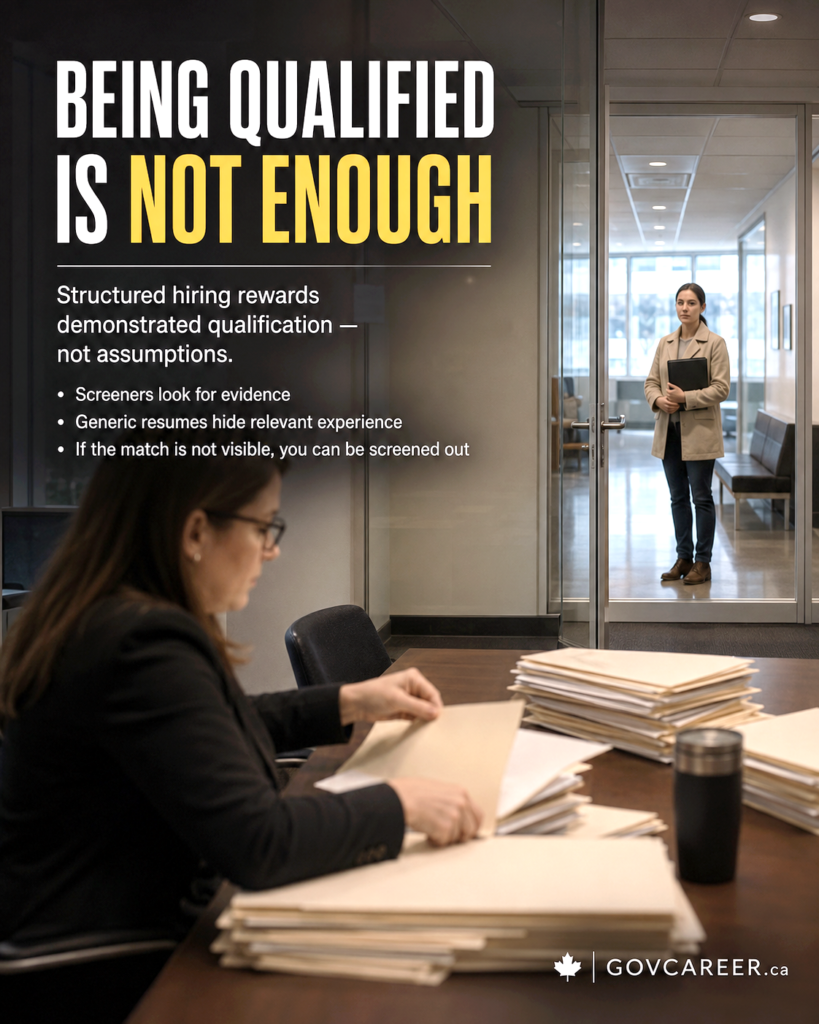
Being qualified can still get you screened out.
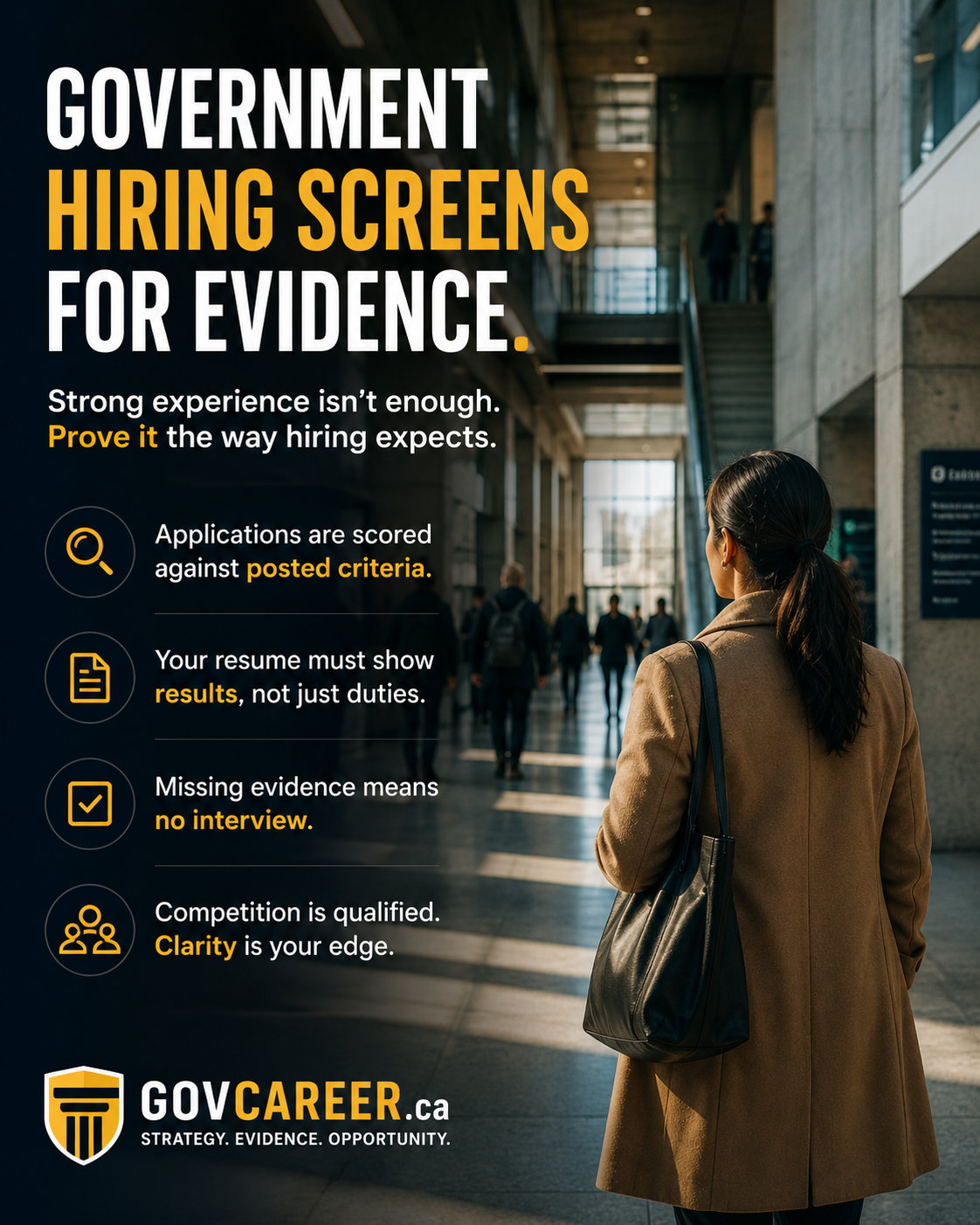
That sounds unfair, but in government and public-sector hiring, the resume does not get assessed on potential. It gets assessed on evidence.
Government jobs and public sector jobs in Canada usually follow structured hiring, merit-based hiring, and defined screening criteria. That means the person reviewing your application is not reading your resume as a general career story. They are checking whether your resume clearly shows the experience, education, technical skills, duties, and qualifications listed in the posting. If you are trying to understand how government job search works in Canada, this distinction matters from the beginning: government job search in Canada.
A lot of capable candidates miss this.
They may have strong experience. They may have done similar work. They may even be able to perform the job well.
Still screened out.
Not because they are unqualified.
Because the application does not prove the qualification clearly enough.
Government Hiring Rewards Demonstrated Qualification
In private-sector hiring, a resume often tries to create interest. It may focus on broad achievements, leadership language, career progression, personality, impact, and professional brand.
That approach can work in some private-sector environments.
Government and public-sector hiring usually works differently.
In structured hiring, reviewers are often working from a posting, screening criteria, job requirements, and a documented process. They are not supposed to guess what you meant. They are not supposed to assume your experience transfers. They are not supposed to rebuild your argument for you.
They are looking for demonstrated qualification.
That means your resume needs to show, directly and clearly, that you meet the stated requirements.
There is a major difference between these two statements:
“I am qualified for this job.”
“My application clearly proves that I meet the requirements listed in this posting.”
Many candidates believe the first statement is enough.
It is not.
The second statement is what usually matters at the screening stage.
What Happens at the Screening Stage
At the screening stage, your resume is often reviewed against the job posting. The reviewer is checking whether your application shows enough evidence to move forward.
That review may include required education, years of experience, technical knowledge, specific duties, sector experience, certifications, language requirements, software skills, supervisory experience, policy experience, project experience, stakeholder work, client service, procurement, financial administration, or other stated criteria.
The exact criteria depend on the role.
A policy analyst posting may emphasize research, briefing notes, stakeholder consultation, legislation, program analysis, Cabinet materials, evaluation, and policy development.
A municipal project coordinator posting may emphasize project tracking, procurement support, cost control, construction coordination, reporting, stakeholder communication, and work with consultants or contractors.
A government administrative role may emphasize records management, correspondence, scheduling, financial processing, client service, internal systems, and knowledge of procedures.
A public-sector communications role may emphasize writing, media relations, issues management, plain-language materials, stakeholder engagement, social media, and communications planning.
Different roles require different evidence.
That is why generic resume writing often fails for government job applications.
A strong resume in general may still be weak for a specific posting.
The Posting Is Not Just a Job Description
Many applicants treat the job posting as a description of the job.
That is only partly true.
For government and public-sector hiring, the posting is also a screening document. It tells you what the employer is likely to assess.
A posting may include:
• required qualifications
• preferred qualifications
• duties and responsibilities
• knowledge areas
• skills and abilities
• education requirements
• certifications
• employment conditions
• language requirements
• location or eligibility details
• application instructions
• information about the hiring process
If your resume does not respond to these elements, you are making the screener do extra work.
That is dangerous.
The screener is usually not trying to find reasons to rescue your application. They are trying to determine whether your application meets the stated criteria.
That is a very different reading environment.
If you are applying through federal, provincial, or municipal systems, read the posting carefully before you start tailoring the resume. The Government of Canada explains its process through official pages such as how to apply for Government of Canada jobs, and provincial or municipal job boards often have their own application instructions.
The important point is simple: the posting is your map.
If your resume ignores the map, the reviewer may not follow your path.
Why Qualified Candidates Get Screened Out
Qualified candidates often lose at screening because their evidence is present but not visible.
The experience may be there, but it is buried.
The skills may be there, but they are described in private-sector language.
The duties may be relevant, but they are spread across several jobs without a clear connection to the posting.
The candidate may have done the work, but the resume only implies it.
The application may sound professional, but it does not answer the specific criteria.
This is especially common for private-sector professionals trying to move into government, newcomers applying to public-sector roles in Canada, and current employees trying to move into a different public-sector stream.
They may have transferable experience.
But transferable experience has to be shown.
You cannot expect the reviewer to do the transfer for you.
If the posting asks for experience preparing briefing materials, do not only say “prepared reports.”
If the posting asks for stakeholder engagement, do not only say “worked with clients.”
If the posting asks for procurement coordination, do not only say “supported projects.”
If the posting asks for policy analysis, do not only say “conducted research.”
Those phrases may be related, but they may not be enough.
Government resume tailoring requires sharper alignment between the posting language and your actual work.
Generic Job Descriptions Are Usually Too Weak
One of the most common resume problems is the generic job description.
A candidate writes something like:
“Responsible for managing projects, communicating with stakeholders, preparing reports, and supporting operational priorities.”
That may sound fine.
It is also too vague.
A government screener needs to know what kind of projects, what kind of stakeholders, what kind of reports, what systems, what procedures, what decisions, what scale, what deadlines, what outcomes, and how the work relates to the posting.
Generic language forces the reviewer to guess.
That is not their job.
A stronger resume does not just list responsibilities. It shows relevant evidence.
For example, instead of saying:
“Managed stakeholder relationships.”
A stronger government-focused bullet might show:
“Coordinated consultation with internal program staff, external partners, and municipal stakeholders to collect input, resolve implementation issues, and support reporting requirements.”
That gives the reviewer more to work with.
It shows who was involved, what the work required, and how it connects to structured public-sector duties.
The goal is not to make the resume longer for no reason.
The goal is to make the evidence easier to recognize.
Government Resume Tailoring Is Not Just Keyword Matching
Many candidates now hear that they need keywords.
That is partly true, but incomplete.
Keywords matter because they help connect your experience to the posting. But government resume tailoring is not just about copying words from the job ad.
A resume full of keywords can still fail if it does not show evidence.
If the posting asks for “experience developing policy options,” simply inserting the phrase “policy options” is not enough.
The resume should show what you analyzed, what options you developed, who used the material, what process it supported, and what level of complexity was involved.
If the posting asks for “experience supporting procurement processes,” the resume should show what part of procurement you supported, whether you worked with vendors, RFPs, contracts, purchase orders, approvals, specifications, evaluation teams, or compliance requirements.
If the posting asks for “experience coordinating projects,” the resume should show planning, schedules, risks, budgets, reporting, stakeholders, deliverables, and follow-up.
Keywords help the reviewer find the evidence.
They do not replace the evidence.
This is why many AI-generated resumes are weak for public-sector applications. They may sound polished, but they often remain too generic. They use the language of the posting without proving the work behind it.
Government hiring does not reward a resume that only sounds aligned.
It rewards a resume that demonstrates alignment.
The Screener Is Not Reading Your Resume Like a Story
Many applicants write resumes as career narratives.
They start with who they are, then describe where they worked, then list responsibilities in a broad way.
That can be useful in some contexts.
But in structured hiring, the screener is usually not trying to understand your whole career journey first. They are trying to determine whether the application contains enough evidence against the requirements.
That means your resume has to be easy to scan.
The reviewer should be able to locate relevant qualifications quickly.
This does not mean the resume should be robotic. It still needs to read professionally. But the structure should help the reviewer do their job.
A government-focused resume should make it easy to see:
• what roles you held
• where you worked
• when you worked there
• what duties match the posting
• what technical skills you used
• what public-sector or transferable experience you have
• what scale and complexity your work involved
• which qualifications are directly demonstrated
The reviewer should not have to search through unrelated information to find the match.
A resume that hides the strongest evidence is not doing its job.
“Defensible” Hiring Decisions Matter
In government and public-sector hiring, decisions are usually expected to be structured, documented, and fair.
That does not mean every process is perfect.
It does mean hiring managers and panels often need to be able to explain why one candidate moved forward and another did not.
This is why evidence matters.
A hiring manager cannot simply say, “I liked this candidate’s background.”
They need a process. They need criteria. They need notes. They need scoring. They need a reason that connects to the job requirements.
At the resume stage, that means your application must give them something clear to assess.
A candidate may be impressive, but if the resume does not show the required qualifications, the panel may not have enough basis to move that person forward.
This is one reason public-sector hiring can feel strange to candidates coming from the private sector.
In private-sector hiring, a strong impression may carry more weight.
In structured hiring, evidence is harder to ignore.
The candidate who gives the clearest evidence often has an advantage over the candidate who only seems broadly capable.
Your Resume Must Reduce the Reviewer’s Work
A good government resume reduces the reviewer’s effort.
It does not make them hunt.
It does not make them infer.
It does not make them translate private-sector language into public-sector criteria.
It does not make them connect scattered experience across several roles without guidance.
It makes the match visible.
That does not mean every bullet should copy the posting.
It means the resume should be built around relevance.
For each serious posting, ask:
What are the required qualifications?
Which duties matter most?
What experience do I have that directly connects?
Where is that evidence in my resume?
Is it clear enough for a stranger to understand quickly?
Does the language match the posting without sounding artificial?
Have I included enough detail to prove the work?
Have I removed or reduced information that distracts from the match?
This is the practical work behind government resume tailoring.
It is not cosmetic editing.
It is application strategy.
The Problem With “One Resume for Everything”
Many candidates use one resume for every job.
That is risky in government job applications.
A broad resume may show that you are experienced, but it may not show that you meet a specific posting.
For example, a supply chain graduate applying to a municipal coordinator role may have relevant experience in procurement, vendor communication, inventory, logistics, data tracking, and process improvement.
But if the posting emphasizes stakeholder coordination, reporting, economic development, project administration, and municipal programs, the resume needs to connect those transferable areas carefully.
A policy researcher applying to a provincial analyst role may have strong research and writing experience. But if the posting asks for legislative analysis, briefing notes, consultation, program evaluation, and senior-level advice, the resume needs to show the closest evidence available.
A construction project coordinator applying to a transit or infrastructure role may have excellent field experience. But if the posting asks for procurement, cost control, consultant coordination, contract administration, and public-sector stakeholder management, the resume needs to bring those details forward.
Same person.
Different posting.
Different evidence priority.
That is why one general resume usually underperforms in structured hiring.
Cover Letters Have a Different Role
Cover letters can help, but they are not a substitute for a weak resume.
In many government and public-sector processes, the resume carries the main screening burden. Some postings ask for a cover letter. Some do not. Some use online screening questions. Some require detailed written responses.
Always follow the application instructions.
If a posting says cover letters are not required, do not assume a cover letter will help.
If the posting asks for a cover letter, use it carefully. A strong government cover letter should not repeat the resume in paragraph form. It should explain why the applicant matches the role, highlight the most relevant evidence, and connect the background to the public-sector environment.
For example, someone applying through the Ontario Public Service jobs system should pay close attention to the exact instructions in each posting. A municipal role through City of Toronto jobs or City of Ottawa jobs may have different expectations.
The rule is simple: follow the posting, then build the application around the criteria.
Do not use the cover letter to compensate for a resume that does not show the required qualifications.
Transferable Experience Must Be Translated Clearly
Many applicants have relevant experience outside government.
That experience can matter.
Private-sector professionals, newcomers, recent graduates, nonprofit workers, consultants, contractors, and people from regulated industries may all have experience that connects to public-sector work.
But the resume must make that connection visible.
For example:
Client service can connect to public-facing municipal service, case management, program support, or stakeholder relations.
Operations experience can connect to process improvement, compliance, reporting, scheduling, procurement, and service delivery.
Project coordination can connect to infrastructure, capital projects, IT implementation, policy initiatives, events, grants, or program delivery.
Supply chain experience can connect to procurement, vendor management, contract administration, inventory control, logistics planning, and public purchasing.
Research experience can connect to policy analysis, program evaluation, briefing materials, environmental scans, and decision support.
But the resume has to show the bridge.
Do not assume the reviewer will understand how private-sector language applies to public-sector requirements.
If the posting uses public-sector language, your resume needs to meet that environment without pretending you have experience you do not have.
That balance matters.
You want to show transferable experience honestly, clearly, and strategically.
Structured Interviews Start Earlier Than You Think
Many candidates think interview preparation begins after they get invited to interview.
In government hiring, interview preparation starts earlier.
The same posting that guides your resume often gives clues about the interview.
If the job requires stakeholder engagement, project coordination, policy analysis, conflict resolution, reporting, leadership, or technical knowledge, those areas may appear later in structured interviews.
A resume that is built properly can help you prepare for the interview because it forces you to identify your strongest examples early.
That does not guarantee an interview.
But it creates a stronger foundation.
Government structured interviews often use scored questions, behavioural examples, technical questions, scenario questions, or role-specific exercises. The details vary by employer and role.
Federal candidates may want to review official Government of Canada information on what to expect when applying for Government of Canada jobs. Provincial candidates should review the relevant provincial job board and instructions, such as BC Public Service job postings, Government of Alberta jobs, or Saskatchewan public service jobs.
The resume and interview are connected.
Both require evidence.
Both require clarity.
Both require the candidate to show how their experience matches the role.
What a Strong Government Application Should Do
A strong government application should make the reviewer’s decision easier.
It should show that the candidate understands the role, meets the key requirements, and has relevant evidence.
That does not mean the resume should be overloaded with every detail.
It means the application should be controlled.
A strong application usually does five things well.
1. It targets the right role
Not every government job is a good target.
Applying everywhere is usually inefficient.
The better question is whether your background gives you a realistic basis for the posting.
Do you meet the required education?
Do you have the required experience?
Can you show the technical or sector knowledge?
Can you demonstrate the duties?
Are there eligibility requirements?
Are you applying at the right level?
If the answer is weak, the application may not be worth the effort.
2. It mirrors the posting intelligently
A strong resume uses the posting as a guide.
It does not copy every phrase mechanically. It uses the employer’s language where accurate and supports that language with real examples.
This helps the reviewer see the match quickly.
3. It shows evidence, not claims
Claims are easy to write.
Evidence is harder.
“I have strong communication skills” is a claim.
“Prepared briefing materials, meeting summaries, and stakeholder updates for internal leadership and external partners” is evidence.
“Excellent project management skills” is a claim.
“Tracked project schedules, coordinated vendor deliverables, prepared status updates, and supported issue resolution across multiple concurrent files” is evidence.
Government applications need more evidence.
4. It prioritizes relevant experience
A resume should not treat every past duty equally.
The most relevant duties should be easier to find.
Less relevant material should be reduced.
A public-sector reviewer should not have to dig through unrelated private-sector achievements to find the few items that matter.
5. It supports later interview preparation
A good resume helps the candidate identify examples they may need later.
If your application says you have stakeholder experience, project coordination, policy analysis, conflict resolution, or leadership experience, be prepared to discuss it in a structured interview.
Do not write a resume you cannot defend.
The “Can a Stranger See It?” Test
Before submitting a government or public-sector application, use a simple test.
Take the posting.
Highlight every required qualification.
Then review your resume and ask:
Can a stranger see clear evidence for each requirement without guessing?
If the answer is no, the issue may not be your background.
The issue may be visibility.
That is one of the most important differences between being qualified and being shortlisted.
You may understand your own experience. You may know that your background fits. You may see the connection.
The reviewer may not.
Your application has to make the match visible to someone who does not know you.
That is why resume tailoring is not just rewriting.
It is evidence organization.
Common Signs Your Application Is Too Generic
If you keep applying to government or public-sector jobs and hear nothing back, look for these warning signs:
• your resume looks almost the same for every posting
• your bullets describe duties but not evidence
• your strongest related experience is buried near the bottom
• you use private-sector language that does not match the posting
• you list skills without showing where you used them
• your resume summary is broad and could apply to many roles
• you do not clearly show required experience
• you assume the reviewer will understand your transferable background
• you include too much irrelevant material
• you do not adjust your resume based on required and preferred qualifications
These are fixable problems.
But they require more than proofreading.
They require reading the posting properly and rebuilding the application around the evidence that matters.
Government Hiring Is Competitive, but Not Random
It is easy to believe government hiring is random when applications go nowhere.
Some candidates assume the jobs are already filled. Some assume only internal candidates have a chance. Some assume nobody reads the resume. Some assume the system is impossible.
There may be internal candidates.
Some competitions may be more competitive than others.
Some processes may be slow.
But the practical question remains:
Did your application clearly show the evidence needed to move forward?
That is the part you can control.
If you are applying for municipal jobs through official boards such as City of Vancouver jobs, City of Edmonton jobs, or City of Calgary careers, the same principle applies. Read the posting carefully, understand the requirements, and make the application match visible.
You cannot control who else applies.
You cannot control timing.
You cannot control internal interest.
You can control whether your resume gives the reviewer clear evidence against the posting.
That is where serious applicants should focus.
What to Do Before You Apply Again
Before sending another government job application, slow down.
Do not start with the resume.
Start with the posting.
Read the requirements.
Separate required qualifications from preferred qualifications.
Identify the duties that appear central to the role.
Look for repeated themes.
Check whether your experience can support those themes.
Then build your resume around the strongest match.
A practical process looks like this:
• read the posting once for general understanding
• read it again for screening criteria
• mark required qualifications
• mark preferred qualifications
• identify the top duties
• list your matching experience
• decide whether the role is realistic
• tailor the resume summary and bullets
• make required evidence easy to find
• remove or reduce unrelated content
• check application instructions before submitting
This may take longer than sending a generic resume.
But sending weak applications quickly is not a strategy.
It is just volume.
For government job applications, quality often matters more than volume.
When to Get Help
You may need help if you are applying consistently and not being shortlisted, especially when you believe you meet the requirements.
You may also need help if you are moving from private sector into government, applying as a newcomer, targeting municipal or provincial roles, trying to translate technical experience, or preparing for structured interviews.
Professional help can be useful when it focuses on the actual posting, not generic resume polishing.
The right question is not simply:
“Can someone make my resume look better?”
The better question is:
“Can someone help me show my experience clearly against this government posting?”
That is the difference between general resume writing and government application strategy.
A polished resume can still fail.
A clear, evidence-based, posting-aligned resume gives the reviewer something useful to assess.
Final Thought
Being qualified is not enough to get shortlisted for government jobs.
That may sound harsh, but it is one of the most important realities of public-sector hiring.
Government and public-sector hiring rewards demonstrated qualification. Your resume, cover letter, application answers, and interview examples all need to show evidence in a way that fits the posting and the structured hiring process.
If you are applying to government jobs, public sector jobs, federal government jobs, provincial government jobs, municipal jobs, or broader public service careers in Canada, do not only ask whether you are qualified.
Ask whether your application proves it clearly enough.
A stranger should be able to see the match.
If they cannot, your experience may be stronger than your application.
That is often where the application is won or lost.
If you have questions about government job applications, resume tailoring, screening criteria, structured interviews, or how to position your experience for public-sector hiring in Canada, you can contact me through GOVCAREER.ca.