There Is No One Correct Resume Format for Government Job Applications
Hook:
The resume format that works for one government job application can weaken the next one.
That is the part most job seekers miss.
There is no single correct resume format for government job applications because public-sector hiring is usually structured around the specific requirements of each job posting. In Canada, Ontario, Toronto, the GTA, Ottawa, and across federal, provincial, and municipal jobs, candidates are often screened against stated criteria, not judged mainly on how modern or attractive their resume looks. A strong government resume should make the match between your experience and the job posting requirements obvious through careful resume tailoring, clear structure, and direct alignment with the screening criteria.
Why Standard Resume Advice Can Fail in Government Hiring
Most resume advice people see online was created for private-sector hiring.
It usually sounds something like this:
Use a clean format. Lead with a strong professional summary. Highlight achievements. Make the resume visually modern. Keep it concise. Show impact. Use strong action verbs. Make yourself stand out.
None of that is automatically wrong.
The problem is that government hiring does not always operate by the same logic.
In many private-sector environments, a recruiter or hiring manager may skim a resume quickly and look for an impressive overall picture. They may be looking for signals: recent experience, recognizable companies, relevant titles, strong accomplishments, clear progression, and a sense that the person is worth interviewing.
Government hiring, public-sector hiring, and other structured hiring processes often work differently.
In many government job applications, the first question is not:
“Does this person look impressive?”
The first question is closer to:
“Does this application clearly demonstrate the required criteria listed in the job posting?”
That is a very different question.
A resume that looks polished but does not clearly show the required education, experience, technical knowledge, communication skills, regulatory exposure, policy background, administrative experience, project coordination experience, or other stated requirements can fail at the screening stage.
That is why the idea of one perfect government resume format is misleading.
There is no universal format that works equally well for every public sector job. The stronger approach is to understand how government job search in Canada actually works, then structure each application around the specific posting.
The Job Posting Is Not Just an Advertisement
Many job seekers treat a government job posting as a basic announcement.
They read the title, salary, location, closing date, and maybe the general duties. Then they send a resume that looks generally relevant.
That is not enough.
For government job applications, the job posting is often closer to a screening map.
It usually tells you:
What qualifications are required.
What experience must be demonstrated.
What education is needed.
What skills may be assessed.
What assets may improve your application.
What competencies may be evaluated later.
What conditions of employment apply.
What language, location, security, or availability requirements may exist.
A public-sector job posting is not only describing the job. It is also giving you clues about how your application may be reviewed.
That does not mean every organization screens identically. Federal government jobs, provincial government jobs, municipal jobs, Crown agencies, hospitals, universities, school boards, and broader public-sector organizations can use different systems and processes.
But the principle is consistent enough to matter.
The posting tells you what the organization says it needs. Your resume should make it easy to see where you meet those needs.
For example, when applying to federal government jobs through the Government of Canada job opportunities portal, applicants are often expected to show how they meet the education and experience requirements identified in the job advertisement. The same general logic appears in many Ontario Public Service, municipal, and broader public-sector competitions.
The posting is not decoration.
It is evidence of what the employer intends to assess.
Why the Order of the Posting Matters
One of the simplest mistakes candidates make is ignoring the order of the posting.
If the posting lists education first, then required experience, then technical knowledge, then communication skills, then assets, that structure may not be random.
Someone built the posting that way.
The organization decided what information mattered. It grouped the requirements. It separated essential qualifications from assets. It identified what must be demonstrated before anything else.
So when your resume uses a completely different structure, the screener may have to work harder.
That is where strong candidates lose ground.
A person may have the right experience, but if the evidence is buried in long paragraphs, mixed across unrelated jobs, hidden under vague bullet points, or scattered across the resume, the match becomes harder to see.
In government hiring, making the screener work harder is usually not a winning strategy.
This does not mean your resume must copy the posting exactly. It does not mean every heading must be identical. It does not mean your resume should become robotic.
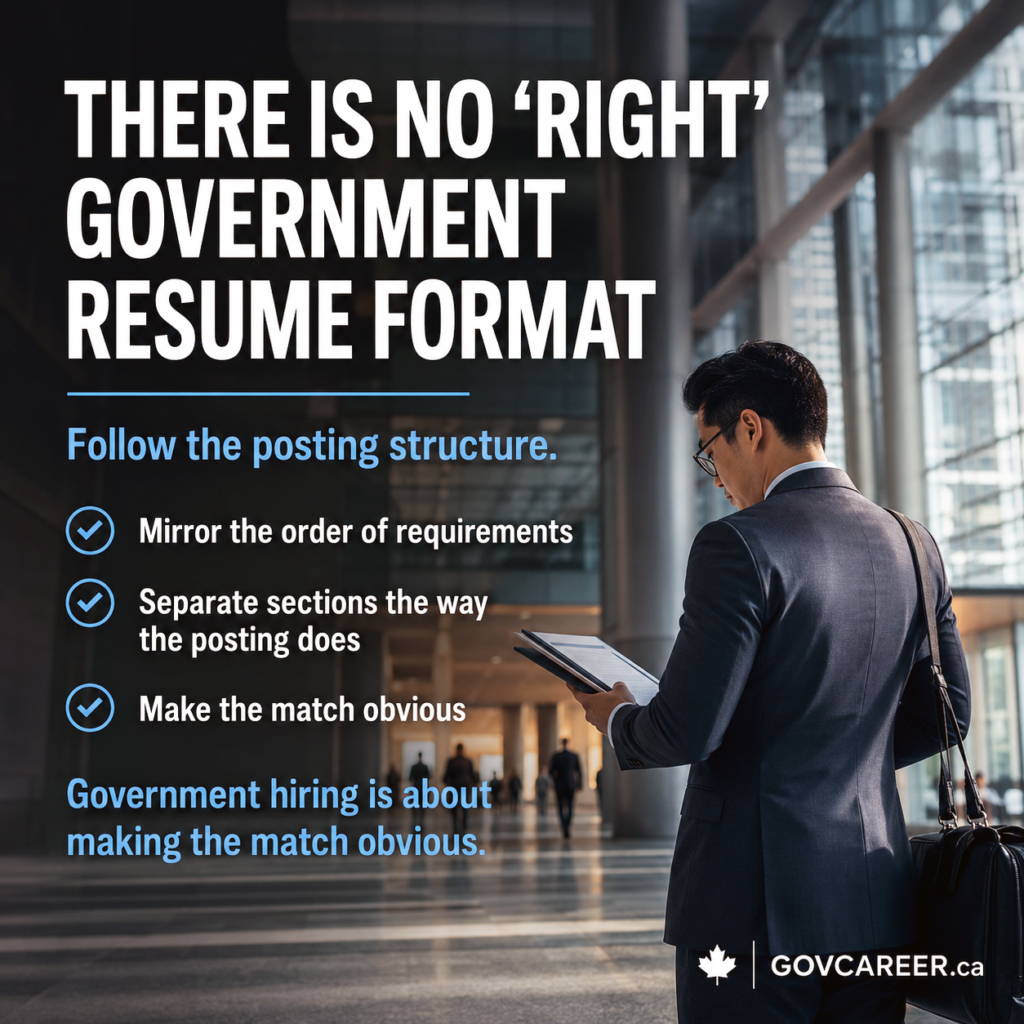
It means the resume should respect the logic of the posting.
If the posting separates technical skills from communication skills, your resume should make both areas easy to find.
If the posting puts required qualifications before assets, your resume should not lead with weak extras while hiding the required criteria later.
If the posting emphasizes client service, case management, policy analysis, inspection experience, program administration, project coordination, regulatory compliance, stakeholder engagement, or written communication, your resume should clearly show evidence in those areas.
The structure of the posting should influence the structure of the resume.
The Problem With “Best Resume Format” Thinking
Many candidates ask: “What is the best resume format for government jobs?”
The better question is:
“What format makes the match easiest to verify for this specific posting?”
That shift matters.
A chronological resume may work well for some applications.
A more targeted qualifications-first resume may work better for others.
A resume with a technical skills section may be useful for one role but unnecessary for another.
A resume that opens with education may make sense when education is a primary requirement.
A resume that opens with relevant experience may make sense when the posting emphasizes direct operational experience.
There is no single correct answer outside the context of the posting.
This is why generic resume writing advice can be risky for government job applications. Generic advice often assumes the resume is a broad marketing document. In structured hiring, the resume is often closer to an evidence document.
It still needs to be readable. It still needs to be professional. It still needs to show value.
But above all, it needs to show fit against the stated criteria.
That is where resume tailoring becomes important.
Resume tailoring does not mean decorating your resume with keywords. It means adjusting the content, structure, examples, and emphasis so the application responds directly to the job posting requirements.
What Government Screeners Are Usually Looking For
A government screener is usually not reading your resume like a story.
They are often checking whether your application demonstrates specific requirements.
That can include:
Education.
Years or type of experience.
Experience in a particular function.
Knowledge of relevant legislation, programs, policies, systems, or procedures.
Technical skills.
Written and oral communication.
Analytical ability.
Customer service or public-facing experience.
Project coordination or program support.
Supervisory or leadership experience.
Financial, administrative, inspection, enforcement, planning, policy, or operational experience.
Ability to work with internal and external stakeholders.
The exact criteria depend on the posting.
This is why vague achievement bullets often underperform in government applications.
For example, a private-sector resume bullet might say:
“Improved team efficiency through strong communication and process optimization.”
That sounds positive, but it may not prove much against a public-sector posting.
A stronger government-oriented bullet might identify the function, context, action, stakeholder group, documentation, system, regulation, service area, or measurable responsibility more clearly.
The goal is not to sound more impressive.
The goal is to provide evidence.
If an Ontario Public Service posting from Ontario Public Service jobs asks for experience preparing briefing materials, coordinating information, supporting program delivery, communicating with stakeholders, or applying policies and procedures, the resume should not leave those points implied.
It should show them clearly.
Why Strong Candidates Still Get Screened Out
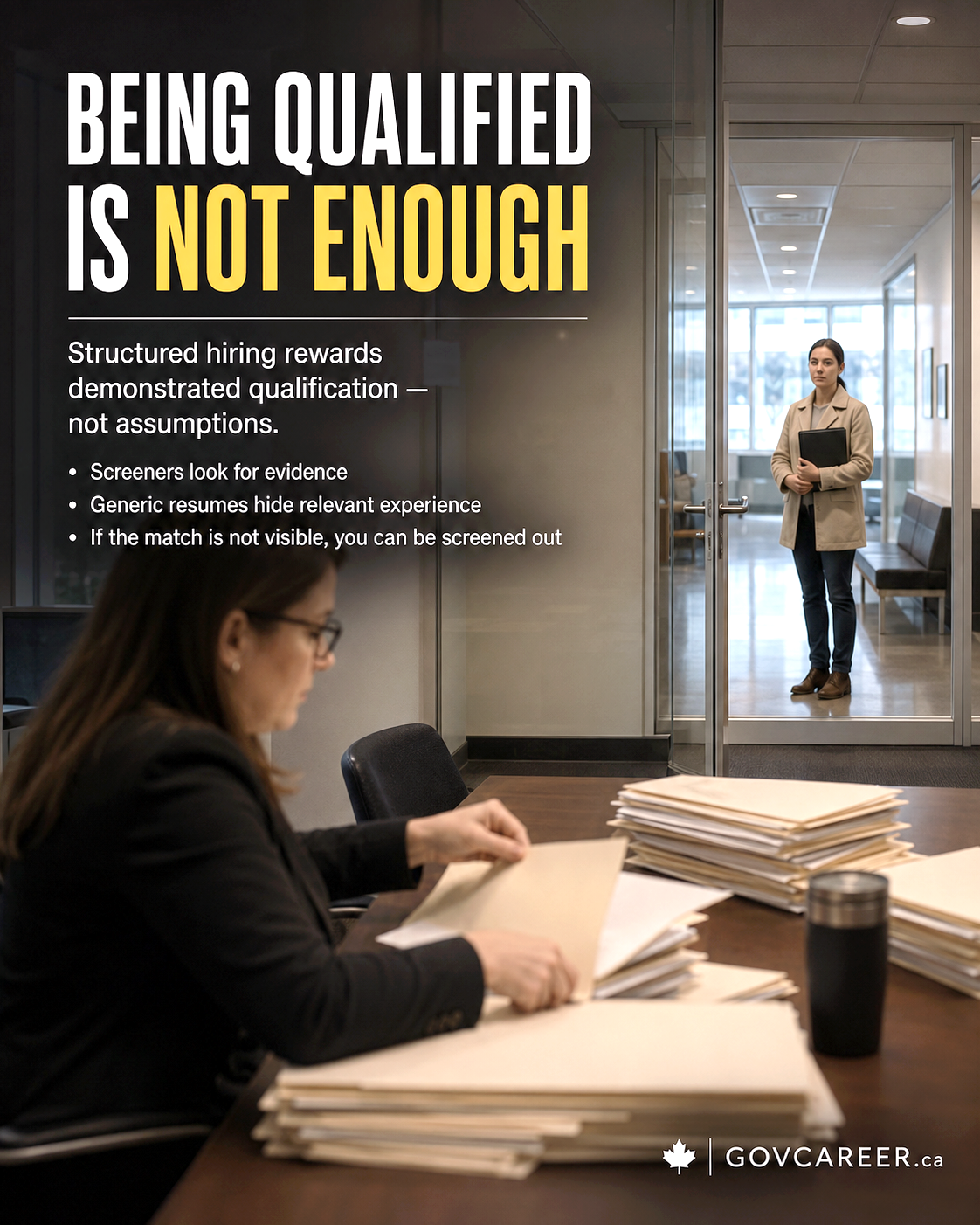
Many capable candidates are screened out not because they are unqualified, but because their resume does not make the qualifications easy to verify.
This is especially common among people moving from the private sector into government jobs or public sector jobs.
They often have relevant experience, but they present it through private-sector resume logic.
They lead with broad achievements.
They compress details to keep the resume short.
They use generic phrases like “responsible for operations,” “supported stakeholders,” “managed priorities,” or “handled documentation.”
They assume the reviewer will understand the relevance.
They leave important details unstated.
In private-sector networking or recruiter-driven hiring, sometimes that can still work.
In structured hiring, it can fail.
If the posting asks for experience interpreting policies, preparing reports, coordinating projects, responding to client inquiries, using a specific system, conducting inspections, processing applications, or managing confidential information, the resume should say so clearly if the experience exists.
Do not make the screener infer.
Do not assume they will connect the dots.
Do not rely on title alone.
A candidate with a title like “Program Assistant,” “Coordinator,” “Analyst,” “Customer Service Representative,” “Administrative Officer,” “Caseworker,” “Planner,” “Inspector,” or “Project Coordinator” may have very different duties depending on the organization. The title does not prove the criteria.
The resume must show the evidence.
Matching the Posting Does Not Mean Copying the Posting
There is an important difference between alignment and copying.
Alignment is good.
Copying is weak.
A government resume should reflect the job posting requirements, but it should not simply repeat them without proof.
For example, if the posting says:
“Experience preparing written reports and briefing materials for management.”
A weak resume response would be:
“Experienced in preparing written reports and briefing materials for management.”
That only repeats the requirement. It does not prove it.
A stronger approach would show where, how, and in what context the person did that work.
For example:
“Prepared weekly operational reports, issue summaries, and briefing notes for management review, consolidating input from program staff and tracking outstanding items for follow-up.”
That gives the screener something more useful.
It shows the action, document type, audience, context, and function.
This is what government resume writing often requires: not flashy wording, but clear evidence.
Keyword stuffing does not solve the problem.
Generic AI rewriting does not solve the problem either if it only produces polished language without substance.
The resume must demonstrate the criteria through real experience.
How to Use the Posting to Structure Your Resume
Start by reading the posting as if it is a checklist.
Not casually. Not once.
Read it carefully.
Identify the main sections. Look for headings such as:
Required qualifications.
Education.
Experience.
Knowledge.
Skills and abilities.
Assets.
Duties.
Competencies.
Conditions of employment.
How to apply.
Selection process.
Different organizations use different terms. A municipal posting may look different from a federal posting. A City of Toronto posting may not look exactly like a provincial posting. A broader public-sector agency may use its own style.
But most postings still give you a structure.
For example, someone applying to City of Toronto jobs may see requirements related to municipal administration, service delivery, legislation, technical knowledge, communication, customer service, or stakeholder coordination. Someone applying to City of Ottawa jobs may see a similar need to demonstrate specific experience, certifications, education, or operational knowledge.
The resume should help the reviewer find those elements quickly.
If the posting emphasizes education and certification, do not bury that information.
If the posting emphasizes direct municipal experience, make that experience visible.
If the posting emphasizes communication with the public, show public-facing communication clearly.
If the posting emphasizes policy or program work, do not describe your experience only as “administrative support.”
If the posting emphasizes technical or regulatory knowledge, include the relevant details where they can be found.
Government job applications are often won or lost on clarity.
When Education Should Come First
Private-sector resume advice often says experience should come before education unless the person is a student or recent graduate.
That is often reasonable.
But in government job applications, the posting may change that decision.
If education is a mandatory requirement and the posting lists it prominently, placing education clearly near the top may help.
This is especially true where the role requires a degree, diploma, professional designation, certificate, licence, or specific field of study.
For example, some roles may require education in public administration, social sciences, engineering, planning, business, accounting, environmental studies, law, information technology, or another relevant field.
If the posting requires that education, make it easy to find.
Do not assume the reviewer will search through the resume to confirm it.
A candidate can still include experience early if that is the stronger choice, but the required education should not be hidden.
For regulated, technical, or credential-heavy roles, the resume structure should respect the screening importance of education and certification.
When Qualifications Should Come Before Work History
Sometimes a posting is structured around required qualifications rather than chronological career history.
In that case, a resume that opens with a targeted qualifications section can be useful.
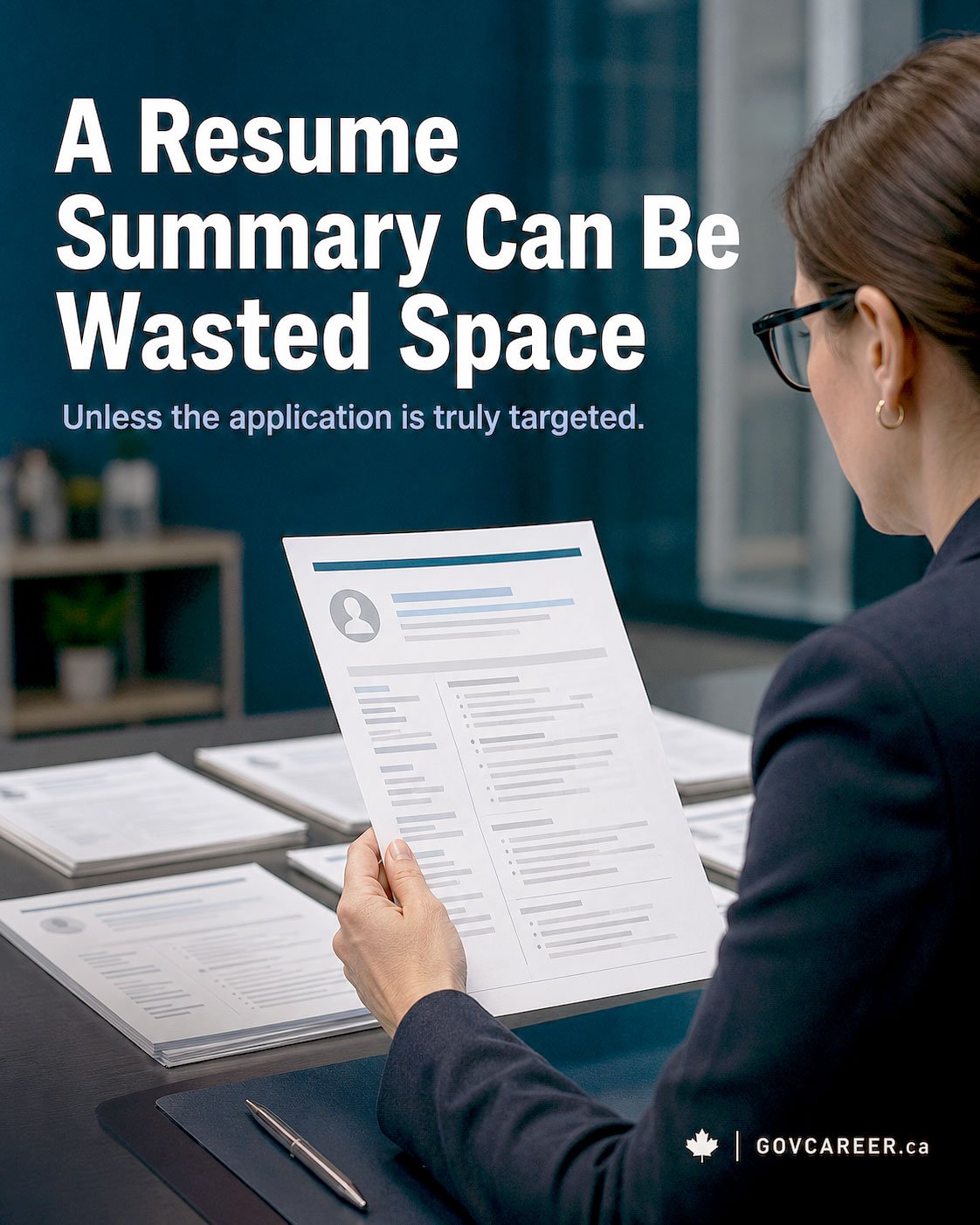
This does not mean adding a generic profile summary full of soft claims.
A weak summary says:
“Motivated professional with excellent communication skills and a passion for public service.”
That may sound fine, but it usually proves very little.
A stronger qualifications section may directly summarize evidence against the posting:
Relevant degree or diploma.
Years of experience in a required function.
Specific public-facing, administrative, policy, program, technical, inspection, compliance, or coordination experience.
Relevant systems, tools, legislation, reports, documents, or stakeholder groups.
Language, certification, or security-related requirements if relevant.
This section should be factual, not promotional.
The goal is to let the screener see quickly that the application deserves deeper review.
For government job applications, the first page of the resume often needs to answer the question:
“Does this person appear to meet the required criteria?”
If the answer is not obvious, the resume may be weaker than the candidate’s actual background.
When Technical Skills Should Be Separate
If the posting separates technical skills from communication skills, do not blend everything together.
For some roles, a separate technical skills section can help.
This may apply to IT, engineering, planning, finance, data, GIS, procurement, construction, policy analysis, regulatory work, inspections, environmental work, or specialized program roles.
For example, a candidate applying for municipal jobs in engineering or infrastructure may need to show knowledge of technical standards, project documentation, contract administration, inspections, construction coordination, asset management, or relevant software.
A candidate applying for administrative or program roles may need to show systems, records management, databases, client management tools, scheduling tools, financial systems, or reporting tools.
A candidate applying for policy or analyst roles may need to show research, briefing notes, data analysis, stakeholder consultation, legislation, program evaluation, or report writing.
If the posting treats these as separate requirements, the resume should not hide them in a generic paragraph.
Use structure to make the evidence easy to find.
That is resume tailoring.
When Communication Skills Need Evidence
Almost every job seeker says they have strong communication skills.
That is not enough.
In government hiring, communication is often assessed through evidence.
The posting may ask for experience:
Preparing reports.
Writing briefing notes.
Responding to public inquiries.
Explaining policies or procedures.
Presenting information.
Dealing with stakeholders.
Coordinating with internal teams.
Resolving complaints.
Communicating technical information to non-technical audiences.
Drafting correspondence.
Documenting decisions.
If your resume only says “excellent communication skills,” it may not show enough.
Instead, show what communication looked like in your actual work.
Did you write reports?
Did you respond to residents, clients, applicants, vendors, elected officials’ offices, managers, or partner organizations?
Did you prepare meeting notes?
Did you explain complex requirements?
Did you coordinate between departments?
Did you handle sensitive or confidential information?
Did you brief supervisors?
This is where many candidates lose an opportunity.
They have the communication experience, but they present it as a soft skill instead of evidence.
Public Sector Resume Tailoring Is Not About Looking Fancy
Government resumes do not need to be ugly.
They should still be clean, organized, professional, and easy to read.
But design is not the main point.
A resume with icons, graphics, columns, skill bars, colours, logos, or heavy formatting may look modern, but that does not mean it is stronger for a structured hiring process.
In many government job applications, simple structure beats decorative design.
This is especially true when applications go through online systems, HR screening, or structured review processes.
A clean resume with clear headings, relevant detail, and strong alignment usually works better than a visually creative resume that hides the evidence.
The resume is not a brochure.
It is not a personal brand poster.
It is a structured document designed to show that your background meets the job posting requirements.
That is a different mindset.
The Role of Screening Criteria
Screening criteria are the requirements used to decide whether an applicant moves forward.
Some criteria may be explicitly stated. Others may be drawn from the posting’s required qualifications, experience, duties, or application instructions.
For federal government jobs, the Government of Canada provides guidance on how to apply for Government of Canada jobs, and applicants are generally expected to provide information showing how they meet the requirements. Provincial and municipal processes vary, but the same practical issue often appears: the candidate must show the match clearly.
This is why the resume should not be written only for general appeal.
It should be written for screening.
That means your application should answer the posting in a way that is easy to assess.
If a requirement is essential, it should be easy to find.
If experience is relevant, it should be specific.
If a skill is requested, it should be supported by examples.
If a qualification is required, it should be clearly stated.
If an asset applies, it should not be hidden.
The resume must reduce uncertainty.
A screener should not have to wonder whether your experience counts.
Why One Resume Cannot Serve Every Government Application
In private-sector job search, people often try to build one strong resume and use it widely.
That approach is already imperfect.
For government job applications, it is even more limited.
Each posting may define the role differently.
Two jobs with the same title can emphasize different requirements.
One administrative role may focus on customer service and scheduling.
Another may focus on records management and financial processing.
Another may focus on council support, reports, correspondence, and meeting coordination.
Another may focus on program intake, eligibility review, and client communication.
The same candidate may be qualified for all four roles, but one resume may not present the evidence equally well for each one.
This is why resume tailoring matters.
Not rewriting from zero every time.
Not reinventing your entire career history.
But adjusting the structure, emphasis, examples, and language so the resume responds to the actual posting.
That is the difference between applying broadly and applying strategically.
Resume Tailoring for Municipal Jobs
Municipal jobs often require very practical alignment.
Cities deliver services directly to residents, businesses, communities, and local infrastructure. Municipal postings may emphasize customer service, public communication, by-law knowledge, technical review, inspection, program administration, council processes, permits, scheduling, community engagement, operations, or project coordination.
A resume for municipal jobs should make the relevant municipal-style experience visible.
For example, if applying to a City of Toronto role involving resident inquiries, your resume should show public-facing service, issue resolution, documentation, and communication.
If applying to a City of Ottawa technical or operational role, your resume may need to show regulatory knowledge, field coordination, reporting, safety awareness, or work with internal and external stakeholders.
If applying to other municipal jobs across Ontario, the same principle applies: read the posting, identify the structure, and make the evidence easy to find.
Municipal employers are not all identical, but their postings often provide strong clues about what matters.
Resume Tailoring for Provincial Government Jobs
Provincial government jobs may involve policy, programs, service delivery, compliance, inspections, administration, finance, communications, case management, operations, or specialized professional work.
In Ontario, many candidates apply through Ontario Public Service postings. These postings often describe qualifications, job duties, knowledge, skills, and sometimes competencies in detail.
A strong resume should not only say that the candidate has “government experience” or “administrative experience.”
It should show the relevant function.
For example:
Did the person support program delivery?
Did they prepare reports?
Did they interpret procedures?
Did they communicate with clients or stakeholders?
Did they work with legislation or policy?
Did they coordinate information?
Did they process applications or cases?
Did they handle confidential records?
Did they support managers or senior staff?
The answer should be visible in the resume.
Provincial government jobs often receive many applications. Clear alignment helps.
Resume Tailoring for Federal Government Jobs
Federal government jobs can be highly structured, and application requirements may be detailed.
Candidates may need to answer screening questions, provide examples, complete tests, or demonstrate specific education and experience criteria.
The resume still matters.
A federal application may require more than a standard resume submission, but the same principle applies: show the evidence clearly and directly.
The Government of Canada also explains what to expect when applying for Government of Canada jobs, including that selection processes can involve multiple steps. A resume that is too generic can weaken the application before the candidate ever reaches later stages.
Federal government jobs can also involve classifications, inventories, pools, security requirements, language profiles, and specific merit criteria.
That makes alignment even more important.
A polished resume that does not clearly address the criteria is not enough.
The Resume Should Make the Match Obvious
This is the core point.
Government hiring is not about making someone admire your resume.
It is about making the match obvious.
That means your resume should answer the posting.
Not vaguely.
Not artistically.
Not only through a summary.
Through structure and evidence.
If the posting asks for experience coordinating projects, show where you coordinated projects.
If it asks for experience preparing reports, show the kinds of reports and who they were for.
If it asks for experience dealing with stakeholders, identify the stakeholder groups where appropriate.
If it asks for experience applying policies or procedures, show the context.
If it asks for public service, client service, or customer service experience, show the audience, volume, complexity, and type of issues if relevant.
If it asks for technical knowledge, do not bury that knowledge under general soft skills.
Make the match easy to see.
Practical Resume Structure for Government Applications
There is no universal resume structure, but a government resume may often include some combination of the following:
Contact information.
Targeted qualifications summary.
Education and certifications.
Relevant experience.
Technical skills or knowledge.
Communication and stakeholder experience.
Leadership or project experience.
Additional experience.
Professional development.
Volunteer or community experience, if relevant.
The order depends on the posting.
If education is central, bring it up.
If direct experience is central, bring it up.
If technical skills are central, create a clear section.
If communication and stakeholder work are central, make that evidence visible.
If the posting separates required qualifications and assets, make both easy to identify.
The structure should serve the screening logic.
A resume format is not “correct” because it looks good.
It is correct only if it helps the reviewer assess the candidate against the posting.
A Simple Way to Review Your Government Resume Before Applying
Before submitting a government job application, ask yourself several questions:
Can the reviewer find my required education quickly?
Can they find my relevant experience quickly?
Did I address the required qualifications clearly?
Did I separate major skill areas if the posting separates them?
Did I include specific evidence rather than only general claims?
Did I make assets visible if I have them?
Did I use the language of the posting naturally without copying it mechanically?
Does the first page show enough relevance to continue reading?
Would someone unfamiliar with my background understand why I am a match?
If the answer is no, the resume may need more tailoring.
This review matters whether you are applying for public sector jobs in Toronto, municipal jobs in Ottawa, provincial government jobs in Ontario, federal government jobs, or broader public service careers across Canada.
Why This Matters for Interview Preparation Too
Resume tailoring does not only affect shortlisting.
It also affects interview preparation.
In structured interviews, candidates are often assessed against competencies, experience, knowledge, and job-related scenarios. If your resume was built around the posting, it can help you prepare for the interview because you have already identified the core evidence.
The same requirements that guide resume writing often appear later in structured interviews.
For example, if the posting emphasizes analytical thinking, stakeholder communication, judgment, customer service, and policy interpretation, those themes may also appear in interview questions.
That means the resume tailoring process can become the first stage of interview preparation.
You are not just writing a document.
You are identifying the evidence you may need later.
This is why government job search should be treated as a structured process, not a one-time resume submission.
The Mistake of Trying to Impress Instead of Prove
Many candidates write resumes to impress.
They use powerful verbs, broad claims, and achievement language.
That has its place.
But in public-sector hiring, proof often matters more than polish.
A screener may not care that you are “dynamic,” “results-driven,” “passionate,” or “highly motivated” unless the resume also shows the required qualifications.
The stronger government resume usually says less about personality and more about evidence.
What did you do?
Where did you do it?
For whom?
Under what requirements?
Using what systems, policies, procedures, documents, or tools?
With what level of responsibility?
How does that connect to the posting?
That is the material that supports shortlisting.
Government hiring is not random, even though it can feel that way from the outside. It is often structured, documented, and criteria-based. The applicant’s job is to make the evidence visible.
Final Thought: The Posting Already Tells You What to Do
There is no correct resume format for every government job application.
The posting decides the structure.
If education is listed first, consider leading with education.
If required qualifications come before work experience, make those qualifications easy to find first.
If the posting separates technical skills from communication skills, your resume should separate them too.
If assets are clearly identified, show them clearly if you have them.
If the duties point to specific types of experience, make that experience visible.
The resume should not force the reviewer to hunt.
A strong candidate can look weak when the match is buried.
A reasonably qualified candidate can look stronger when the match is clear.
That is the practical reality of government job applications, public-sector hiring, structured hiring, merit-based hiring, resume tailoring, resume writing, screening criteria, job posting requirements, structured interviews, and interview preparation.
The goal is not to create the most impressive resume.
The goal is to create the clearest match.
If you are applying for government jobs in Canada, Ontario, Toronto, the GTA, Ottawa, or across federal government jobs, provincial government jobs, municipal jobs, and broader public service careers, start with the posting.
Read its structure.
Respect its order.
Then build your resume so the evidence is right where the screener expects to find it.
If you have questions or need help understanding how your background fits public-sector hiring, government job applications, resume tailoring, or structured interview preparation, you can contact GOVCAREER.ca for guidance.