How to Tailor Your Resume to a Job Posting for ATS and Human Review
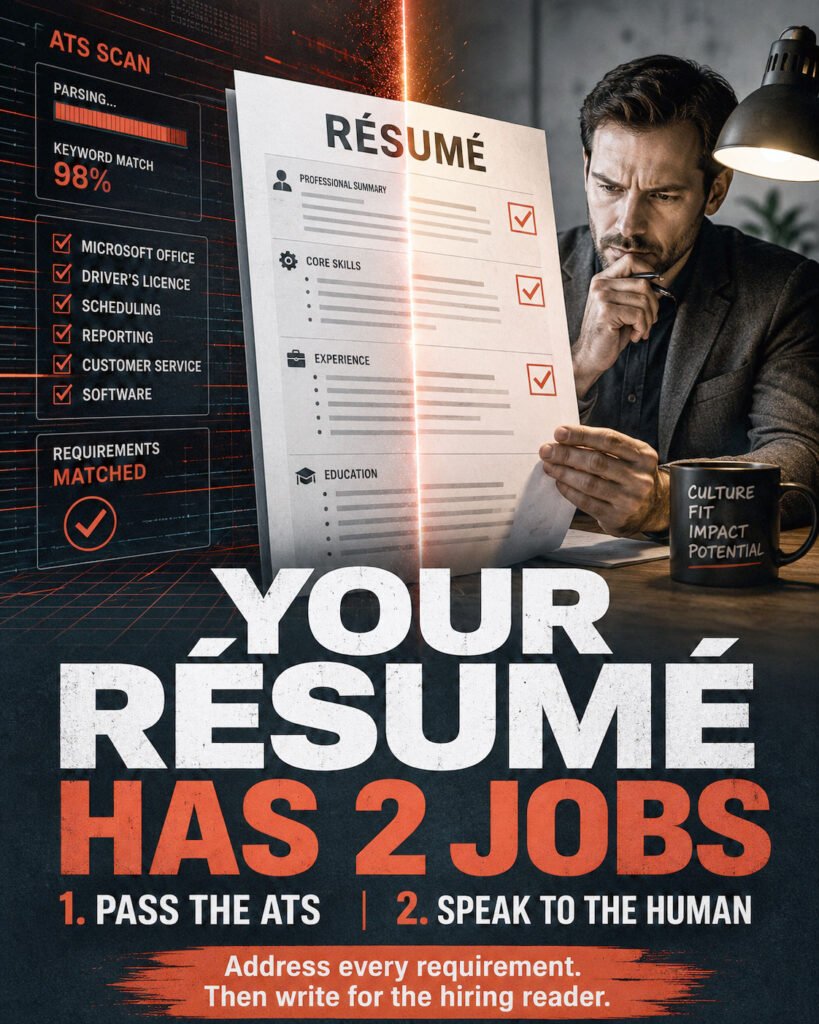
Learning how to tailor your resume to a job posting means identifying every material requirement you genuinely meet, connecting each requirement to clear evidence from your background, and placing that evidence where both application technology and a human reviewer can recognize it. A tailored résumé should use accurate posting language without keyword stuffing, address specific requirements directly, and give the hiring reader a credible reason to continue.
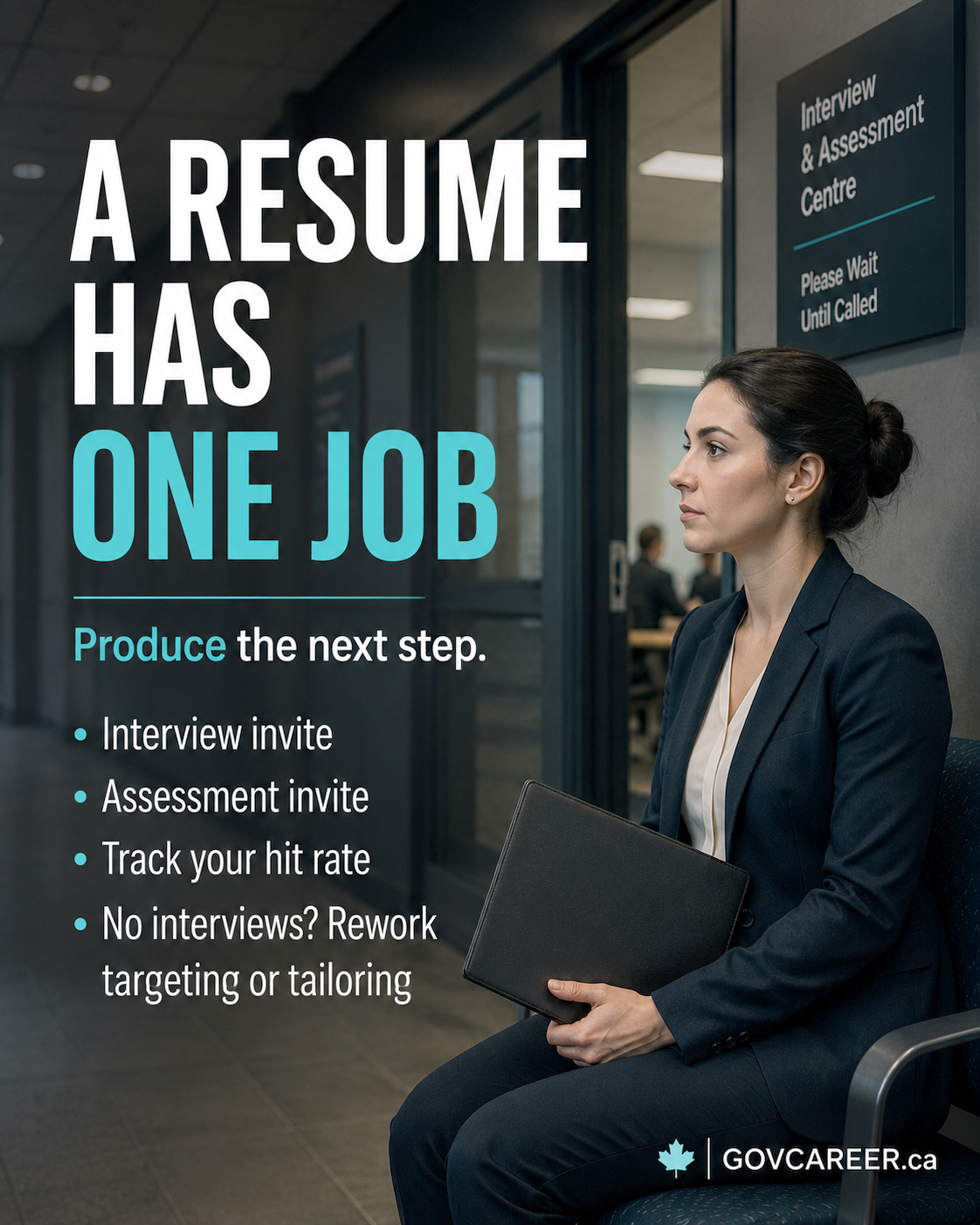
A résumé has two jobs.
First, it must survive the technical and administrative stages that allow an employer to receive, parse, search, organize or screen the application. Second, it must communicate your value to the person who reviews it.
Candidates often prepare for only one of those audiences.
Some concentrate almost entirely on applicant-tracking-system compatibility. They simplify the format, insert keywords and hope the software recognizes a match. Others write polished professional summaries intended to impress a hiring manager but leave important posting requirements implied, scattered or absent.
A stronger application does both.
For candidates pursuing structured public-sector employment, the broader principles of writing a resume for government jobs in Canada are especially important. Government and broader public-sector employers may use different platforms and assessment processes, but the posting normally remains the central source of information about what the employer requires and what the application must demonstrate.
What Does It Mean to Tailor Your Resume to a Job Posting?
Tailoring a résumé means changing its content, emphasis, terminology and sometimes its structure so that it responds directly to one specific job posting. It does not mean inventing experience, copying the advertisement or replacing every sentence with employer keywords.
The objective is to make the match between your actual background and the posted requirements easy to recognize.
A generic résumé asks the reviewer to determine which parts of your career might be relevant. A tailored résumé identifies the relevant connection directly.
For example, a generic résumé may say:
“Provided administrative support and assisted with daily operations.”
A tailored version could say:
“Coordinated calendars, prepared monthly operational reports, maintained electronic records and responded to service enquiries for a five-person management team.”
The second version is not stronger because it is longer. It is stronger because it identifies recognizable functions that may correspond to the posting.
Tailoring may affect:
- the professional summary
- the order of résumé sections
- the skills or qualifications section
- the amount of space given to each position
- the terminology used to describe relevant work
- the selection and wording of accomplishments
- the treatment of licences, certifications and software
- the cover-letter opening
- supporting screening answers or application questions
The employer’s instructions still control. Some applications require a résumé and cover letter. Others use an online profile, questionnaires, screening questions, work samples or several documents. The tailoring method must follow the actual process rather than assume that every employer assesses the résumé in the same way.
Your Resume Has Two Jobs
Your résumé must be technically recognizable and professionally persuasive.
These are related objectives, but they are not identical.
Job 1: Make the Qualifications Recognizable
An applicant-tracking system or résumé parser may extract contact details, employment history, dates, education, skills and other information. Recruiters or hiring teams may also search or filter applications using specific terms.
The exact technology and degree of automation vary by employer. It is inaccurate to assume that every résumé is automatically scored and rejected by a sophisticated robot before a person can see it.
However, technical readability still matters. Complicated tables, text boxes, unusual headings, images and graphic layouts can make information harder to extract in some systems. The application must also contain the terminology needed to make relevant qualifications recognizable.
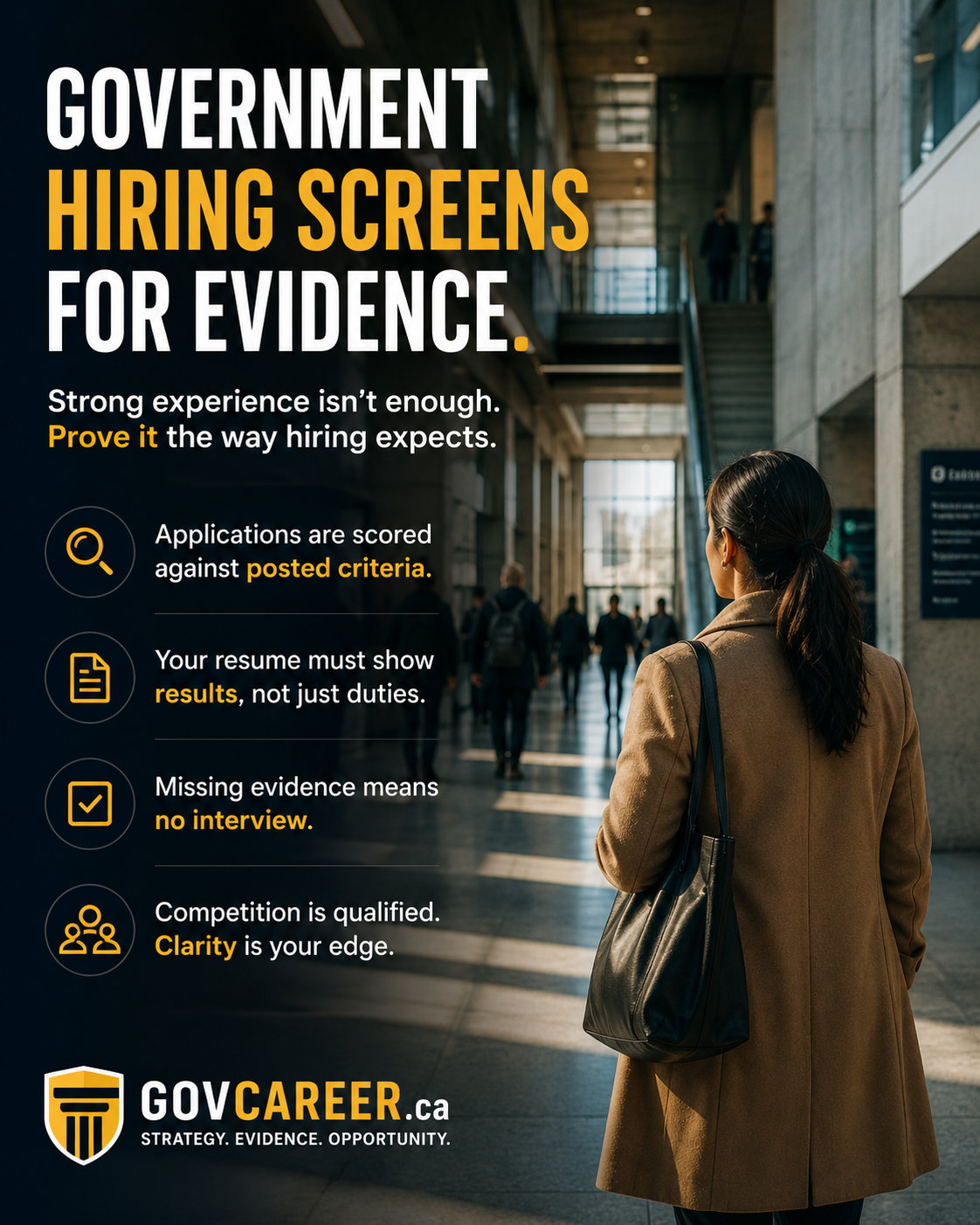
This is why how government resumes are screened cannot be reduced to “beat the ATS.” Passing through a system does not prove that the application demonstrates the required experience.
Job 2: Give the Human Reader a Reason to Continue
The human reviewer needs more than isolated keywords.
A list containing “Microsoft Office,” “reporting,” “stakeholder engagement” and “project coordination” may help with recognition, but it does not prove how you used those capabilities, at what level or with what result.
The reviewer needs context:
- What did you do?
- Where and when did you do it?
- What responsibility did you personally hold?
- Who or what did the work affect?
- What complexity, scale or constraints were involved?
- What result, improvement or operational value did you produce?
The system needs recognizable language.
The person needs credible evidence.
A strong résumé connects the two.
How to Read the Entire Job Posting Before Editing Your Resume
Read the full posting before changing a single résumé sentence.
Do not stop at the job title, introductory description or duties. Important requirements may appear under several headings or inside application instructions.
Review:
- essential or minimum qualifications
- asset or preferred qualifications
- education
- experience
- technical knowledge
- licences and certifications
- language requirements
- work location and travel
- availability or scheduling conditions
- security or background requirements
- application documents
- screening questions
- assessment methods
- submission instructions
- closing date and time
For federal public-service applications, the Government of Canada’s current application guidance tells candidates to apply when they meet all essential qualifications, tailor the résumé for each position and provide details or examples rather than merely claiming experience.
That principle applies more broadly: the full advertisement is not promotional background. It is your application specification.
Separate Requirements From Duties
Duties describe what the successful person may do after being hired.
Requirements describe what the applicant must demonstrate to remain competitive or eligible.
The two categories often overlap, but they should not be treated as identical.
A posting may describe responsibility for preparing reports while separately requiring experience analysing data and communicating findings. Your résumé may need to demonstrate both the function and the underlying capability.
Separate Essential Requirements From Assets
Essential requirements normally require the closest attention. When you do not meet an essential qualification, keyword insertion will not solve the problem.
Asset qualifications are different. An employer may use them to identify stronger candidates, narrow a large pool or address a particular operational need. When you possess an asset qualification, make it visible rather than assuming it will be discovered.
Do not misrepresent partial experience as full compliance. Accurate tailoring strengthens an application; exaggeration weakens its credibility.
Which Job Requirements Must Appear in Your Resume?
Every material requirement you genuinely meet should be addressed somewhere in the complete application when the employer expects the résumé or cover letter to demonstrate it.
That does not mean repeating the advertisement line by line. It means ensuring the application contains enough accurate information for the reviewer to confirm the match.
Candidates commonly overlook requirements that appear ordinary or obvious:
- Microsoft Office or another named software suite
- a valid driver’s licence
- access to transportation
- evening or weekend availability
- travel
- report preparation
- scheduling
- records management
- customer or client service
- stakeholder communication
- database use
- policy or procedure application
- certification or professional registration
- occupational health and safety knowledge
- bilingual or other language capability
If the posting asks for Microsoft Office and you use Word, Excel, Outlook and PowerPoint, state that accurately. Do not assume that an office-based job title proves software proficiency.
If the posting requires a valid driver’s licence and you hold the required class, state it in a concise credentials or additional-information section.
If the position requires occasional evening work and you can meet that condition, follow the application instructions for confirming availability.
The requirement may seem minor to you. It may still matter to the employer.
This is one reason qualified candidates get screened out: the candidate possesses the qualification, but the application does not make it visible enough to assess.
Do Not Add Unsupported Requirements
Tailoring must remain truthful.
Do not insert a skill because it appears in the posting when your experience does not support it. Do not claim “advanced Excel” because you have used basic spreadsheets. Do not present occasional exposure as several years of direct responsibility.
Use accurate levels and context:
- proficient in Microsoft Excel, including pivot tables and lookup functions
- working knowledge of Microsoft Power BI developed through monthly dashboard reporting
- used SAP to enter purchase orders and verify invoice information
- supported project scheduling rather than led project scheduling
- participated in stakeholder meetings rather than managed stakeholder engagement
Precision builds credibility.
How to Build a Requirement-to-Evidence Map
A requirement-to-evidence map is a working document that connects every material posting requirement to proof from your background before you revise the résumé.
It prevents random editing and helps you see where the application is strong, incomplete or unsupported.
Create a table or private worksheet with these columns:
- posting requirement
- requirement type
- evidence from your background
- employer or project where the evidence was gained
- duration or frequency
- result or operational value
- intended résumé section
- cover-letter relevance
- gap or clarification needed
Consider a posting that requires:
- experience coordinating schedules
- proficiency in Microsoft Office
- experience preparing reports
- client-service experience
- a valid driver’s licence
Your map might identify:
- scheduling: coordinated weekly field schedules for 12 technicians
- Microsoft Office: used Outlook, Word, Excel and PowerPoint daily
- reports: prepared monthly service and performance reports for management
- client service: handled approximately 30 public and internal enquiries each week
- driver’s licence: valid Ontario Class G licence
The mapping stage forces an important distinction:
Having relevant experience is not the same as presenting it clearly.
The résumé must show evidence in the location where the reviewer is likely to look. This is also central to understanding why being qualified is not enough to get shortlisted.
How to Tailor Your Resume to a Job Posting Using the Evidence Map
Use the map to decide what must be added, clarified, moved, expanded or removed.
For each requirement:
- Confirm that you genuinely meet it.
- Identify the strongest supporting example.
- Determine whether the evidence belongs in the summary, skills, employment history, education or credentials section.
- Use the employer’s terminology when it accurately describes your experience.
- Add context showing what you personally did.
- Include scale, frequency, complexity or results when useful.
- Check that the evidence is not contradicted elsewhere in the application.
Do not give every requirement equal space.
A mandatory technical qualification may require a clear skills entry and supporting employment evidence. A valid driver’s licence may need only one concise line. A major leadership criterion may require several bullets across relevant positions.
The posting determines importance. Your evidence determines depth.
How to Use Keywords From a Job Description Without Keyword Stuffing
Use exact or closely aligned terminology when it accurately describes your experience, but place it inside meaningful evidence.
Suppose the posting asks for “experience preparing briefing materials.”
Weak keyword insertion:
“Briefing materials, reports, communication, stakeholders.”
Stronger evidence:
“Prepared briefing materials, decision notes and monthly performance reports for senior management using operational and financial data.”
The stronger version includes the phrase naturally and shows the work performed.
Use the Employer’s Professional Language
Different occupational groups describe similar work differently.
One organization may use:
- clients
Another may use:
- residents
- patients
- students
- program participants
- service users
- regulated parties
- stakeholders
- members of the public
Use the language that accurately reflects the target environment and your actual experience.
A private-sector account manager may possess relevant stakeholder-service experience, but simply changing “customers” to “stakeholders” without explaining the underlying work is superficial. The résumé should show the function: resolving complex enquiries, explaining requirements, managing expectations, documenting decisions or coordinating multiple parties.
Do Not Copy Sentences From the Posting
Copying the posting can produce a résumé that sounds artificial and fails to distinguish evidence from aspiration.
Posting:
“Ability to organize competing priorities and meet tight deadlines in a fast-paced environment.”
Weak résumé copy:
“Ability to organize competing priorities and meet tight deadlines in a fast-paced environment.”
Stronger evidence:
“Managed concurrent procurement, scheduling and reporting deadlines for eight active projects, reprioritizing weekly activities to meet contractual and operational requirements.”
The second version demonstrates the qualification rather than repeating it.
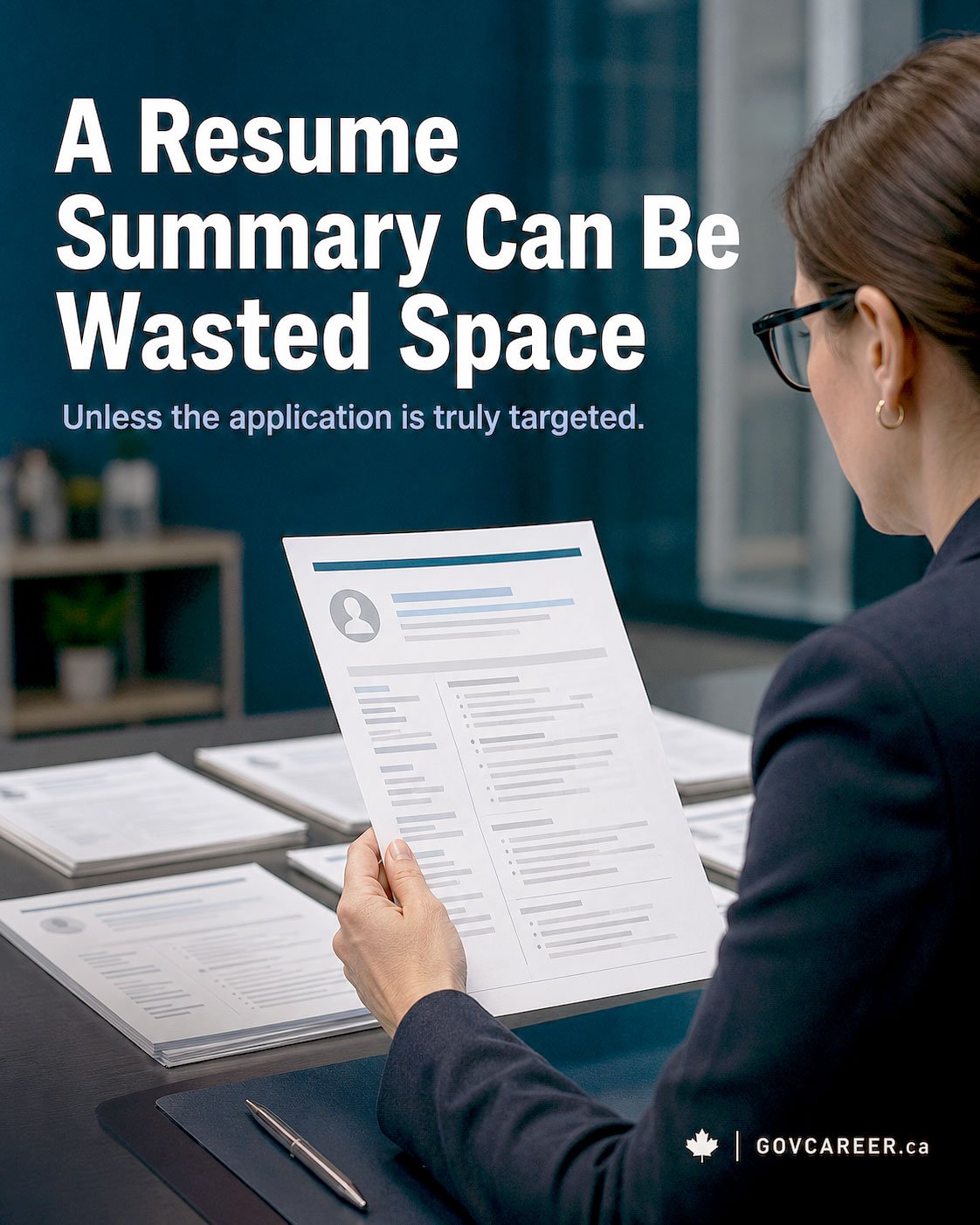
How to Tailor Your Resume Summary
A tailored professional summary should identify the target professional value of your background without becoming a collection of generic claims.
Avoid openings such as:
“Results-driven professional with excellent communication skills and a proven track record of success.”
This wording is broad enough to apply to thousands of candidates.
A stronger summary connects the candidate’s actual background to the role:
“Administrative and operations professional with seven years of experience coordinating schedules, maintaining confidential records, preparing management reports and responding to high-volume client enquiries. Proficient in Microsoft Office and experienced supporting cross-functional teams in regulated service environments.”
This summary works because it introduces relevant evidence that should also be supported in the employment history.
How to Tailor Your Resume to a Job Posting in the Opening Summary
The opening summary should answer three questions quickly:
- What professional function do you perform?
- Which priority requirements do you meet?
- What relevant context or value distinguishes your experience?
Do not try to place every keyword in the summary. Its purpose is to establish the application’s central relevance, not replace evidence in the rest of the résumé.
Use the summary to foreground the strongest two or three qualification themes. Then prove them through specific entries below.
How to Tailor Your Work-Experience Bullets
Work-experience bullets should translate duties into recognizable evidence.
A practical structure is:
Action + object of the work + context or method + result or purpose
For example:
Weak:
“Responsible for reports.”
Stronger:
“Prepared monthly operational reports by consolidating service, staffing and budget data for management review.”
Weak:
“Helped customers.”
Stronger:
“Responded to approximately 40 weekly client enquiries, explained program requirements and documented resolutions in the case-management system.”
Weak:
“Worked on projects.”
Stronger:
“Coordinated schedules, meeting materials and action logs for six concurrent infrastructure projects involving internal teams, consultants and contractors.”
Not every bullet needs a numerical result. Some work is important because of accuracy, compliance, service continuity, risk control or decision support.
The objective is not to manufacture impressive metrics. It is to describe the work at a level that allows the reviewer to understand its relevance.
Give More Space to Relevant Experience
Tailoring does not require rewriting your entire career.
Expand roles and projects that provide direct evidence for the posting. Compress older or unrelated experience while preserving an accurate employment history.
A recent role that demonstrates five priority qualifications may deserve substantial detail. A position from 15 years ago that adds no relevant evidence may need only a concise entry.
Relevance should control space.
How to Address Licences, Software and Specific Requirements
Small requirements should be easy to verify.
A concise section near the end of the résumé may include:
Technical tools: Microsoft Word, Excel, Outlook, PowerPoint, SharePoint and SAP
Licence: Valid Ontario Class G driver’s licence
Certification: Project Management Professional certification, active
Languages: English and French, according to the level you can accurately claim
Do not hide a mandatory licence inside a work-experience bullet. Do not expect the reviewer to infer software knowledge from the type of job you held.
The Canadian Food Inspection Agency’s selection-process guidance states that applicants should address the specific qualifications in the posting and that screeners cannot make assumptions from job titles or previous employers alone.
That is a useful application principle beyond any one employer: make the evidence explicit.
How to Write the Cover-Letter Opening for the Hiring Reader
The opening paragraph of a cover letter should sound like a knowledgeable professional speaking to another professional.
It should identify:
- the position
- the candidate’s relevant background
- the strongest qualification connection
- the practical value the candidate could bring
Avoid generic AI-style openings:
“I am excited to apply for this incredible opportunity. With my diverse background and passion for excellence, I am confident that I would be an ideal candidate.”
This says little about the job or the candidate.
A stronger opening might read:
“I am applying for the Program Coordinator position with seven years of experience coordinating service delivery, preparing operational reports and supporting cross-functional projects. In my current role, I manage concurrent schedules, maintain program records and work with internal and external stakeholders to resolve service issues within established procedures.”
The paragraph immediately tells the reader why the application deserves attention.
Speak the Language of the Professional Group
A finance hiring reader expects financial language.
An engineering hiring reader expects technical and project language.
A communications hiring reader expects evidence of audience, messaging, channels and outcomes.
A human-resources hiring reader expects language connected to staffing, labour relations, policy, employee service or workforce administration, depending on the role.
This does not mean using jargon for appearance. It means describing your work with the vocabulary professionals in that function use to distinguish one level of responsibility from another.
AI-generated wording often fails here because it smooths every profession into the same language:
- leveraged
- spearheaded
- dynamic
- results-oriented
- strategic
- passionate
- innovative
- impactful
Those words are not automatically wrong. They become weak when they replace concrete occupational meaning.
Why ATS Formatting Alone Is Not Enough
An ATS-friendly format can help preserve readability, but formatting cannot compensate for missing evidence.
A simple résumé that omits a mandatory qualification is still weak.
A keyword-rich résumé that does not explain the candidate’s experience is still weak.
A visually polished résumé that makes the reviewer search for the match is still weak.
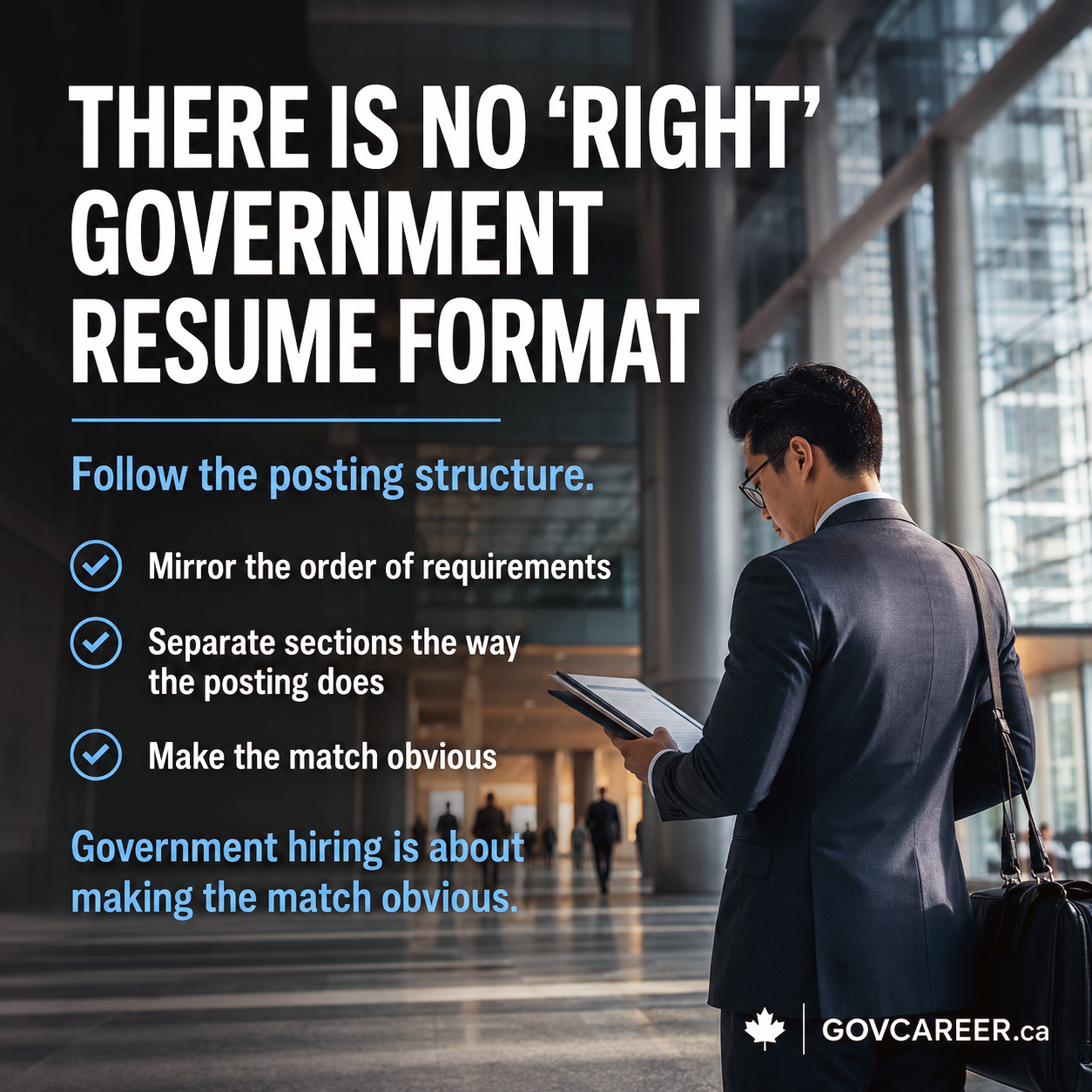
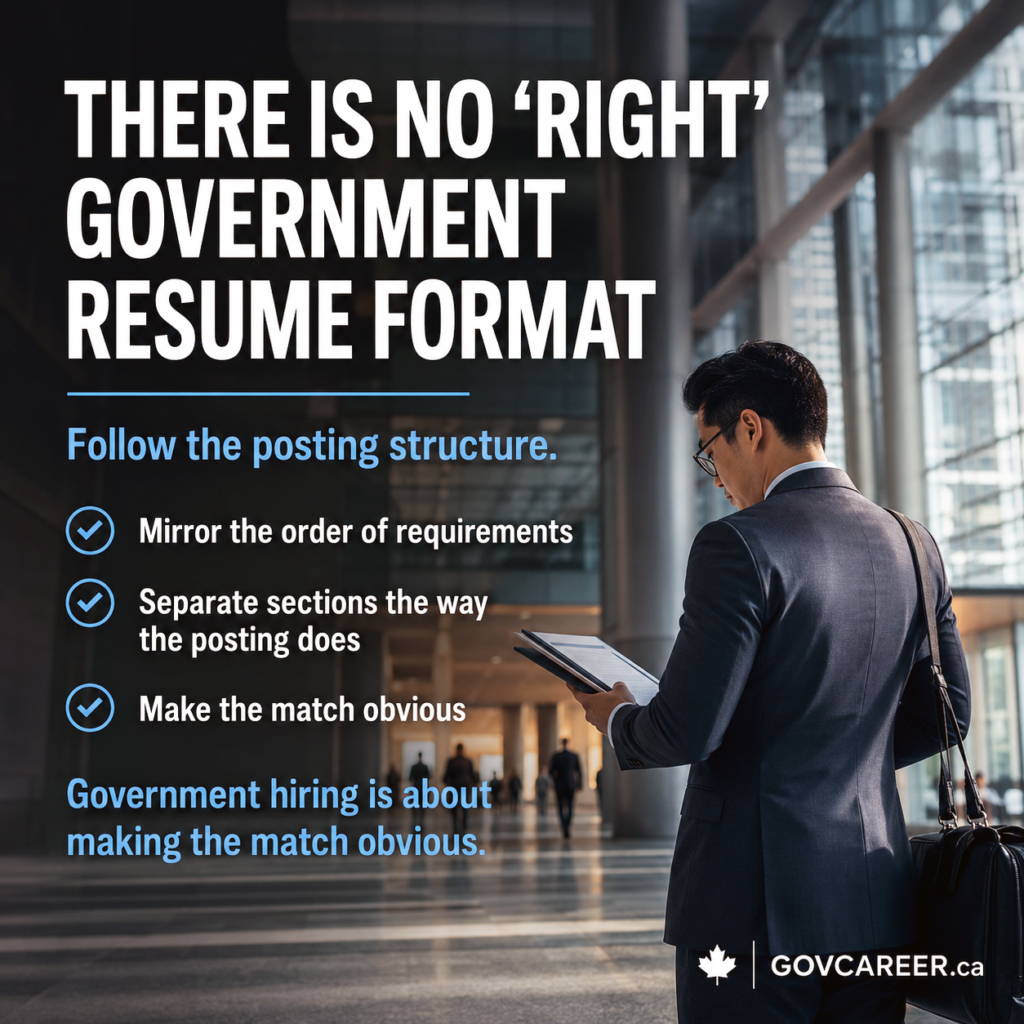
There is also no single design that is correct for every application. The appropriate structure depends on the employer’s instructions, submission system, occupation and screening process. GOVCAREER’s guidance on choosing the right resume format for an application explains why the posting should control the document rather than a universal template.
Use a technically conservative format when the application system requires it:
- clear standard headings
- consistent chronology
- readable fonts
- selectable text
- restrained formatting
- ordinary bullet points
- no critical information inside decorative graphics
- no unnecessary icons, charts or complex text boxes
But remember the larger objective: the document must make your qualifications easy for a person to verify.
Can AI Tailor a Resume Safely?
AI can assist with organization, comparison and editing, but it must not decide what experience you have.
Useful AI-supported tasks may include:
- extracting stated requirements from a posting
- creating a preliminary requirement checklist
- identifying terminology used by the employer
- comparing a résumé draft with the posting
- finding vague or repetitive wording
- improving grammar and sentence structure
- suggesting questions that reveal missing context
- checking whether major requirements are addressed
Human verification remains essential.
AI may:
- invent accomplishments
- exaggerate responsibility
- insert software you never used
- change a supporting role into a leadership role
- create metrics with no source
- misunderstand occupational terminology
- overstate your proficiency
- make every bullet sound generic
- copy the posting too closely
A safe instruction is not “Rewrite my résumé to match this posting.”
A better process is:
- Ask AI to extract and organize the requirements.
- Supply only verified facts from your own background.
- Decide which evidence supports each requirement.
- Use AI to improve clarity without changing meaning.
- compare every revised claim with the original facts.
- Remove wording you could not confidently explain in an interview.
The final résumé must remain your truthful professional record.
Do You Need a Different Resume for Every Application?
You normally need a tailored version for each serious application, but you do not need to rebuild the document from zero every time.
Maintain a comprehensive master résumé containing:
- full employment history
- projects
- responsibilities
- accomplishments
- software
- licences
- certifications
- training
- education
- volunteer experience
- technical and transferable skills
For each application:
- duplicate the master file
- identify the posting requirements
- select the most relevant evidence
- change the summary
- reorganize sections where useful
- expand relevant roles
- compress unrelated material
- adjust terminology accurately
- verify every requirement
- revise the cover letter
- proofread the complete application
This creates efficiency without reverting to one generic résumé.
Final Resume-Tailoring Checklist
Before submitting, confirm:
- I read the complete posting and application instructions.
- I meet the essential requirements I claim to meet.
- Every material supported requirement appears clearly in the application.
- Mandatory licences, certifications and software are stated explicitly.
- My summary reflects the specific role rather than generic professional claims.
- My employment history provides context and evidence, not keywords alone.
- Relevant experience receives more space than unrelated experience.
- The terminology matches the posting where it accurately describes my background.
- I did not copy the employer’s sentences as substitutes for evidence.
- I did not add skills, accomplishments or metrics I cannot verify.
- The résumé remains readable by both technology and people.
- The cover-letter opening speaks directly to the role and professional audience.
- Dates, titles and claims are consistent across all documents.
- I followed the employer’s required format and submission instructions.
- I reviewed the final application after copying or uploading it into the portal.
Frequently Asked Questions
Should You Include Every Requirement From the Job Posting?
You should address every material requirement you genuinely meet when the application documents are expected to demonstrate it. Essential qualifications deserve priority, while assets should be included when supported. Do not insert requirements you do not meet or repeat the posting without evidence.
Should Resume Wording Match the Job Description Exactly?
Use exact terminology when it accurately describes your experience, especially for named software, credentials, technical functions and clearly defined qualifications. However, the surrounding wording should explain what you actually did. Exact keywords cannot replace evidence.
Can an ATS Automatically Reject a Resume?
Some systems may use filters, required questions or employer-configured criteria, but processes vary considerably. Do not assume that every employer uses automated résumé scoring in the same way. Technical readability and accurate keywords matter, but human screening and employer-specific requirements remain critical.
How Much of a Resume Should Change for Each Job?
Change the sections that affect relevance: the summary, skills, selected accomplishments, emphasis, section order and level of detail. Stable facts such as employers, titles, dates, credentials and verified achievements should remain accurate. Tailoring changes presentation, not history.
What Should You Do When You Do Not Meet One Requirement?
First determine whether the requirement is essential or preferred. A missing essential qualification may make the application ineligible, while a missing asset may not prevent you from applying. Follow the employer’s wording and do not imply that you possess a qualification you lack.
Can You Use AI to Tailor a Resume?
Yes, but use it to organize requirements, identify vague language and improve clarity—not to invent or inflate your experience. Verify every sentence against your actual work and remove any claim you could not defend during screening, reference checks or an interview.
Make the Match Easy to Verify
The strongest tailored résumé is not the one with the most keywords or the most polished language. It is the one that makes the relevant match easy to recognize and credible to verify.
Start with the posting. Identify every material requirement. Connect each one to truthful evidence. Place that evidence where it can be found. Then write the summary and cover-letter opening in language that makes sense to the professional reading the application.
The system must recognize the application.
The person must believe the evidence.
Your résumé needs to do both.