Resume Summary for Government Jobs: When It Helps and When It Hurts
A resume summary for government jobs can be useful when it quickly connects your relevant background to one specific position. It becomes wasted space when it contains generic claims, repeats information already obvious from the résumé, or is reused across unrelated applications. The summary is optional. Its value depends on whether it helps the reader understand your fit for the actual competition.
Many candidates have been taught that every résumé should begin with a professional summary or Summary of Qualifications.
That advice is too absolute.
For a broader explanation of how qualification evidence should be presented, start with this guide to writing a resume for government jobs in Canada.
A résumé summary does not become valuable merely because it appears above your employment history.
It has to earn that space.
Do You Need a Resume Summary for Government Jobs?
No universal rule requires every government or public-sector résumé to begin with a summary.
Application requirements vary substantially among employers and hiring systems. Some competitions use an uploaded résumé. Some require information to be pasted into an online profile. Others combine résumés with screening questions, cover letters, application forms or other assessment material.
The Government of Canada currently advises applicants to keep their résumé up to date and tailor it for each position. Its GC Jobs guidance also emphasizes providing concrete details and examples when answering qualification-related screening questions.
The Ontario Public Service similarly advises candidates to customhttps://www.ontario.ca/page/careers-hiring-process?utm_source=chatgpt.comize their résumé and cover letter to the qualifications in the specific job advertisement.
Those are stronger principles than “always include a summary.”
The question should therefore be:
Will an opening summary make my relevant fit easier to understand in this particular application?
If not, the space may be better used for evidence elsewhere.
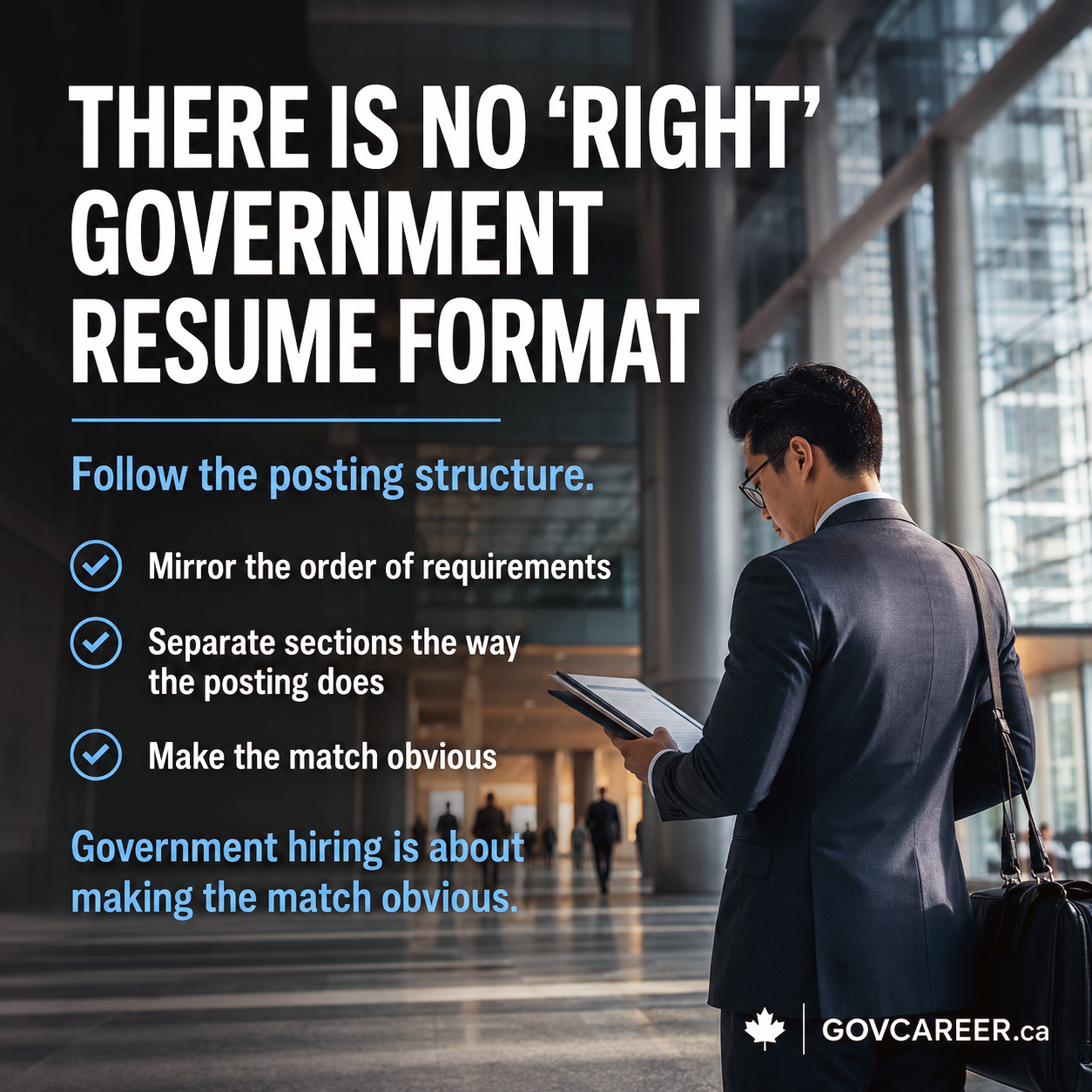
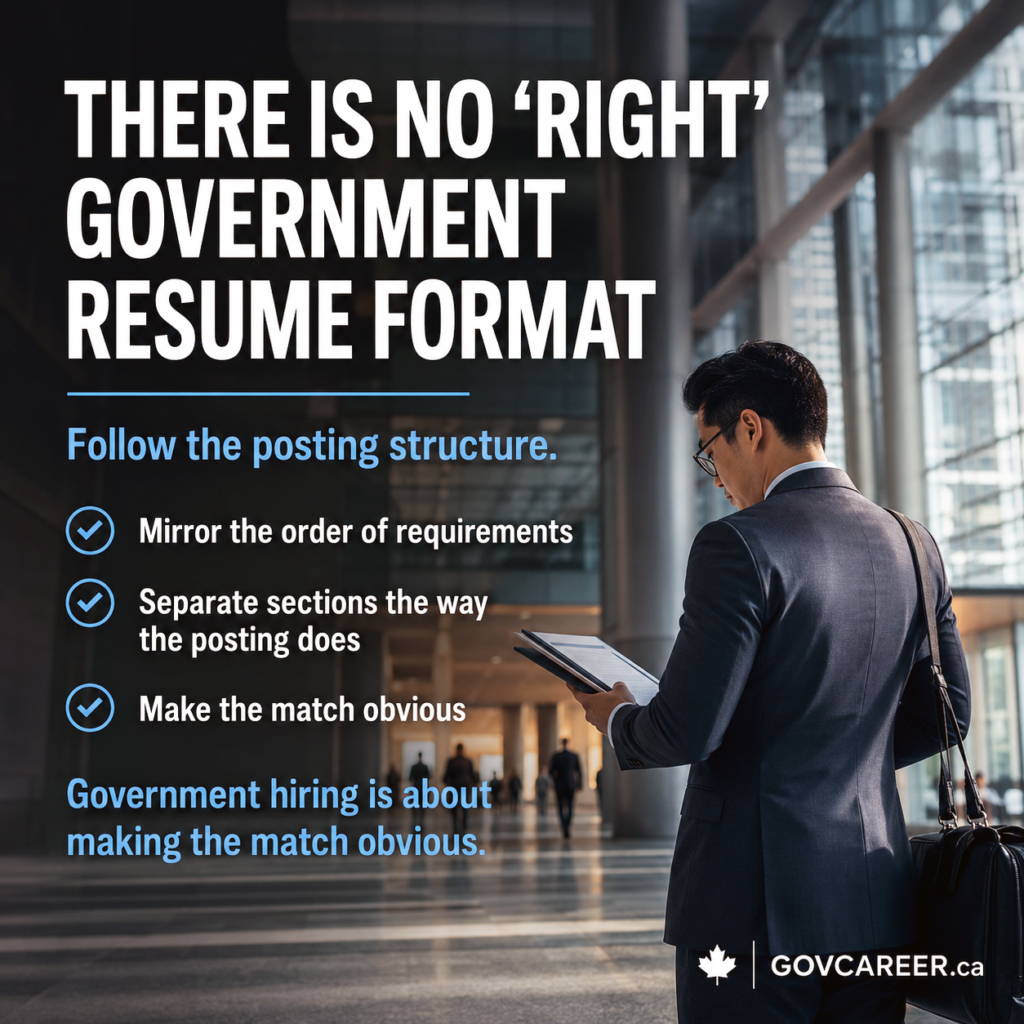
This is consistent with a broader GOVCAREER principle: there is no single correct government resume format. The structure should serve the competition rather than obey a generic résumé template.
When a Resume Summary Becomes Generic Filler
A weak résumé summary often sounds impressive while communicating very little.
For example:
“Results-driven professional with excellent communication, leadership and problem-solving skills and a proven record of success.”
The problem is not grammar.
The problem is information.
Thousands of candidates could make essentially the same statement.
The reader still does not know:
- what type of work you actually perform
- which qualifications you bring to this position
- what operating environment you understand
- what distinguishes your experience
- why the information matters to this competition
The summary occupies some of the most valuable space on the first page without helping the reader assess anything important.
That is filler.
Mass Applying Makes the Problem Worse
A generic summary becomes particularly weak when the same résumé is sent to many unrelated positions.
Imagine applying with one document to:
- program analyst positions
- project coordinator positions
- administrative positions
- policy positions
- procurement positions
- operational roles
A summary broad enough to cover all six directions will usually become vague.
You end up with language such as:
“Experienced professional with strong analytical, communication, organizational and stakeholder-management abilities.”
It may all be true.
It still tells the reader very little about why your background matters to their position.
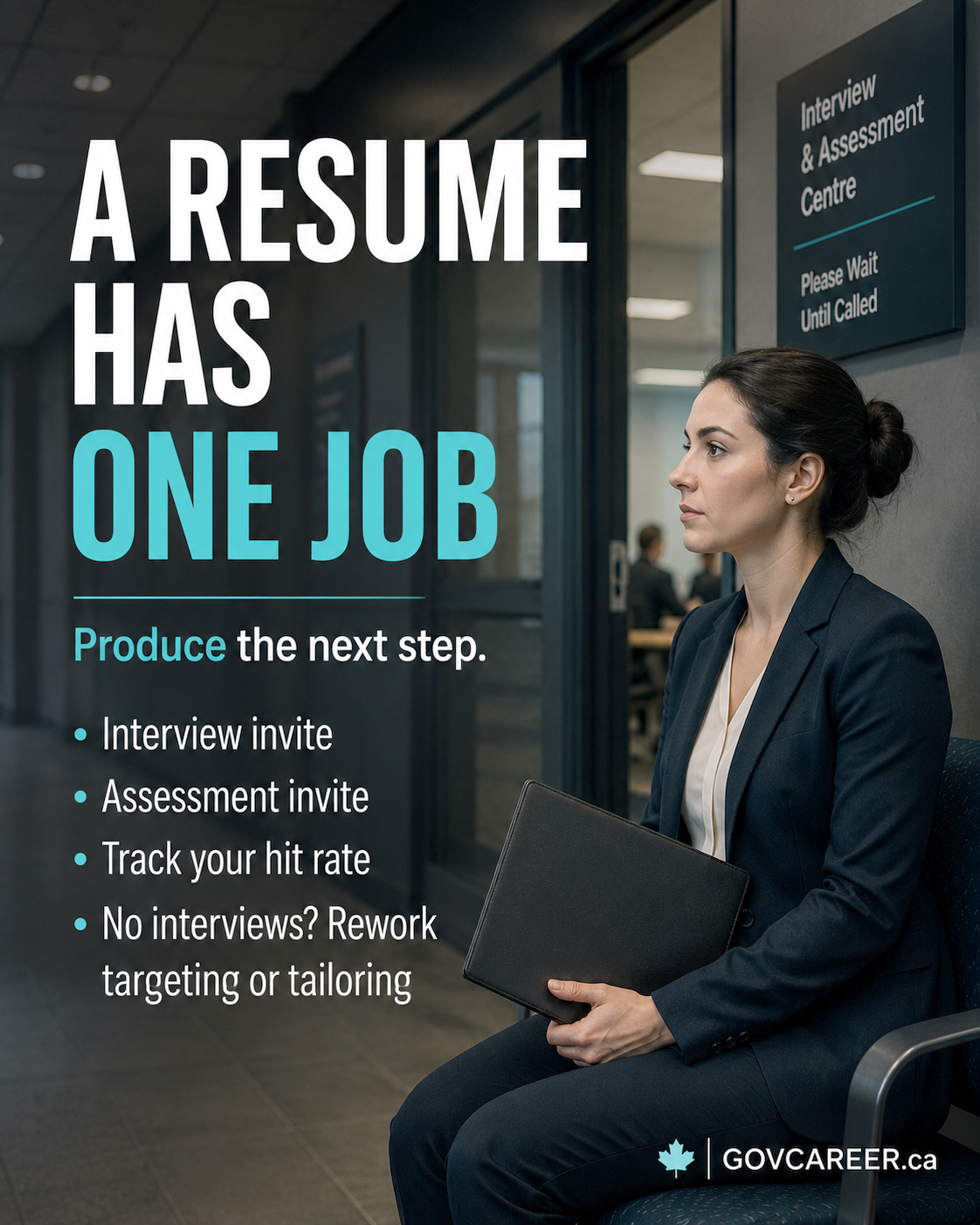
This is one reason GOVCAREER recommends that candidates tailor their resume to a specific job posting rather than treating tailoring as a final cosmetic edit.
Targeting changes what deserves emphasis.
When a Resume Summary Can Be Useful
The situation changes when the application is genuinely specific.
You know:
- the organization
- the position
- the qualifications
- the primary functions of the role
- the experience from your background that matters most
- why this opportunity makes sense for you
Now the opening can perform a real function.
A targeted summary can orient the reader before they enter a longer employment history.
It can establish:
- your principal professional function
- the type and level of relevant experience you bring
- the operating environments in which you gained it
- one or two important technical or professional strengths
- qualifications that are central to the posting
- a concise indication of the contribution your background prepares you to make
The summary is no longer generic branding.
It becomes an introduction to the evidence that follows.
Think of the Summary as a Lens, Not the Evidence
This distinction is critical.
Your summary should help the reader understand the relevance of the résumé.
It should not be expected to prove your entire qualification case.
Suppose a position requires experience with:
- program administration
- stakeholder coordination
- performance reporting
- policy interpretation
A summary might identify that these are central parts of your background.
But the employment section still needs to show where, when and how you performed that work.
A claim such as “experienced in stakeholder management” is not equivalent to evidence showing that you coordinated consultations with municipalities, contractors, community organizations or internal departments as part of a defined responsibility.
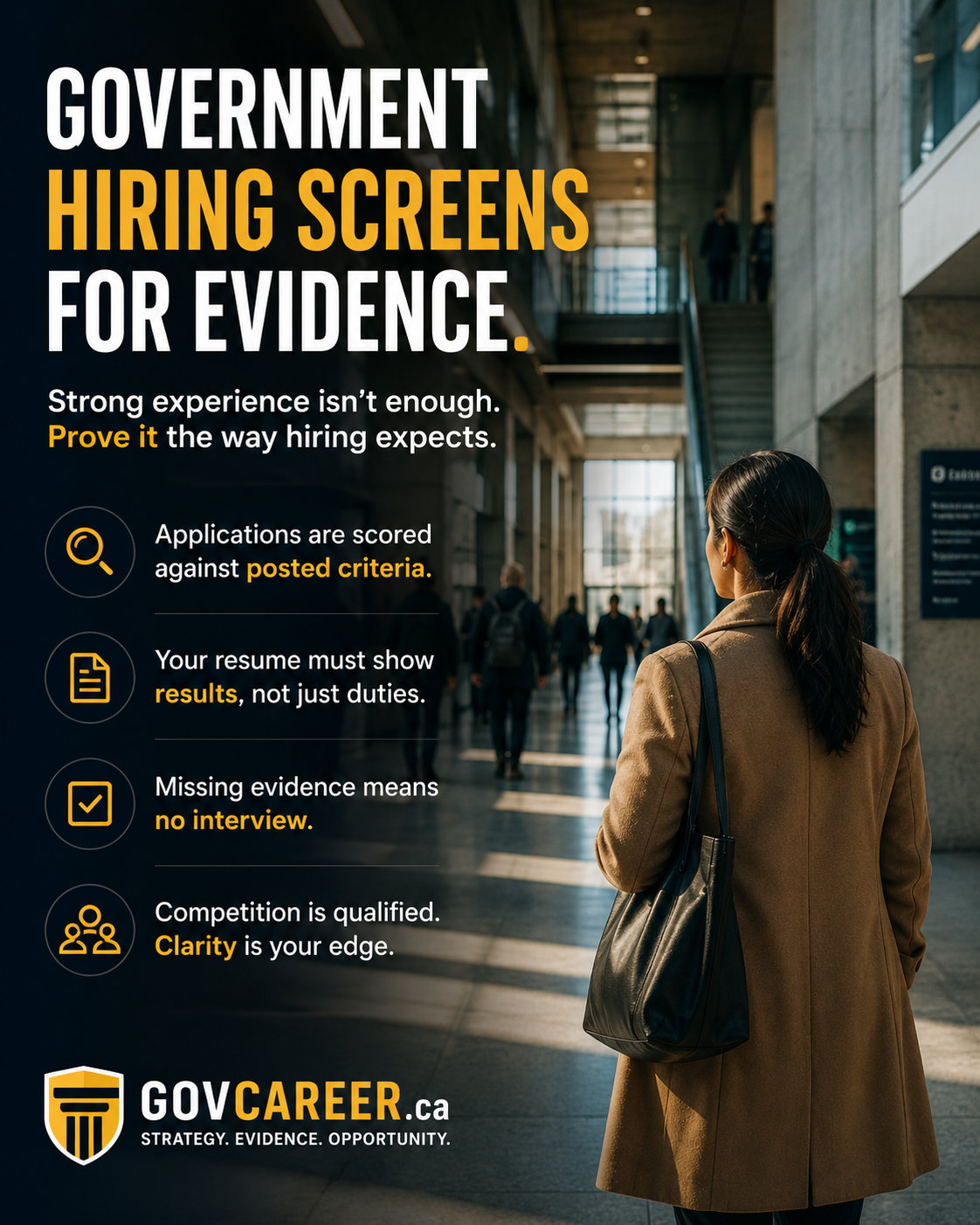
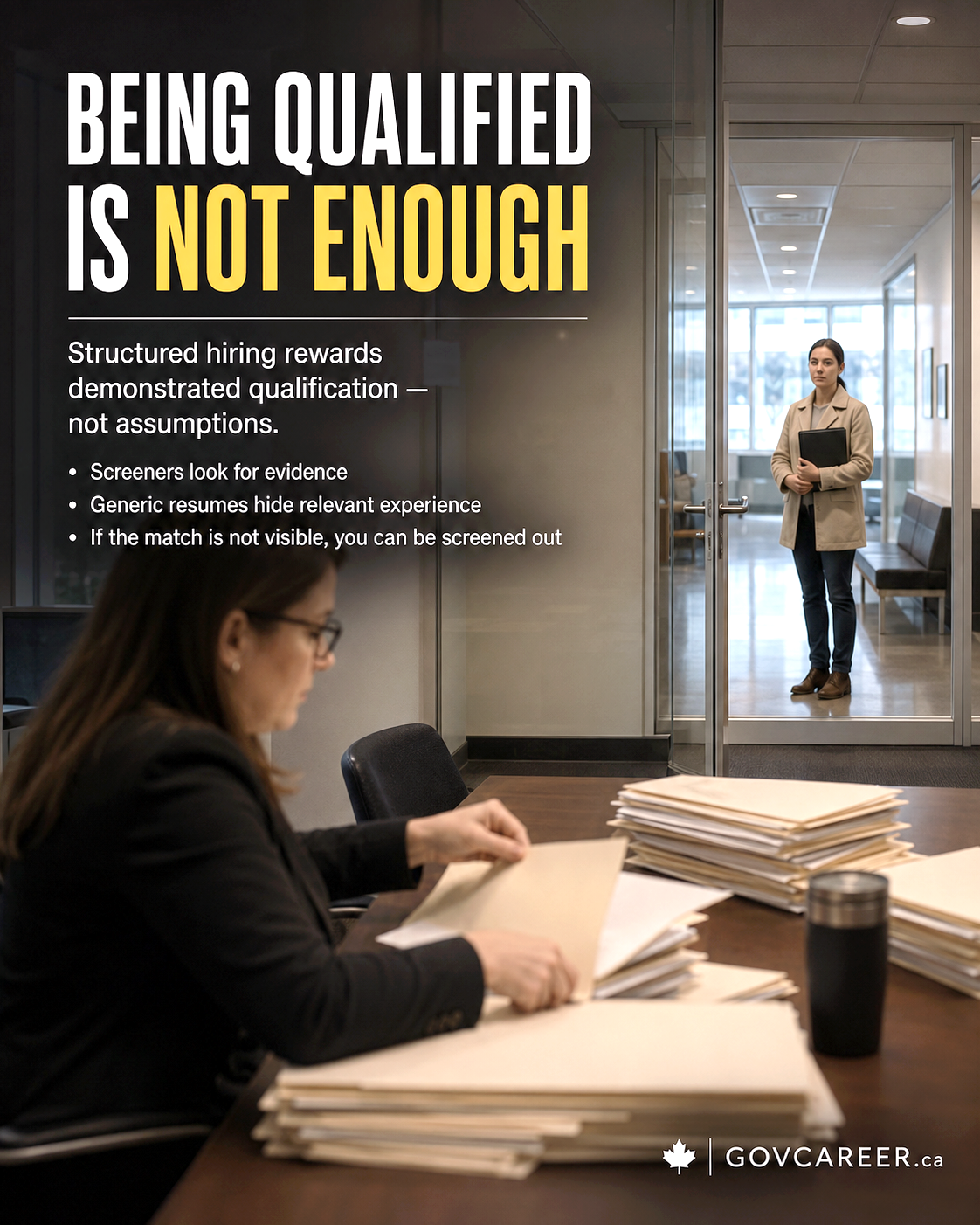
This is why candidates who appear qualified can still have difficulty when the supporting evidence is not clear. See why qualified candidates can still be screened out.
The summary directs attention.
The rest of the application has to substantiate it.
What Should a Targeted Government Resume Summary Include?
A useful summary normally needs only a few carefully selected ideas.
Start with the position itself.
Ask:
What professional function am I bringing to this role?
Do not begin with personality adjectives.
Begin with occupational substance.
For example:
“Program and operations professional with eight years of experience supporting regulated service delivery…”
That immediately gives the reader professional context.
Which qualifications matter most in this competition?
Do not try to reproduce the entire job advertisement.
Identify the two or three themes that matter most and that you can genuinely support.
For example:
“…including program administration, operational reporting and coordination with internal and external stakeholders.”
Those claims should then be demonstrated in the employment history.
What context makes the experience relevant?
Context can make otherwise generic experience understandable.
Relevant context might include:
- municipal operations
- healthcare administration
- regulated financial services
- infrastructure delivery
- post-secondary education
- client-service environments
- policy or program operations
- technical project environments
Use only context that is accurate and useful.
What makes the application particularly relevant?
This does not mean manufacturing a dramatic personal statement.
It means identifying the strongest legitimate connection between your background and the role.
A candidate moving from private-sector infrastructure consulting into a municipal capital-project position, for example, may foreground project coordination, procurement exposure, consultant management and regulatory work.
A candidate moving from banking operations into a public-sector program-administration role may emphasize regulated processes, documentation, client service, quality control and operational reporting.
The summary gives the reader the map.
The experience section supplies the terrain.
A Weak and Stronger Resume Summary Example
Weak:
“Results-driven professional with excellent leadership, communication and problem-solving skills. Proven ability to work independently and collaboratively in fast-paced environments. Seeking a challenging position where I can contribute my expertise.”
Almost none of that language is specific enough to differentiate the candidate.
A stronger targeted version might read:
“Program and operations professional with seven years of experience coordinating service delivery, preparing management reports, maintaining regulated records and resolving complex client enquiries. Experienced working across operational teams and external stakeholders, with strong knowledge of Microsoft Office and process documentation.”
The second version is not stronger because it sounds more sophisticated.
It is stronger because it contains recognizable professional information.
The employment history still needs to prove those statements.
Should You Explain Why You Want the Job?
Sometimes.
This requires judgment.
A résumé is primarily an evidence document, so a long statement about motivation usually does not belong at the top.
But in a highly targeted application, one restrained sentence can sometimes help explain the professional connection between the candidate and the opportunity.
For example, a candidate with substantial regulatory experience moving toward a government compliance role may have a clear and logical reason for the transition.
The useful question is not:
“How passionate can I sound?”
It is:
“Does this information help the reader understand why my background makes sense for this particular role?”
Keep the answer professional, specific and brief.
Do not use the résumé summary as a motivational letter.
Do Not Rely on the Summary to Rescue Weak Qualification Evidence
A polished opening cannot compensate for missing essential qualifications.
It also cannot repair a résumé that leaves important experience buried, vague or unsupported.
If the posting requires five years of a particular type of experience and the résumé does not demonstrate that experience clearly, writing “five years of relevant experience” in the summary does not solve the underlying problem.
The evidence needs to appear where the assessor can understand:
- what you did
- where you did it
- when you did it
- your personal responsibility
- the scope or complexity involved
- the connection to the requirement
Government of Canada application guidance explicitly tells applicants not merely to state that they have required experience when answering screening questions, but to provide details and examples.
The same evidence discipline is useful when writing the résumé.
The objective is to make relevant qualifications easy to recognize, not simply to announce that you possess them.
What About the Cover Letter?
Treat the cover letter and résumé as separate application components whose importance depends on the actual employer and competition.
Do not assume that the cover letter will be ignored.
Do not assume that it will carry evidence that is missing from the résumé.
And do not assume that every employer evaluates the two documents in the same way.
For example, current Ontario Public Service guidance tells applicants to customize both their cover letter and résumé to the qualifications in the job advertisement and states that the two documents combined should normally remain within its specified page limit.
Federal processes can work differently. GC Jobs may require detailed screening-question responses in addition to résumé information.
The practical rule is straightforward:
Follow the actual application instructions and make important qualification evidence visible in every component where the employer requires it.
A résumé summary should complement that process, not substitute for it.
When I Would Leave the Summary Off
I would seriously consider removing the opening summary when:
- it contains only generic personality claims
- it repeats the first employment entry
- the résumé is being circulated broadly without a defined target
- the candidate cannot identify two or three qualifications worth foregrounding
- the employer’s required format leaves little room for optional content
- another required section deserves the space more
- the summary has become a keyword container rather than readable professional information
Removing a weak summary does not make the résumé incomplete.
Sometimes the strongest opening is simply a clear employment-history section that immediately presents relevant evidence.
When I Would Keep It
I would normally consider keeping a summary when:
- the application is for one clearly defined position
- the candidate has deliberately analyzed the posting
- several parts of the candidate’s career need to be synthesized
- transferable experience needs brief context
- the candidate has a long career and the reader benefits from orientation
- the strongest qualifications can be stated concisely and then proved below
- the summary makes the candidate’s professional direction clearer
This can be particularly useful for career changers, internationally experienced professionals, senior candidates and people whose most relevant evidence is spread across several positions.
The summary can connect those pieces without requiring the reader to reconstruct the career story alone.
How Long Should a Resume Summary Be?
Short enough that every sentence earns its place.
There is no universal Canadian government rule establishing one required length.
Ontario résumé guidance has used a short Summary of Qualifications section as one possible structure, while other government systems use different résumé formats entirely.
For most targeted applications, a concise paragraph or a few tightly written lines will usually provide enough orientation.
Do not turn the top third of the résumé into an autobiography.
The strongest material should remain the evidence supporting the qualifications.
Frequently Asked Questions
Is a resume summary required for government jobs?
No universal rule requires a résumé summary for every government job application. Follow the specific employer’s instructions and use a summary only when it helps make your relevant background easier to understand.
Is a Summary of Qualifications the same as a professional summary?
The terms are often used for similar opening sections, although formats vary. What matters more than the label is whether the content identifies relevant, supportable qualifications for the specific position.
Should I use keywords in my resume summary?
Use terminology from the job posting when it accurately describes your experience. Do not turn the summary into a keyword list. Important qualifications should also be supported by evidence elsewhere in the résumé or application.
Can a resume summary replace a cover letter?
No. They perform different functions, and employer requirements vary. If the competition requires a cover letter, screening questions or another application component, complete it according to the instructions.
Should career changers use a resume summary?
Often, yes. A targeted summary can help connect transferable experience from another sector or occupation to the new role. The connection must remain accurate and should be supported by detailed evidence later in the résumé.
Conclusion
A resume summary for government jobs is not automatically good résumé practice.
It is useful when it helps a specific employer understand the strongest connection between your background and a specific opportunity.
It is weak when it becomes generic branding placed above an equally generic résumé.
Before keeping the section, ask one question:
Does this opening make my relevant fit for this particular competition clearer?
If it does, make every line specific and support every important claim with evidence below.
If it does not, the space has not earned its place.
That is the standard I would use for a targeted government or public-sector application.