Resume for Government & Public-Secto in Canada: How to Write It
A resume for government jobs in Canada must make your qualifications easy to assess. It should connect your experience directly to the posting, show where and when you gained the relevant evidence, clarify your personal contribution, and follow the employer’s instructions for format, length and submission.

Introduction
Writing a resume for government jobs in Canada is not simply a matter of extending a standard corporate resume. The document must give the employer enough accurate and relevant information to determine whether you meet the qualifications stated in a specific competition.
When it comes to Government Job Search in Canada, there is no single resume format. Federal departments, provincial and territorial governments, municipalities, Crown corporations, agencies, hospitals, school boards, colleges, universities and other public-sector employers may use different application systems and document requirements including conducting interview scoring.
One employer may request a conventional resume. Another may require plain-text content, detailed online employment history, screening questions, a cover letter or a combined application with a strict page limit.
The consistent principle is evidence.
A strong resume for a government job should not require the assessor to infer qualifications from your title, seniority or reputation. It should show the relevant experience clearly enough to connect your background to the posting.
This guide explains how to analyze the advertisement, map qualifications to evidence, choose an appropriate structure, write experience that can be screened, tailor the resume accurately, determine a defensible length and avoid common application mistakes.
Disclaimer
This guide is provided for informational and educational purposes only.
GOVCAREER.ca is an independent, fee-based career-advisory business. It is not affiliated with or acting on behalf of any government or public-sector employer and does not influence hiring decisions or guarantee interviews, offers, pool placement, promotion or other outcomes.
Hiring systems, requirements, deadlines and procedures vary by employer, jurisdiction and competition and may change. Always verify current information through the employer’s official website and job posting.
This guide is not legal, employment, human-resources or government-policy advice.
Why This Government Resume Guide Is Different
I am Val, founder of GOVCAREER.ca and an independent public-sector career advisor.
My work is not based on inserting keywords into a generic resume or making private-sector experience sound more impressive than it is.
It is based on two disciplines:
- experience synthesis;
- Clear Application Language
Experience Synthesis
I help candidates examine their full career history, identify evidence they may have overlooked, and connect that evidence honestly to the qualifications in a government or public-sector job posting.
Relevant evidence may be scattered across different jobs, projects, committees, volunteer roles or responsibilities that were never described properly in an earlier resume.
My role is to identify:
- the underlying function;
- the candidate’s personal contribution;
- the scope and complexity of the work;
- the result or practical effect;
- the defensible connection to the posted qualification.
This process does not invent a match. It makes genuine qualification evidence visible.
Screening-Language Translation
The second part of my work is presenting that evidence in clear language that connects accurately to the requirements of the actual posting.
Government and public-sector applications may be reviewed by:
- supervisors;
- hiring managers;
- operational managers;
- subject-matter experts;
- human-resources staff;
- screening-panel members.
These readers are not looking for inflated corporate branding or polished language that obscures the work.
They need to understand:
- what you did;
- where and when you did it;
- what your responsibility was;
- which process, system, policy or method you used;
- what level of work was involved;
- how the experience relates to the position.
This is why I write resume summaries, experience paragraphs, qualification statements and cover letters in direct occupational language connected to the actual role and screening requirements.
A hiring manager responsible for operations, policy, finance, procurement, administration, engineering or service delivery should be able to recognize the work being described without translating vague corporate language.
For example, phrases such as:
- “leveraged cross-functional synergies”;
- “drove transformational outcomes”;
- “optimized stakeholder-centric solutions”;
- “executed high-impact strategic initiatives”
may sound polished but provide little assessable information.
A public-sector reader is more likely to understand language such as:
- coordinated work across operational departments;
- reviewed submissions against established requirements;
- prepared reports and recommendations for management;
- interpreted policies and procedures;
- documented decisions, risks and follow-up actions;
- resolved service issues with clients and internal teams;
- monitored project schedules, deliverables and outstanding issues.
The objective is not to make the candidate sound more sophisticated.
The objective is to make the candidate’s experience recognizable, credible and assessable to the people responsible for screening and selection.
Accuracy Remains the Standard
The final application must remain truthful and defensible.
I do not invent:
- experience;
- qualifications;
- authority;
- metrics;
- technical knowledge;
- responsibilities;
- results.
GOVCAREER.ca is an independent advisory business. I am not a recruiter, employer representative or hiring authority, and I do not have special access to government jobs or hiring decisions.
This guide reflects the same principle used in my advisory work:
A strong government resume identifies genuine evidence and presents it in language the screening team can understand.
What Is a Government Resume?
A government resume is prepared for a government or broader public-sector competition. Its purpose is to present your career history in a form that helps the employer assess whether you meet the qualifications stated in the posting.
It must be readable and professional, but its effectiveness depends primarily on:
* relevance;
* accuracy;
* clear dates and context;
* visible qualification evidence;
* compliance with the employer’s instructions.
Federal, provincial, territorial, municipal and broader public-sector employers do not use one recruitment system or one universal resume format. The correct approach is to follow the specific competition while applying the same core principle: make the relevant evidence easy to identify and assess.

What a Government Resume Must Accomplish
An effective government job resume should make relevant qualification evidence easy to identify, understand and assess.
The reader should be able to determine:
- what relevant work you performed;
- where and when you performed it;
- what your personal responsibility was;
- how frequently or for how long you performed the work;
- what level of scope, complexity, risk or authority was involved;
- which tools, systems, methods, policies or standards you used;
- what result, output or practical effect followed;
- how the experience relates to the qualification being assessed.
Not every resume bullet needs to answer every question. The document as a whole should provide enough accurate and traceable information for the assessor to understand the evidence without reconstructing your career or making unsupported assumptions.
How a Resume for Government Jobs in Differs from a Private-Sector Resume
Resume requirements vary across both public- and private-sector employers. The important difference is not the sector label itself, but how the specific employer uses the resume in its hiring process.
Where a government or public-sector application is assessed against defined qualifications, the resume may need more explicit evidence of dates, responsibilities, context, scope and relevant experience than a shorter general-purpose resume provides.
A polished resume can still be ineffective if it does not provide the information required for that specific competition. Follow the posting and application instructions rather than assuming that one resume style works across employers.
There Is No Single Canadian Government Resume Format
There is no universal template that applies to every government resume in Canada. The Government of Canada’s GC Jobs application guidance advises applicants to prepare simple, unformatted resume text because much of the formatting is removed when content is pasted into the system. The BC Public Service job-application guidance describes a different applicant-profile and resume process.
Other employers may accept Word or PDF documents, impose combined cover-letter and resume limits, or require detailed application fields in addition to an uploaded document. The correct format is the one that makes your evidence clear while complying with the specific system and instructions.
Is a Government Resume the Same as a CV?
Usually not.
For most government and public-sector competitions in Canada, a resume is a targeted employment document that presents the experience, education and qualifications relevant to a specific posting.
A curriculum vitae, or CV, is generally more detailed and may include:
- academic appointments;
- research;
- publications;
- presentations;
- teaching;
- grants;
- professional service;
- clinical or scientific work.
Some employers use the terms differently, and certain academic, research, medical, scientific or executive positions may specifically request a CV.
Follow the employer’s wording and instructions. Do not submit a full academic CV when the posting asks for a resume unless the employer indicates that either format is acceptable.
The correct document is the one requested by the competition and structured around the qualifications being assessed.
How to Read a Government Job Posting Before Writing Your Resume
The job posting and official application instructions are the controlling sources for deciding what your resume and application should contain. Before editing your document, identify the qualifications, instructions and required application components for that specific competition.
A useful first pass separates the posting into five categories: who may apply, what must be demonstrated at screening, what may be assessed later, what could improve competitiveness and what conditions must be satisfied before appointment.
Understand the Position Purpose and Duties
Start with the position purpose and duties. Identify why the role exists, what function it supports, the problems it addresses and the outputs expected from the successful candidate. Look for recurring themes such as policy development, program delivery, financial control, procurement, regulatory work, public service delivery, project management, technical operations or stakeholder engagement.
Duties help you understand the work, but they do not always define the screening standard. A posting may describe ten responsibilities while screening only selected experience and education criteria. Use the duties to understand context; use the qualifications to determine the evidence obligations.
Identify Every Essential Qualification
Essential or mandatory qualifications normally determine whether you can remain in the process. The terminology varies, but the logic is consistent: if the employer requires a particular type of education, experience, licence or eligibility and your application does not demonstrate it, other strengths may not compensate.
Extract each essential qualification into a separate line. If a requirement includes several components, separate them. For example, “experience developing policy advice and presenting recommendations to senior management” may require evidence of both developing advice and presenting recommendations, at the stated organizational level.
Do not assume that one impressive project proves every requirement. Each criterion needs visible support somewhere in the application, in the form requested by the employer.
Identify Relevant Asset Qualifications
Asset, preferred or additional qualifications may help the employer manage a large applicant pool, fill a particular vacancy or select among qualified candidates. They should not displace essential criteria, but they should not be ignored.
When you possess an asset qualification, include accurate evidence in the resume or other required application component. When you do not possess it, do not stretch adjacent experience until it becomes a false claim. A clear application that fully proves the essentials is stronger than one that undermines credibility by overstating assets.
Separate Multi-Part Qualification Requirements
Government postings frequently compress several evidence obligations into one sentence. Break the sentence apart before writing.
A criterion might specify experience:
- performing a defined function;
- in a particular environment;
- for a minimum duration;
- at a stated level of complexity;
- with specific stakeholders;
- using a particular system, policy or method.
Your resume may need several lines or more than one position to demonstrate the complete requirement. If the evidence comes from two roles, make the combined duration and relevance easy to follow.
Review Application Instructions and Required Documents
Before deciding on format or length, read the entire posting and application page for instructions concerning:
- page limits;
- file types;
- character limits;
- cover letters;
- screening questions;
- online application fields;
- supporting documents;
- deadlines;
- time zones;
- naming conventions.
A strong resume cannot compensate for a missing questionnaire, incomplete declaration, wrong file type or document submitted through the incorrect channel.
The Government of Saskatchewan’s application guidance advises applicants to include the documents requested in the advertisement and tailor those documents to the qualifications of the position.
Treat application instructions as part of the competition, not as administrative detail.
Build a Criterion-Based Government Resume Strategy
Do not begin by polishing the resume you already have. Begin by deciding what the target employer must be able to find. A criterion-based government resume strategy starts with the posting and works backward to your evidence.
This approach protects against two common problems: overloading the document with impressive but irrelevant history, and omitting qualifying evidence because it was not prominent in your previous resume.
Create a Qualification-to-Evidence Map
Build a private working table with one row for every essential qualification and selected assets. Record the best evidence available for each criterion, including the employer or project, dates, personal role, relevant actions, scope and outcome.
Add a column showing where the evidence will appear: employment history, project section, education, certification, screening response or cover letter. The table is a planning tool, not a required attachment.
It should expose weak spots before you draft. If a criterion has no evidence, decide whether you genuinely meet it through another role, whether the application instructions allow a combination of experience, or whether the opportunity is not a realistic target. Do not fill the gap with vague language.
Select the Most Relevant Employment and Project Evidence
Your current or most senior role is not automatically the best evidence for every requirement. A previous position may contain the clearest example of a required function, while a volunteer board role or major project may demonstrate a competency absent from your formal title.
Select evidence based on relevance and strength. Include enough chronology for the reader to understand your career, but give the most space to roles and projects that support the target criteria.
Use a Master Resume or Career Evidence Record
Maintain a comprehensive private record of your employment, projects, responsibilities, achievements, stakeholders, systems, training, credentials and dates.
For example, the Government of Manitoba’s resume guidance recommends keeping a master version and removing information that is not relevant to the position being pursued.
Your master record should contain more detail than any one submitted resume. It can preserve:
- older but potentially relevant experience;
- project examples;
- quantified results;
- systems and technical tools;
- acting assignments;
- volunteer and committee work;
- training and certifications;
- evidence connected to recurring qualifications.
For each competition, select and reorganize only the evidence that supports the posting. The submitted resume is not the master record. It is a targeted application document built from it.
Tailor the Resume for Each Competition
Tailoring does not mean changing facts, inflating authority or copying the advertisement. It means selecting, ordering and explaining your true experience so the relationship to the posting is visible.
You may use accurate terminology from the posting when it genuinely describes your work. You may also need to translate private-sector or internal language into terms a public-sector assessor can understand. The goal is alignment, not imitation.
A resume reused without review may accidentally omit a required function, bury the relevant dates or emphasize achievements that do not matter to the competition. At minimum, reassess the profile, ordering, experience detail, technical terms and qualification coverage for every application.
Government Resume Format and Structure
The best government resume format is the one that makes relevant evidence easy to verify and works within the employer’s application system. For many candidates, reverse chronology provides the clearest relationship between roles, employers and dates. Other structures can work when they preserve traceability.
The format should support the content. It cannot compensate for weak evidence, and elaborate design should never make the document harder to screen.
Chronological Resume Format
A reverse-chronological resume lists the current or most recent role first and proceeds backward. It helps assessors verify employment sequence, duration, progression and the context in which experience was gained.
This format is often effective for government competitions because the evidence remains attached to specific employers, positions and dates. Manitoba’s guidance notes that a chronological resume may work well for showing how an applicant meets advertised qualifications, but it does not make that format universally mandatory.
Use clear date ranges and consistent headings. When several positions with one employer are relevant, show progression without making the reader reconstruct it.
Combination Resume Format
A combination resume may begin with a concise qualifications summary or selected areas of expertise, followed by detailed chronological employment history. This can help orient the reader when the candidate has a long career or evidence spread across several roles.
The summary must remain supported by the employment section. Do not separate skills from their context so completely that the assessor cannot determine where, when or how they were demonstrated.
Functional Resume Format
A functional resume groups experience by skill rather than employer. It can highlight transferable capabilities, but it may also obscure chronology, duration and the source of evidence.
That is a significant risk in criteria-based screening. If you use functional elements, preserve a complete employment history and connect every material claim to a role, project or timeframe. Do not use the format to hide gaps or make unrelated experience appear direct.
Recommended Government Resume Section Order
A practical order is contact information, an optional qualifications summary, employment experience, relevant projects, education, credentials, technical knowledge, language abilities, professional development and relevant volunteer or board experience.
Adjust the order to the posting. A regulated role may need credentials near the top, while an early-career candidate may place education before employment.
Plain-Text Resumes and Online Application Systems
Some systems remove formatting or require information to be pasted into text fields. GC Jobs specifically advises applicants to use simple, unformatted resume text because most formatting is removed when pasted.
Prepare a plain-text version with clear headings, simple spacing and standard characters. After pasting, review the entire entry for merged paragraphs, missing dates and lost symbols. Do not assume that uploading a resume excuses you from completing required fields. Some systems use those fields for screening, reporting or candidate records.
Resume Design and Readability
A government resume can be visually professional without being decorative. Use readable type, clear headings, consistent spacing and a hierarchy that makes qualifications easy to locate.
Columns, tables, graphics and text boxes can create compatibility or accessibility problems. Use them only when the employer accepts the format and the document remains readable after conversion. When uncertain, choose a simpler layout.
File Type, File Name and Technical Requirements
Confirm whether the employer accepts Word, PDF, plain text or another format. Check file-size limits, character limits and whether attachments are permitted. Use a professional file name that identifies you and the document, unless the employer provides a required naming convention.
Open the final file after saving or conversion. Verify that headings, dates, bullets and page breaks remain intact. Then confirm that the application system shows the document as successfully uploaded.
How to Use Government Resume Examples and Templates
Government resume examples can illustrate structure and detail, but they are not universal templates. The BC Public Service publishes sample cover letters and resumes that show one employer’s approach. Study the organization, but do not copy wording or assume identical requirements. The posting and your actual experience must determine the content.
What to Include in a Resume for Government Jobs
A resume for a government job should contain the information needed to understand and assess your relevant qualifications. The exact content depends on the posting, but most documents need accurate contact information, traceable employment history, relevant education and credentials, and enough evidence to establish the required experience.
Include information because it supports eligibility, screening or competitiveness. Do not include it simply because it appears in an old resume.

Contact Information
Provide your name, a reliable telephone number and a professional email address. A city and province or territory may be useful when location or area of selection matters, but a complete street address is not always necessary unless requested.
Make sure the information matches the application profile and remains current throughout the competition. Do not include a Social Insurance Number, date of birth, photograph or unrelated personal details.
Government Resume Summary or Objective
A resume for resume for government jobs in Canada does not always require a professional summary or career objective. Include one only when it helps the assessor understand your relevant background quickly.
A useful resume for resume for government jobs may identify:
- your principal occupational function;
- the type and level of relevant experience;
- sectors or operational environments;
- specialized technical or regulatory knowledge;
- credentials directly connected to the position;
- two or three qualifications central to the posting.
Avoid generic statements such as:
- “results-oriented professional”;
- “dynamic team player”;
- “seeking a challenging position”;
- “motivated candidate looking to grow.”
These phrases do not demonstrate a qualification.
A traditional objective usually focuses on what the candidate wants. That is generally less useful than a concise summary showing what relevant experience and capabilities the candidate brings to the competition.
The summary should orient the reader, not carry the full qualification case. Every material claim must still be supported through employment, project, education or credential evidence elsewhere in the application.
Employment History
Employment history is normally the main evidence source. Each relevant entry should identify the employer, accurate title and dates, then describe the environment, your personal role, the functions performed and the results produced. Allocate detail according to relevance rather than giving every position equal space.
Employment Dates and Duration
Use consistent dates. Months and years are often preferable when a posting requires a defined duration or recency of experience. If the work was part-time, intermittent, acting or project-based and that distinction affects the requirement, explain it accurately.
When a criterion is met through several roles, make the sequence clear enough that the combined experience can be understood without calculation errors or assumptions.
Position Title, Employer and Organizational Context
Use your official or accurate working title. Do not replace it with the target title. When the title is unfamiliar, add a short clarifier rather than changing the fact.
Provide enough organizational context to explain the nature of the work. This may include the industry, public mandate, size of operation, service population, jurisdiction, team, reporting level or project purpose. Keep the context proportionate; the resume is about your evidence, not the employer’s history.
Relevant Responsibilities
Select responsibilities that demonstrate the target qualifications. Describe what you personally handled, not only what the unit was responsible for.
A useful responsibility statement often combines an action with the subject, context and level of accountability. For example, “Managed competitive procurement processes for professional services across a multi-site capital program” is more informative than “Responsible for procurement.”
Achievements and Outcomes
Achievements show effectiveness, judgement and impact. They may include completed projects, improved service, controlled risk, resolved problems, implemented systems, strengthened compliance or delivered advice that supported a decision.
Use numbers when they are accurate and meaningful, not as decoration. A credible qualitative result is stronger than a fabricated percentage.
Education and Academic Credentials
List the education required or relevant to the role, including the credential, field, institution and completion status. If the posting permits an equivalency or a combination of education and experience, describe your information accurately and allow the employer to determine whether it satisfies the requirement.
International credentials may require assessment or recognition depending on the employer, jurisdiction and occupation. Do not state that a credential is equivalent unless you have a recognized basis for doing so.
Professional Licences, Certifications and Designations
Include licences, certifications and professional designations relevant to eligibility, appointment or competitiveness. Identify current status and expiry information when material.
Do not imply that a lapsed, pending or non-transferable credential is active. For regulated occupations, follow the posting and regulator’s instructions.
Technical Knowledge, Tools, Systems and Methods
A technical section can identify relevant software, systems, equipment, legislation, analytical methods or occupational tools. Keep it connected to the target role, and support important technical claims with employment evidence showing how you used the tool or method.
Language Abilities
Include language ability when it is relevant to the posting or operational environment. Use accurate descriptions and any official results requested by the employer.
Federal bilingual profiles and testing terminology should not be applied automatically to provincial, municipal, healthcare, education or other public-sector employers. Follow the language requirements stated in the competition.
Security Status and Conditions of Employment
Include an existing security status, licence or occupational condition only when relevant and accurate. Existing federal reliability status or clearance may not automatically transfer to another organization or role.
Do not imply that you meet a condition that remains subject to employer verification. The resume can identify current facts; the employer determines appointment eligibility.
Professional Development and Training
Include recent and relevant courses, workshops or formal training that support the target qualifications. Prioritize recognized credentials, substantial programs and training that explains a capability not otherwise visible.
Do not fill pages with short, obsolete or unrelated courses. A master record can preserve them even when they do not belong in the submitted version.
Volunteer, Board and Community Experience
Unpaid experience can demonstrate relevant functions, leadership, governance, financial responsibility, stakeholder work or technical skills. Present it with the same discipline as paid employment: identify the organization, role, dates, responsibilities and outcomes.
Do not label volunteer experience as employment. Its value comes from the evidence, not from disguising its status.
Information That Usually Does Not Belong on the Resume
Unless the employer specifically requests it, a resume normally should not contain a photograph, date of birth, marital or family status, religion, health information, Social Insurance Number, salary history or unrelated personal details.
References are generally provided when requested rather than embedded in the resume. Hobbies and interests should appear only when they provide material evidence relevant to the position.
Accommodation Information
Accommodation needs are generally addressed through the employer’s application or assessment process, not established through resume content. Follow the posting’s accommodation instructions and provide only the information required for that process.
There is usually no reason to include personal medical details in the resume. This is separate from presenting volunteer, employment or lived experience that is directly relevant to a qualification and that you choose to disclose.
How to Write Government Resume Experience That Can Be Screened
Government resume experience must be specific enough to assess. Identify the context, your personal responsibility, actions, level of work and outcome. This is not a rigid formula for every bullet; it is the evidence needed to prevent assumptions.
The Government of Newfoundland and Labrador’s application-preparation guidance advises applicants to keep resumes factual and current and to include the specific, relevant skills, experience and education that make them qualified. Its competition guidance also states that screening boards review whether the listed screening criteria are clearly met. That principle is broadly useful even though other employers may use different terminology.
Establish the Role and Work Context
Begin by giving the reader enough information to understand the setting. Identify the program, project, service, operational environment or business function when it affects the qualification.
For example, “prepared reports” is too open-ended. “Prepared monthly financial variance reports and recommendations for directors responsible for a $12-million operating portfolio” establishes subject, audience and scope. Keep the context concise.
Clarify Personal Responsibility
Public-sector assessors need to know your contribution, especially when the work involved a team, consultant, committee or senior decision maker. Use verbs that reflect your real level of responsibility: led, analyzed, coordinated, drafted, advised, reviewed, implemented, supported or approved.
Do not claim ownership of a result produced by the whole organization. Conversely, do not hide your contribution behind “we.” A statement such as “Co-led the implementation and personally developed the reporting framework” separates shared and individual work accurately.
Describe the Actions and Methods Used
A strong statement shows how you performed the work. This may include the analysis completed, options considered, tools used, procedures followed, stakeholders consulted, risks assessed or decisions made.
Compare:
- Weak: “Experienced in stakeholder management.”
- Stronger: “Planned and facilitated monthly working sessions with municipal, technical and community representatives, documented unresolved issues and prepared decision notes for the steering committee.”
The stronger version provides assessable behaviour. It also gives the employer material that may later support interview or reference questions.
Demonstrate Scope and Complexity
The same function can exist at very different levels. “Managed a project” could mean coordinating a short internal task or leading a multi-year initiative with significant public impact.
Where relevant, establish scope through facts such as:
- number and type of stakeholders;
- geographic or service reach;
- budget or contract value;
- team size;
- project duration;
- regulatory or policy complexity;
- decision authority;
- operational risk;
- volume of cases, files or transactions;
- level of management advised.
Use only facts you can support. Scale is not always numerical. A complex stakeholder environment, sensitive mandate or high consequence of error may be more relevant than a large budget.
State Results and Outcomes
Results show what changed, was delivered or was learned because of your work. Examples include an approved policy, completed implementation, reduced processing delay, stronger control, resolved dispute, improved service standard, accepted recommendation or successful regulatory review.
The result does not have to be dramatic. Routine public-sector work can be valuable because it is accurate, timely, compliant and dependable. State the observable outcome rather than manufacturing a marketing claim.
Should a Government Resume Include Duties or Accomplishments?
A strong government resume normally uses both duties and accomplishments.
Duties establish the function, context and level of responsibility. Accomplishments show how you performed the work, what changed and what result followed.
Do not force every routine responsibility into an exaggerated achievement. Public-sector work may be valuable because it was:
* accurate;
* timely;
* compliant;
* defensible;
* well documented;
* delivered consistently;
* completed with appropriate judgement.
The objective is credible evidence, not promotional language.
Claims Versus Demonstration
Terms such as “strategic,” “collaborative,” “innovative” and “results oriented” are conclusions. They may be useful in moderation, but the assessor cannot score an adjective without supporting facts.
Replace unsupported claims with evidence:
- Instead of “excellent communicator,” identify the reports, briefings, consultations or presentations you delivered and to whom.
- Instead of “strong leader,” identify the team, objective, decisions, coaching or change you led.
- Instead of “expert in policy,” identify the policy issues analyzed, advice prepared and decision process supported.
Writing Accomplishments Without Forced Metrics
Numbers can establish scale and impact, but not every government resume accomplishment needs a metric. A policy recommendation may be adopted without producing a neat percentage. A sensitive employee issue may be resolved successfully but cannot be described in detail. A compliance decision may prevent risk rather than create measurable revenue.
Use a metric when it is accurate, relevant and understandable. Otherwise, state the outcome through completion, acceptance, implementation, quality, timeliness, risk control or service impact.
Using Clear Language and Explaining Acronyms
Do not assume that a public-sector assessor understands your former employer’s acronyms, product names, internal grades or corporate shorthand. Spell out important terms on first use and explain specialized context briefly.
Plain language does not mean oversimplifying technical work. It means presenting the work so a qualified reader outside your previous organization can follow it. Preserve the technical terms required by the posting, but remove jargon that serves only your former workplace.
How to Tailor Your Resume to Government Job Qualifications
To tailor a resume for a government job, map the evidence in your career history to the exact qualifications in the posting, then make those connections visible through accurate terminology, dates, context and relevant detail. Tailoring is not a cosmetic keyword exercise. It is a screening strategy based on proof.
Map Evidence to Each Essential Qualification
Review every essential qualification and confirm where it is demonstrated. The evidence may appear in one employment entry, across several roles or in a combination of employment, education and project experience permitted by the posting.
Do not assume the assessor will infer a criterion from your title. A procurement manager may have extensive negotiation experience, but if negotiation is an essential qualification, the resume should describe the negotiations performed, the parties involved, the issues addressed and the scope of authority.
If the application includes screening questions, decide which evidence belongs in each document according to the instructions. The resume should remain coherent even when a screening response provides additional detail.
Address Relevant Asset Qualifications
After essential coverage is secure, identify assets you genuinely possess. Add the evidence where it fits naturally rather than creating a disconnected list of preferred terms.
Assets may be especially important when an employer receives many applications that meet the minimum. They can also help match a candidate to a particular vacancy within a pool. However, never sacrifice clarity on an essential qualification to make room for numerous weak assets.
Use Keywords Accurately and Naturally
Government resume keywords should come from the posting’s real terminology: functions, qualifications, legislation, systems, methods, stakeholder types and occupational language. Use the terms when they accurately describe your experience.
Do not copy a phrase into the resume without demonstrating it. Repeating “project management,” “strategic advice” or “stakeholder engagement” does not prove any of those capabilities. The keyword helps the reader find the evidence; the surrounding facts establish the qualification.
Avoid changing an official title to mimic the posting. You may add a clarifier, such as “Operations Coordinator (project-management responsibilities),” when accurate, but the factual employment record must remain intact.
Demonstrate Duration, Recency and Frequency
Some requirements specify a minimum number of years, recent experience or substantial performance of a function. Make the relevant dates visible and show whether the work was ongoing, periodic or project-based.
If you performed a function for three months during a five-year role, the five-year employment period does not automatically establish five years of that experience. Clarify the period and frequency. When several roles contribute, explain the evidence in each entry so the total can be understood.
Demonstrate the Required Level of Complexity
A posting may require experience at a strategic, senior, multi-jurisdictional or high-risk level. Do not rely on adjectives. Show the complexity through the nature of decisions, stakeholders, independence, consequences, resources or ambiguity involved.
For leadership roles, distinguish between participating, coordinating and having authority. For analytical roles, identify the questions examined, sources used, options developed and decision level supported. For operational roles, identify volume, standards, safety, service and escalation responsibilities.
Use Transferable Experience Without Overclaiming
Transferable experience can satisfy a government requirement when the function, level and context align. Translate commercial language into accurate functional language. “Closed enterprise sales” may demonstrate negotiation and relationship management, but it is not automatically equivalent to public consultation, procurement or regulatory work.
Applying Without Previous Government Experience
You can obtain many government jobs without previous government experience when the posting does not require it and your evidence meets the stated criteria. Direct public-sector experience may be an asset for some positions and essential for others, particularly where the work depends on specialized legislation, public administration or institutional systems.
Focus on the qualification, not the employer label. Show comparable functions, accountability, stakeholders, standards and results. Do not add generic statements about wanting to serve the public as a substitute for evidence.
For detailed decisions about which competitions are realistic, continue to GOVCAREER.ca’s Government Job Search pillar.
How Long Should a Government Resume Be?
There is no universal page limit for a government resume in Canada. The correct length depends on the employer’s instructions, the application system, your experience and the amount of relevant evidence needed to demonstrate the qualifications. Use enough space to prove the criteria clearly, but remove material that does not help the employer assess the target role.
Follow the Employer’s Instructions First
A stated page, word or character limit controls. Do not exceed it because another government employer uses a different standard. Some competitions limit a combined cover letter and resume; others accept a longer resume; some systems replace pages with structured fields.
Employer guidance can differ materially. Manitoba’s official guide generally discusses two to three pages while emphasizing that fit and relevant facts determine the useful length. Do not convert one jurisdiction’s guidance into a national public-sector standard.
Use the Length Needed to Prove Relevant Qualifications
A senior candidate with several essential criteria may need more space than an entry-level applicant. A technical position may require detailed projects and credentials. A competition with screening questions may allow the resume to be more concise because the questions carry much of the criterion-specific evidence.
Length should follow evidence needs. Do not delete dates, context or qualifying examples simply to meet a generic two-page convention when the employer has not imposed it. At the same time, do not treat permission to be longer as permission to include an autobiography.
How Far Back Employment History Should Go
There is no universal number of years. Include older experience when it is required, relevant, necessary to establish duration or important to understanding progression. Compress or omit older unrelated detail when it does not support the target competition.
If the posting asks for extensive or specialized experience, an older role may be essential evidence. If the candidate has a long career and the posting emphasizes recent work, earlier positions may need only titles and dates.
Decide What to Shorten or Remove
Shorten duplicated duties, generic profile language, outdated technical lists, long training inventories, unrelated early roles and broad employer descriptions. Remove claims that do not add evidence.
Do not cut the only example that proves an essential criterion. Use the qualification-to-evidence map to distinguish removable history from required proof.
Balance Evidence and Readability
A detailed resume must still be easy to navigate. Use clear sections, short paragraphs or disciplined bullets, consistent dates and sufficient white space. Group related evidence and keep the strongest information near the beginning of each relevant entry.
The objective is not the fewest possible pages. It is the shortest document that still makes the relevant qualifications clear and credible.
How the Resume Works With Screening Questions, Cover Letters and Application Forms
The resume is one part of a government application package. Screening questions, cover letters, online fields and supporting documents may each have a separate assessment function. Candidates must complete every component as instructed rather than expecting one document to compensate for another.
Resume and Screening Questions
Screening questions often ask for direct evidence against a particular qualification. They may require dates, employers, context, actions and results in more detail than the resume.
Do not answer “see resume” unless the instructions explicitly permit it. The assessor may be required to evaluate the response on its own. At the same time, keep the resume consistent with the screening answer so the two documents support rather than contradict each other.
The federal application page includes a dedicated explanation of screening questions and warns applicants against vague or incomplete responses. Detailed guidance belongs in GOVCAREER.ca’s Government Resumes and Applications content; the resume principle is that the evidence across documents must be accurate, coherent and traceable.
Resume and Cover Letter
A cover letter may organize the candidate’s case around major qualifications, explain motivation or add evidence not presented efficiently in the resume. It should not simply repeat every resume bullet.
Whether it is required depends on the posting. Manitoba’s official resume and cover-letter page explicitly connects the application documents to the qualifications of the advertised role. Other employers may use different requirements. Follow the competition, not a universal cover-letter rule.
Resume and Online Application Fields
Online systems may require separate entries for education, employment, eligibility and declarations. Complete every required field even when the same information appears in an attachment.
Use consistent dates and titles. A discrepancy between the profile and resume may create confusion or require clarification. Save a copy of the information entered when the system permits it.
Resume and Supporting Documents
Transcripts, proof of education, licences, certifications, portfolios or other documents may be requested at application or later. Do not attach unrequested records if the employer limits documents.
The resume can identify a credential; the supporting document verifies it. Never alter the credential wording to make it appear to meet a requirement it does not meet.
Maintain Consistency Across the Entire Application
Check that the resume, cover letter, screening answers and application form use consistent dates, titles and facts. The level of detail can differ, but the underlying information should not.
Also review any public professional profile that the employer may reasonably see. It does not need to match word for word, but major contradictions in employment history or responsibility can damage credibility.
How Government Resumes Are Screened
Government resume screening varies by employer, but the central question is usually whether the submitted application demonstrates the qualifications selected for the screening stage. Some employers use a pass-or-fail review; others add ratings, asset criteria or comparative shortlisting.
Nova Scotia’s official applicant guidance notes that employers review resumes differently and encourages candidates to understand the posting so they can highlight the information the employer seeks. The practical rule is to use the specific employer’s posting and official guidance rather than assume that another employer uses the same screening method.
Human Review, Application Systems and Automated Tools
Government employers may use applicant-tracking systems, search tools, structured application fields or automated administrative functions. This does not mean every resume is rejected by an algorithm or that exact keyword density determines success.
Write for both system compatibility and human assessment: use clear headings, standard text, accurate terminology and complete evidence. Do not add invisible keywords, repeated phrases or unnatural lists intended to manipulate software.
Essential-Qualification Screening
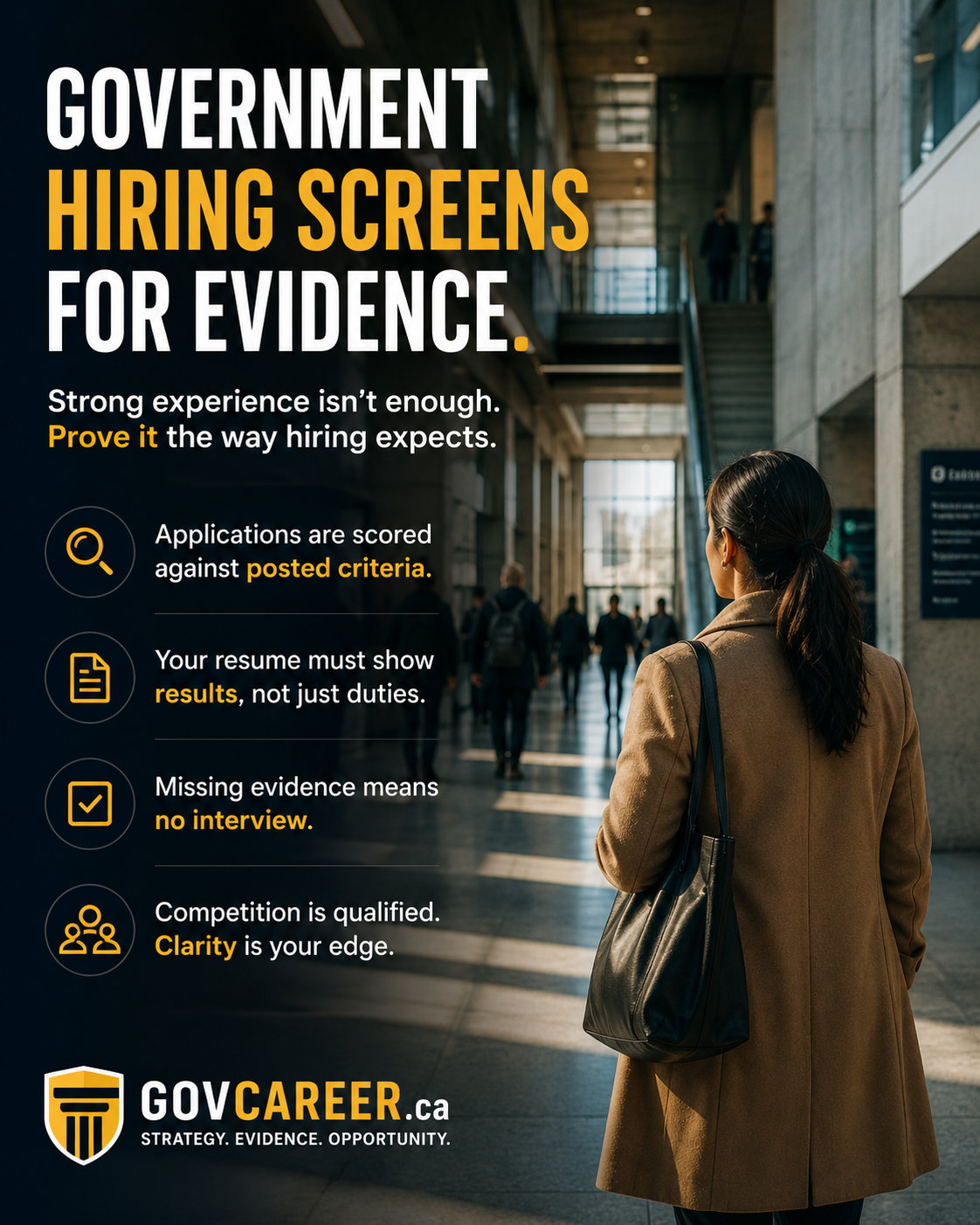
At the initial stage, assessors may review whether each mandatory criterion is demonstrated. Missing one requirement can end the application even when the candidate has substantial strengths elsewhere.
This is why broad statements such as “more than 15 years of leadership experience” are insufficient when the posting requires a specific type of leadership, environment or responsibility. The resume must show the relevant component.
Shortlisting and Asset Qualifications
After minimum screening, the employer may move all qualified candidates forward or use assets, additional criteria, ranking or volume-management methods. The method depends on the competition and governing rules.
A resume should therefore prove the essentials and make relevant assets easy to identify. It should not assume that meeting the minimum guarantees an interview.
Why Qualified Candidates Are Screened Out
A candidate may possess the required experience but fail to demonstrate it. Common resume-specific causes include:
- missing dates or unclear duration;
- a title without supporting responsibilities;
- vague or generic claims;
- incomplete coverage of a multi-part criterion;
- evidence buried in unrelated material;
- unexplained acronyms or private-sector terminology;
- inconsistent information across documents;
- failure to follow the posting’s instructions;
- an application focused on seniority rather than the actual qualification.
Newfoundland and Labrador’s official competition guidance states that applicants who do not clearly meet mandatory screening criteria do not progress. Other employers may describe the stage differently, but assessors can evaluate only the evidence available in the required materials.
Why Keyword Stuffing Is Not a Screening Strategy
Keyword stuffing may make a resume harder to read and less credible. A phrase such as “stakeholder engagement” repeated ten times does not explain who the stakeholders were, why engagement was required or what the candidate did.
Use the employer’s terminology to create a clear connection, then provide facts. The correct density is the amount needed for accurate, natural explanation.
Government Resume Strategies for Different Candidate Situations
Different career histories change the evidence available, but they do not change the basic standard. The resume must present relevant, accurate and assessable information against the posting.
Moving from the Private Sector to Government
Private-sector candidates should translate commercial experience into functions relevant to the public role. Sales leadership may involve planning, negotiation, service, performance management and analysis, but aggressive “winning” language may not communicate fairness, accountability or process discipline. Describe the actual work and judgement.
Changing Careers or Occupational Fields
A career changer should identify transferable functions and use examples that show comparable complexity. Education, volunteer work, projects and professional development may help establish readiness.
Do not claim direct experience that does not exist. Explain the underlying capability and let the employer decide whether it meets the criterion. When the posting requires occupation-specific experience, transferable skills alone may not be enough.
Handling Overqualification
Overqualification is best handled through relevance and credible alignment, not by falsifying or hiding required facts. A senior candidate applying to a narrower role should focus the resume on the functions the target position needs rather than presenting an executive biography.
Include enough senior history to remain accurate, but do not allow status, titles and unrelated scale to dominate. The application should make it plausible that the candidate understands the role and can perform it without implying that the job is merely temporary or beneath them.
Employment Gaps and Career Breaks
Use accurate dates and avoid unnecessary personal disclosure. A gap does not need an elaborate explanation in the resume unless clarification is material to the application.
Relevant activities during the period—education, caregiving-related skill development, volunteer work, consulting or professional training—may be included accurately. Do not invent work or disguise dates.
Contract, Consulting and Self-Employment Experience
Consulting and self-employment can demonstrate strong evidence when the resume explains the clients or sectors, project dates, personal role, deliverables, methods, scope and results.
Avoid a vague company description followed by a list of services. Show the work performed. Where confidentiality limits detail, provide enough non-sensitive context to establish the qualification without disclosing protected information.
Students, Graduates and Entry-Level Candidates
Candidates with limited employment history can use co-op placements, internships, academic projects, research, student employment, volunteer work and community leadership.
Describe these experiences as evidence, not filler. Identify the objective, your contribution, tools or methods, stakeholders and outcome. An academic project can demonstrate analysis or technical skill, but it should not be represented as professional employment.
International Experience and Canadian Work Experience
Present international experience with enough context to explain the employer, jurisdiction, function and level of work. Do not assume “Canadian experience” is universally required. Some roles require Canadian legislation, standards or professional registration; others assess the function regardless of country. The posting controls.
Internal Candidates and Government Employees
Internal candidates still need to prove the qualifications. Do not assume the panel knows your reputation, acting assignments, internal projects or informal responsibilities.
Use official titles and explain internal acronyms. If you performed higher-level duties temporarily, identify the assignment and dates accurately. Familiarity with the organization is not a substitute for evidence.
Adapting Your Resume to Different Government and Public-Sector Employers
Canadian government resume requirements vary by jurisdiction and employer. The core principles—accuracy, relevance, traceability and qualification alignment—remain useful, but the application method and terminology may change.
How a Canadian Federal Resume Differs from a U.S. Federal Resume
Canadian applicants should be cautious with online advice about a “federal resume.” Much of that guidance is written for the United States federal hiring system and may recommend information or formatting that is not routinely required in Government of Canada applications.
For Canadian federal competitions, follow the current GC Jobs instructions and the specific advertisement. Do not automatically include items such as salary history, hours worked per week, supervisor contact details or other U.S.-specific conventions unless the Canadian posting explicitly requests them.Provincial and Territorial Government Applications
Each province and territory has its own public-service system. Some provide detailed resume guidance; others focus on the application portal and posting. Requirements can include uploaded resumes, cover letters, questionnaires, profiles or combined page limits.
Use official jurisdictional guidance when applying. Do not assume that a practice described by Manitoba, British Columbia or Saskatchewan applies elsewhere.
Municipal and Regional Government Applications
Municipal and regional employers commonly use independent career portals and may set their own document rules. A city may use a conventional resume, prescreening questions, competency questionnaires or union-specific internal procedures.
The municipal posting and official career page are the controlling sources. Do not treat a local government role as less formal simply because the employer is smaller.
Crown Corporations, Agencies, Healthcare and Education Employers
Crown corporations, agencies, hospitals, health authorities, school boards, colleges and universities may use recruitment practices that resemble corporate hiring, core public-service hiring or a combination of both.
Identify the employer’s legal and operational context, but do not assume that public ownership creates one uniform resume standard. Regulated roles may place greater weight on licences, professional registration, clinical credentials or academic qualifications.
For a broader explanation of these employer categories, see GOVCAREER.ca’s Government Jobs in Canada mega pillar.
Using AI to Write a Government Resume
Artificial intelligence can help improve a government resume, but it cannot replace the work of understanding your experience and matching it accurately to a specific competition.
AI tools can help with:
- organizing information;
- improving grammar and sentence structure;
- identifying repeated wording;
- suggesting clearer headings;
- extracting terminology from a job posting;
- producing a first draft;
- shortening or reorganizing existing content.
Those functions can save time. They do not complete the application strategy.
AI Can Polish a Resume Without Tailoring It
A polished resume is not necessarily a tailored resume.
AI can insert keywords from a posting, improve sentence flow and produce professional-sounding language. The result may look complete while still failing to demonstrate the qualifications the employer intends to assess.
Real government resume tailoring requires you to:
- identify each essential qualification;
- locate genuine evidence from your background;
- determine where and when the experience occurred;
- explain your personal responsibility;
- show the appropriate level of scope and complexity;
- connect the evidence to the employer’s terminology;
- remove information that distracts from the qualification.
AI cannot independently perform that work because it does not know your career history beyond the information you provide.
It cannot discover an important example from an earlier position unless you tell it that the example exists. It cannot determine whether you performed a function regularly or only once. It cannot know whether you led the work, supported it or merely observed it.
When information is incomplete, an AI system may fill the gap with generic language, unsupported assumptions or invented detail.
AI Cannot Creatively Reconstruct Your Experience
Effective tailoring sometimes requires looking across several roles, projects, assignments or volunteer activities to identify evidence relevant to one qualification.
For example, a posting may require experience:
- coordinating stakeholders;
- interpreting procedures;
- preparing recommendations;
- managing competing priorities;
- supporting regulatory or operational decisions.
You may possess that experience without having used the same language in your previous resume.
The real work is to identify what you actually did and translate it honestly into terminology the assessor understands.
AI can help rewrite an example once the facts are available. It cannot safely create the underlying experience.
Do not ask an AI tool to “make you sound qualified” when the evidence has not been established. That can lead to inflated authority, invented achievements, false metrics or responsibilities you could not defend during an interview or reference check.
Hiring Managers Need Recognizable Evidence, Not Polished Filler
AI-generated resume language often sounds smooth but says very little.
Examples include phrases such as:
- “leveraged cross-functional synergies”;
- “spearheaded transformative initiatives”;
- “optimized stakeholder-centric solutions”;
- “drove strategic excellence”;
- “delivered high-impact outcomes.”
These phrases may sound professional, but they do not tell an assessor what happened.
Government and public-sector hiring managers usually need language they can connect to the role, such as:
- reviewed applications against established criteria;
- prepared briefing materials for senior management;
- coordinated work between operational departments;
- interpreted legislation, policies or procedures;
- responded to public or client inquiries;
- tracked project risks, decisions and deliverables;
- prepared reports, recommendations or technical documentation.
The objective is not to make the resume sound impressive. It is to make the candidate’s experience understandable.
A hiring manager should be able to identify:
- the function you performed;
- the context in which you performed it;
- your own contribution;
- the level of responsibility;
- the methods or standards used;
- the result or output.
Generic AI language can obscure those facts.
Keywords for resume for government jobs in Canada Do Not Replace Qualification Evidence
AI can quickly identify and insert keywords from a government job posting. That may help align terminology, but keyword placement alone is not tailoring.
If a posting asks for stakeholder engagement, repeating that phrase does not prove the qualification.
The resume should explain:
- who the stakeholders were;
- why engagement was required;
- what you personally did;
- how issues or interests were managed;
- what result followed.
The same principle applies to terms such as:
- project management;
- policy analysis;
- conflict resolution;
- client service;
- strategic advice;
- records management;
- regulatory compliance.
Use the employer’s language when it accurately reflects your experience. Then support the term with evidence.
How to Use AI Responsibly for a Government Resume
Use AI after the qualification analysis has begun, not instead of it.
A safer process is:
- analyze the posting yourself;
- identify every essential qualification;
- collect factual examples from your career;
- provide the AI tool with accurate context;
- ask it to improve clarity or structure;
- review every sentence against your real experience;
- remove generic, exaggerated or unfamiliar wording;
- confirm that the final language sounds like work the hiring manager would recognize;
- verify that every claim can be defended in an interview or reference check.
The candidate remains responsible for the final document.
AI can help polish and organize a government resume. It cannot determine whether your experience genuinely meets the competition’s requirements, and it should never be used to manufacture the match.
Common Government Resume Mistakes
Most resumes for resume for government jobs in Canada fails occur when the document does not prove the right qualifications in the required form. These mistakes interfere directly with screening.
Using One Generic Resume for Every Competition
A generic resume may describe a strong career while failing to address the specific criteria of the target job. Review and tailor the document for every competition.
Making Claims Without Evidence
Statements such as “strong strategic thinker” or “extensive project-management experience” do not establish what happened. Add context, actions, scope and outcomes.
Omitting Dates, Duration or Role Context
Missing months, unclear acting periods or vague project timelines can prevent the assessor from verifying required experience. Use dates appropriate to the criterion and posting.
Copying the Job Posting
Repeating the employer’s duties or keywords demonstrates reading, not experience. Use the posting’s language only when it accurately describes work you can prove.
Including Too Much Irrelevant History
An overloaded resume makes the relevant evidence difficult to find. Preserve a complete master record, but submit a focused application.
Using Unexplained Acronyms or Employer-Specific Jargon
Internal language can hide otherwise valuable experience. Spell out important terms and explain unfamiliar systems or structures briefly.
Prioritizing Design Over Assessability
Complex layouts, graphics or text boxes may fail in an application system or make chronology difficult to follow. Design should support screening, not compete with it.
Ignoring Employer Instructions
A resume cannot overcome a missed deadline, wrong file type, exceeded limit, omitted screening question or incomplete application field. Follow every instruction.
Providing Inconsistent or Inaccurate Information
Contradictory dates, inflated titles and unsupported metrics damage credibility. Verify every material claim and preserve consistency across documents.
Using Artificial Intelligence Without Verification
AI can help organize content, identify repetition or improve clarity, but the candidate remains responsible for every word. Do not allow an AI system to invent responsibilities, metrics, qualifications, legislation, technical tools or results.
Review the output against your records and the posting. Make sure the wording reflects your actual experience and can be defended in an interview or reference check. Follow any employer instructions concerning AI or outside assistance.
Final Government Resume Review Checklist
Before submitting, conduct a criterion-by-criterion review rather than relying only on proofreading.
Qualification-Coverage Review
Confirm that every essential qualification is supported in the required application component. Check relevant assets after the essentials are complete.
Evidence-Quality Review
For each major criterion, verify that the application identifies:
- where the experience occurred;
- when it occurred;
- your personal responsibility;
- the actions and methods used;
- the scope or complexity;
- a result, output or observable effect where relevant.
Accuracy and Consistency Review
Check employment dates, job titles, employer names, credentials, technical terms and numerical claims. Compare the resume with the application form, cover letter and screening answers.
Relevance and Duplication Review
Remove repeated duties, broad summaries and unrelated history. Keep repeated facts only when they serve a different purpose or are required in another application component.
Language and Readability Review
Check grammar, spelling, sentence length, acronym definitions, heading consistency and page flow. Ensure the most relevant evidence is not buried at the end of long paragraphs.
Application-System and Submission Review
Confirm the accepted file type, file name, size, page or character limit, required fields, attachments, deadline and time zone. Review pasted text after the system processes it.
Preserve the Posting and Submitted Resume
Save the complete posting, submitted resume, cover letter, screening responses, supporting documents and confirmation. Postings may be removed after closing, and the exact criteria will be important if you are invited to an assessment or interview.
Frequently Asked Questions About Resume for Government Jobs
What Is the Best Resume Format for a Government Job?

There is no universal best format. Reverse chronology often works because it connects evidence to employers and dates; a combination format can also work when it preserves traceability. Follow the employer’s instructions.
How Long Should a Resume for Government Jobs Be?
Use the length permitted by the employer and needed to demonstrate the qualifications. Do not assume a universal two-page rule. Keep the document focused and readable.
Is a Government Resume Different from a Private-Sector Resume?

It can be. Government and public-sector screening often requires more explicit evidence of dates, responsibilities, scope and qualification alignment. A private-sector resume may still provide a strong foundation, but it usually needs review against the specific public-sector posting.
Can I Use the Same Resume for Every Government Job?
Maintain one master resume, but tailor the submitted version to each competition. Review the qualifications, choose the strongest evidence and adjust ordering and detail so the relationship to the job is clear.
Can I Get a Government Job Without Government Experience?
Yes, when the posting does not require it and your transferable evidence meets the criteria. Describe comparable functions, responsibility and complexity accurately. Some roles require public-sector, legislative, regulatory or institutional experience, so the posting controls.
Should I Use Keywords from the Government Job Posting?
Use accurate posting terminology naturally when it matches your experience. Keywords can help the assessor locate relevant evidence, but they do not replace facts. Do not copy criteria you cannot support or repeat terms solely to influence an applicant-tracking system.
Do Government Employers Use Applicant-Tracking Systems?
Some do, but practices vary. Prepare a technically simple, readable resume, complete all required fields and focus on clear evidence rather than assuming one ATS formula applies to every employer.
Should I Include Every Job on My Government Resume?
Not necessarily. Include the positions needed to establish relevant qualifications, chronology and required duration. Older or unrelated roles can often be shortened. Do not remove the only evidence that proves an essential criterion simply to keep the document brief.
Should I Include References on My Resume?
Provide references according to the employer’s instructions. In many competitions, references are requested later and do not need to appear on the resume. Keep a separate current reference list and obtain permission before sharing contact information.
Should I Include LinkedIn on a Government Resume?
Normally, include only professional contact and qualification information unless the employer requests something else. Including a LinkedIn profile is optional. Add it only when the profile is current, professional and consistent with the material facts in your application.
Your LinkedIn profile does not need to reproduce the full detail of a tailored government resume. However, employment dates, job titles and major responsibilities should not materially contradict the resume, screening responses or application form.
Do not rely on LinkedIn to demonstrate an essential qualification. Required evidence should appear in the application component the employer has identified for assessment.
Do I Need a Cover Letter for a Government Job?
Only when the posting or employer requires it, although some employers may permit an optional cover letter. A cover letter does not replace the resume, application fields or screening questions. Use it to organize relevant evidence or provide information that the application process asks for.
Why Was My Government Job Resume Screened Out?
Common reasons include missing essential evidence, unclear dates or duration, generic descriptions, inconsistent information and failure to follow instructions. A qualification cannot be credited when the required materials do not demonstrate it clearly.
Can I Use AI to Write a Government Resume?
AI may help with organization, editing and clarity, but you must verify every statement. Remove invented details, unsupported metrics and generic language. Ensure the final resume reflects your own experience, complies with employer instructions and can be defended during assessments, interviews and reference checks.
Should I Use a Government Resume Template?
A template can organize headings and spacing, but it cannot determine the correct evidence or employer-specific requirements. Use it as a structural aid, tailor the content and confirm that the application system preserves the layout.
Conclusion: Build the Resume Around Evidence, Not Assumptions
A successful resume for a government job is built from the posting outward. It identifies what the employer will screen, maps each relevant criterion to credible evidence and presents that evidence in a format the assessor can follow.
The process is disciplined:
- analyze the position and application instructions;
- separate essential qualifications from assets and appointment conditions;
- create a qualification-to-evidence map;
- choose a traceable structure;
- provide accurate dates and role context;
- describe your personal actions, methods, scope and outcomes;
- use posting terminology only when it accurately reflects your experience;
- coordinate the resume with screening questions, cover letters and online fields;
- follow employer-specific technical requirements;
- complete a final criterion-by-criterion review.
Do not expect a job title, professional reputation or total years of experience to make the qualification case for you. The strongest resume for a government job in Canada presents relevant evidence clearly, accurately and in the format required by the employer.
Before submitting, review the complete application package—including the resume, screening questions, required forms, cover letter and submission instructions—to confirm that every essential qualification is addressed consistently.