AI Can Write Your Cover Letter in 30 Seconds. That May Be Why It Gets Ignored.
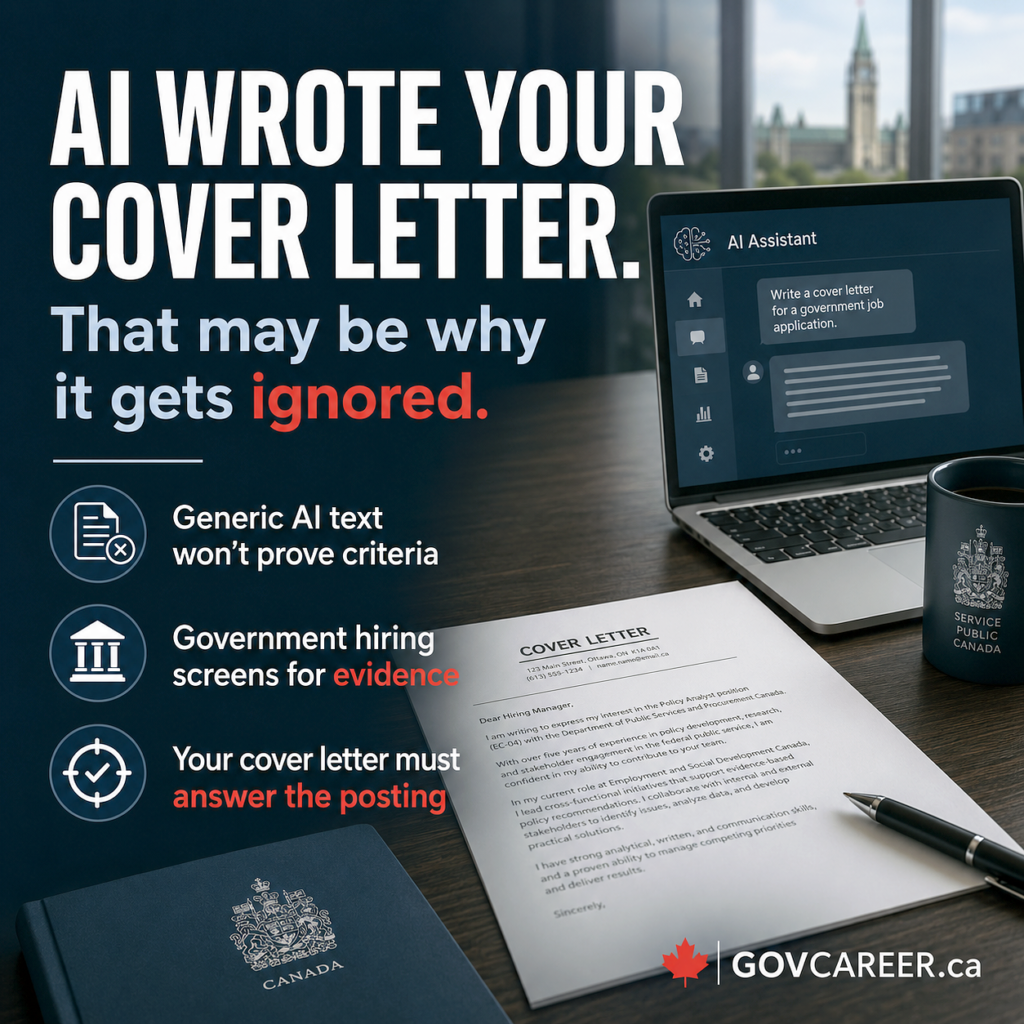
AI can produce a clean, professional cover letter almost instantly. But in government job applications, a polished cover letter is not automatically a useful cover letter.
For government jobs, public sector jobs, and other structured hiring processes, a cover letter often needs to do more than introduce you. It may need to show direct evidence that you meet the job posting requirements, understand the role, and can demonstrate the screening criteria clearly. AI can help draft the document, but if the strategy behind the cover letter is weak, the result may still be generic, shallow, and easy to ignore.
The Problem With Most AI Cover Letters
Most AI-generated cover letters sound fine at first glance.
They are usually professional, polite, confident, well-formatted, and full of phrases like “strong communication skills,” “proven ability,” “team player,” and “excited to apply.”
That is exactly the problem.
They sound like cover letters. But they often do not function as strong application evidence.
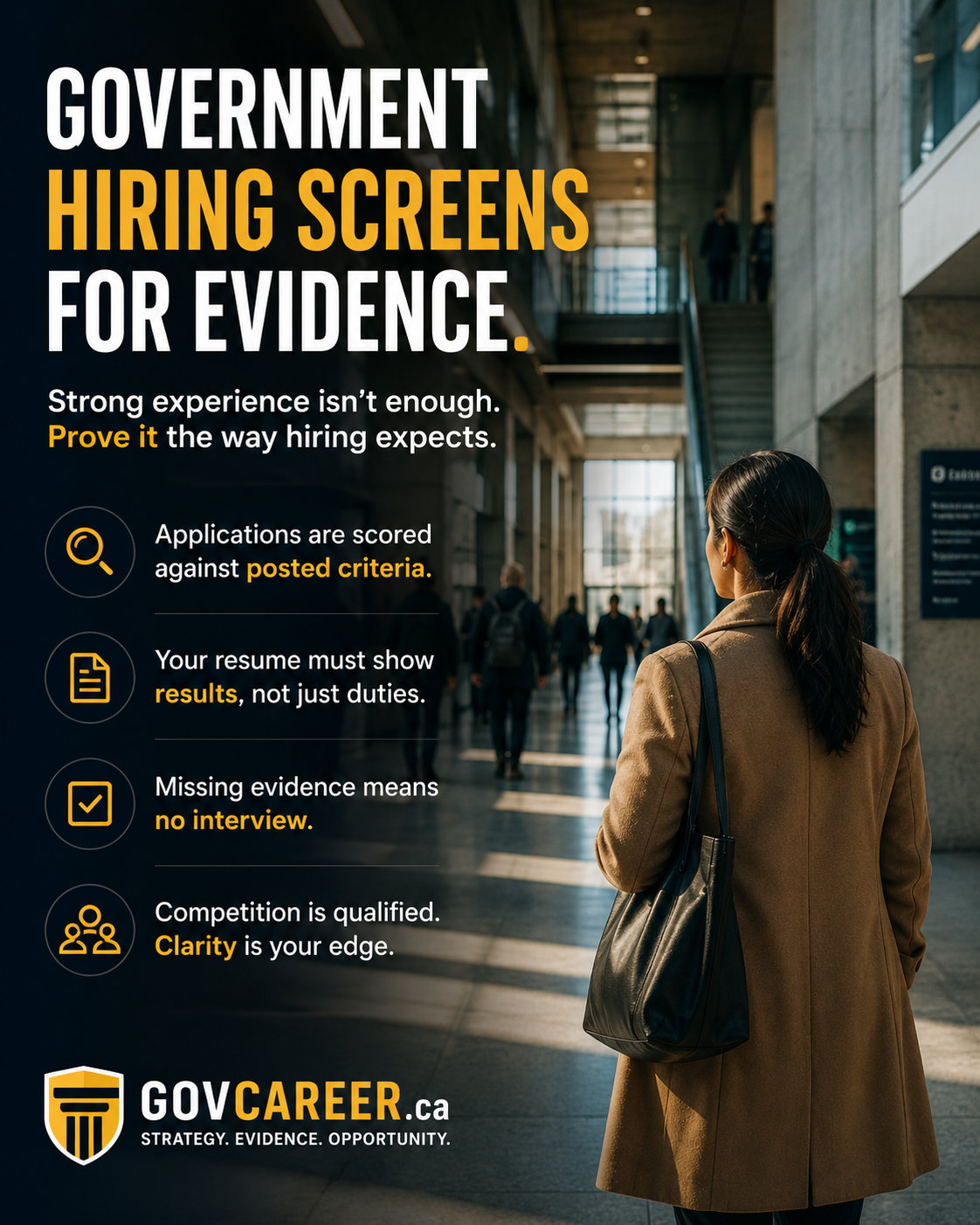
In public-sector hiring, especially in Canada, Ontario, Toronto, the GTA, Ottawa, federal government jobs, provincial government jobs, and municipal jobs, hiring processes are often structured. That means the employer is not simply reading your application to get a general impression. The employer may be assessing whether your application demonstrates specific qualifications, experience, knowledge, and competencies listed in the job posting.
A clean cover letter may look professional. But clean does not mean useful.
A well-written paragraph that says you are “excited about the opportunity” does not prove that you meet the criteria.
A polished sentence saying you have “excellent stakeholder communication skills” does not show when, where, or how you used those skills.
A generic AI-generated cover letter can make you sound employable in a broad sense while still failing to prove you are qualified for that specific competition.
Public-Sector Hiring Is Not the Same as Generic Job Search
In many private-sector applications, a cover letter may be treated as a short introduction. Sometimes it is barely read. Sometimes it is optional. Sometimes it is mainly a tone-setting document.
Government job applications can be different.
In public-sector hiring and merit-based hiring, the application process is often more formal. The job posting may include required qualifications, preferred qualifications, knowledge areas, technical skills, behavioural competencies, and sometimes very specific experience requirements.
This means your cover letter may need to do more than say why you want the job.
It may need to help prove that you meet the screening criteria.
That distinction matters.
A generic cover letter says:
“I believe my skills and experience make me a strong candidate for this position.”
A useful government cover letter says:
“My experience coordinating multi-stakeholder projects, preparing written reports, interpreting policy requirements, and communicating with internal and external partners aligns with the posted requirements for this role.”
The second version is still not complete, but it is moving in the right direction. It begins connecting experience to the job posting.
That is what many AI cover letters fail to do unless the candidate knows how to guide the AI properly.
The Common AI Cover Letter Mistake
Many candidates use AI like this:
They paste their resume.
They paste the job posting.
They ask the tool to “write a strong cover letter.”
They receive polished generic text.
Then they submit a slightly edited version everywhere.
That is not a strategy.
That is mass production.
And government applications usually do not reward mass production.
The problem is not that AI is useless. The problem is that AI often produces a surface-level document when the candidate gives it surface-level instructions.
If you ask for “a professional cover letter,” you will usually get professional-sounding language.
But professional-sounding language is not enough.
For government job applications, the better question is:
Does this cover letter clearly answer the posting?
That means the cover letter should address the actual requirements of the role, not just describe you as a generally capable person.
What a Government Cover Letter Must Do
A strong cover letter for government jobs or public sector jobs should usually do five things.
First, it should address the posted requirements.
This means the cover letter must be built from the job posting, not from a generic career summary. If the posting asks for experience with policy interpretation, client service, stakeholder engagement, report writing, project coordination, legislation, data analysis, supervision, or technical knowledge, the cover letter should directly speak to those areas where relevant.
Second, it should connect your experience to the screening criteria.
This is where many candidates fail. They describe what they have done, but they do not connect it to what the employer asked for. In structured hiring, the employer should not have to guess why your background matters.
Third, it should show specific evidence.
Evidence is more powerful than claims. Saying “I have strong written communication skills” is weaker than explaining that you prepared briefing notes, technical reports, client correspondence, policy summaries, council reports, case notes, inspection reports, or analytical documents.
Fourth, it should use the language of the competition.
This does not mean stuffing keywords mechanically. It means reflecting the real language of the posting so that your application feels clearly aligned with the role. If the posting uses “stakeholder engagement,” do not hide that experience under vague wording like “worked with people.” If the posting asks for “project coordination,” do not only say “supported team activities.”
Fifth, it should make the reviewer’s job easier.
This is critical. A good public-sector cover letter does not force the reviewer to dig, infer, or translate your experience. It presents relevant evidence clearly.
The goal is not to impress with fancy writing.
The goal is to make the match visible.
What Weak AI Cover Letters Usually Do
Weak AI cover letters often have the same problems.
They sound excited.
They repeat the resume.
They use generic achievements.
They overuse soft skills.
They avoid direct evidence.
They often include sentences like:
“I am thrilled to apply for this role.”
“My background has prepared me well for this opportunity.”
“I am a dedicated professional with strong communication and organizational skills.”
“I believe I would be a valuable addition to your team.”
These sentences are not automatically wrong. But they do very little by themselves.
In public-sector hiring, vague confidence is not enough. If the hiring process is structured, the reviewer may be looking for evidence linked to specific requirements.
A cover letter full of enthusiasm but light on evidence may feel good to the applicant but weak to the reviewer.
The Real Test for a Government Cover Letter
Before submitting a cover letter for a government or public-sector role, test it against the posting.
If the posting asks for stakeholder communication, does your cover letter show stakeholder communication?
If it asks for policy interpretation, does it show policy interpretation?
If it asks for project coordination, does it show project coordination?
If it asks for report writing, does it show report writing?
If it asks for legislation, regulation, or public-sector process, does it show where you used it?
If it asks for client service, does it show the type of clients, the environment, the issues, and the level of responsibility?
If it asks for analytical skills, does it show what you analyzed, why it mattered, and what outcome your work supported?
If it asks for leadership, does it show leadership evidence rather than simply calling you a leader?
This is where AI can help, but only if you use it correctly.
AI can help identify themes in the posting. It can help organize your experience. It can help improve sentence structure. It can help tighten wording. It can help reduce repetition.
But AI cannot decide what matters unless you understand the hiring logic.
AI Is a Tool, Not the Strategy
AI can help write a cover letter.
But AI is not the strategy.
The strategy is understanding how structured hiring works.
In government job applications, the posting is not just information. It is the map. It tells you what the employer is likely to care about. It gives clues about the screening criteria, the duties, the competencies, and the type of evidence the application should present.
If you use AI without first analyzing the posting, you may end up with a cover letter that is smooth but unfocused.
That is dangerous because the document may look finished before it is actually competitive.
This is one of the biggest risks with AI resume writing and AI cover letter writing. The tool creates a sense of completion. The document looks good. The grammar is clean. The formatting is acceptable. The tone is professional.
But the core question remains unanswered:
Does it prove the criteria?
If the answer is no, the cover letter is not strong enough.
A Polished Cover Letter Can Still Be Weak
Many candidates confuse polish with strength.
Polish means the document is readable, clean, and professional.
Strength means the document makes a clear case that you meet the role requirements.
Those are not the same thing.
A polished but weak cover letter may say:
“I have excellent communication and organizational skills developed through my previous roles.”
A stronger version may say:
“In my previous role, I coordinated communication between internal teams, external service providers, and members of the public, ensuring that project updates, timelines, and service issues were documented and communicated clearly.”
The stronger version gives the reviewer something to assess.
It shows context.
It shows responsibility.
It shows relevance.
That is what cover letters need in public-sector hiring.
Why Generic Cover Letters Fail in Government Applications
Generic cover letters fail because they usually do not reflect the specific competition.
Government hiring is often competition-based. Each job posting may have its own requirements, its own evaluation criteria, and its own screening logic.
A cover letter written for one posting may not work for another, even if the job titles look similar.
For example, two administrative roles may look similar from the outside. But one may emphasize client service and records management, while another may emphasize financial processing, scheduling, and correspondence. A generic cover letter may miss both.
The same applies to policy roles, engineering roles, planning roles, social service roles, analyst roles, enforcement roles, project roles, and management roles.
The title alone is not enough.
The posting controls the application.
That is why resume tailoring and cover letter tailoring matter so much in government job applications.
What Candidates Should Do Before Asking AI to Write
Before using AI, candidates should first break down the posting.
Start by identifying the required qualifications. These are the minimum requirements that may determine whether the application moves forward.
Then identify the experience requirements. Look for phrases such as “experience in,” “demonstrated ability to,” “knowledge of,” “skills in,” “ability to interpret,” “experience preparing,” or “experience coordinating.”
Then identify the duties. Duties show what the successful candidate will actually do. Your cover letter should help show that your background connects to those duties.
Then identify repeated language. If the posting repeatedly refers to stakeholder engagement, policy analysis, customer service, compliance, project delivery, or written communication, those themes probably matter.
Only after this analysis should AI be used to help draft.
Otherwise, AI may write a nice letter that misses the actual competition.
Better AI Prompting for Government Cover Letters
A weak prompt is:
“Write me a strong cover letter for this government job.”
A better prompt is:
“Analyze this government job posting and identify the key screening criteria, required experience, knowledge areas, and competencies. Then help me structure a cover letter that addresses those criteria using my actual experience.”
An even better prompt includes specific evidence from your background:
“Use only the evidence I provide. Do not invent experience. Organize the cover letter around the posted requirements. Make the connection between my experience and the screening criteria clear.”
That last part matters.
AI can invent, exaggerate, or overgeneralize if the user is not careful. In government and public-sector applications, that is risky. Your application should be accurate, honest, and defensible.
The goal is not to manufacture qualifications.
The goal is to present real qualifications clearly.
What a Useful Government Cover Letter Looks Like
A useful government cover letter is usually focused, evidence-based, and aligned to the posting.
It does not need to be dramatic.
It does not need to sound like a sales pitch.
It does not need to be filled with big language.
It should explain why your background fits the posted requirements.
A useful structure may include:
An opening paragraph that identifies the role and gives a concise summary of your relevant fit.
One or two body paragraphs that connect your experience to the key criteria.
Specific examples that demonstrate required skills, knowledge, and responsibilities.
A closing paragraph that remains professional without becoming generic or exaggerated.
The cover letter should feel tailored to that specific competition.
If it could be sent to 20 different employers without changing anything, it is probably too generic.
Cover Letters and Resume Tailoring Work Together
A cover letter should not simply repeat the resume.
It should support the resume.
The resume provides structured evidence of your employment history, duties, achievements, education, and qualifications.
The cover letter can help explain relevance, context, and alignment.
In public-sector hiring, the two documents should work together. They should both point toward the same conclusion:
This candidate meets the posted requirements and has provided enough evidence to be considered further.
If the resume says one thing and the cover letter says another, the application becomes weaker.
If the cover letter introduces claims that are not supported in the resume, the application may feel thin.
If the cover letter repeats the resume without adding clarity, it wastes space.
The best approach is alignment.
Resume, cover letter, and any screening questions should all support the same evidence-based case.
The Role of Keywords in AI Cover Letters
Keywords matter, but not in the simplistic way many people think.
A cover letter should include relevant language from the posting where appropriate. This helps show alignment and may help the reviewer quickly identify matching experience.
However, keyword stuffing is not strategy.
If the posting asks for “stakeholder engagement,” simply inserting that phrase five times is not enough.
You need to show stakeholder engagement through evidence.
Who were the stakeholders?
What was the issue?
What was your role?
What communication did you manage?
What was the result?
The same applies to screening criteria, resume writing, job posting requirements, structured interviews, interview preparation, and public service careers. Keywords can help organize the document, but evidence gives the document weight.
The Main Difference: Claim vs. Evidence
This is the simplest way to understand strong application writing.
A claim says:
“I have strong communication skills.”
Evidence says:
“I prepared written reports, briefings, and client correspondence for internal and external audiences, ensuring information was accurate, clear, and aligned with organizational requirements.”
A claim says:
“I am experienced in project coordination.”
Evidence says:
“I coordinated project timelines, tracked deliverables, communicated with stakeholders, and supported reporting to management.”
A claim says:
“I understand policy.”
Evidence says:
“I reviewed policy requirements, interpreted guidelines, identified compliance issues, and provided recommendations based on established procedures.”
Government hiring often needs evidence.
AI is very good at claims.
Candidates must force it toward evidence.
Final Thought: AI Can Help, But It Cannot Replace Judgment
AI can write quickly. That is useful.
But speed is not the same as strategy.
For government jobs and public sector jobs, your cover letter should not simply say:
“I am a strong candidate.”
It should say:
“Here is the evidence that I meet what you asked for.”
That is the difference between a polished cover letter and a useful one.
A polished cover letter may look good.
A useful cover letter helps the reviewer understand why you should move forward in a structured hiring process.
If you are applying for public-sector roles in Canada, Ontario, Toronto, the GTA, Ottawa, federal government jobs, provincial government jobs, or municipal jobs, do not treat the cover letter as decoration. Treat it as part of the application evidence.
AI can help you draft.
But the strategy must come first.
If you have questions about government job applications, resume tailoring, cover letters, screening criteria, or interview preparation for structured public-sector hiring, feel free to contact me through GOVCAREER.ca.