Is AI Killing Resume Writing, or Just Exposing Generic Resume Advice?
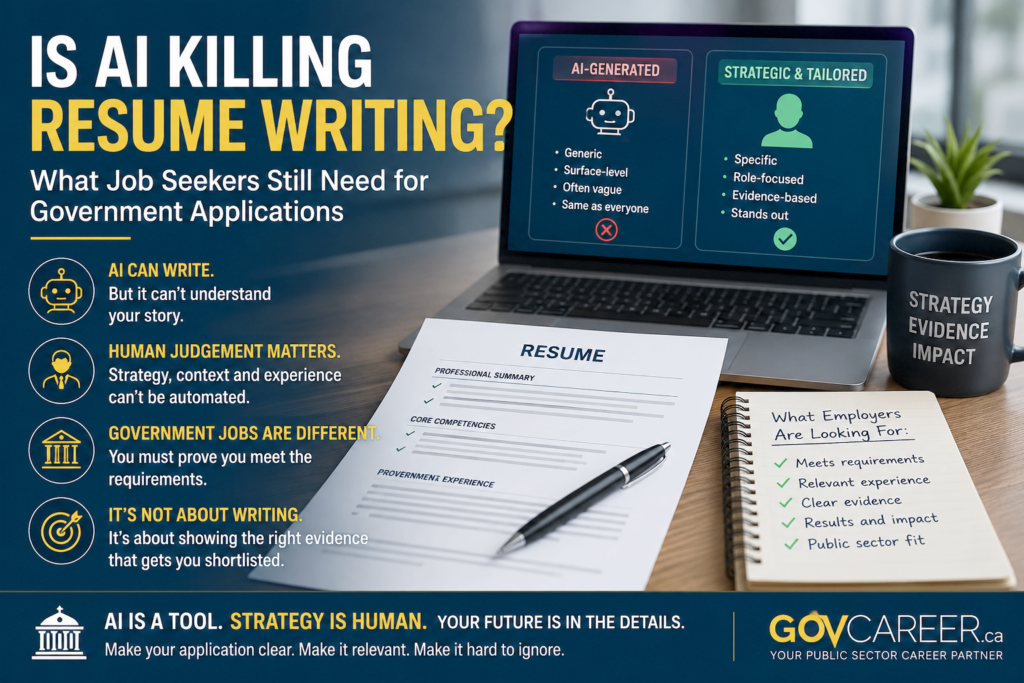
AI is not killing serious resume work. It is killing the cheap illusion that polished wording is the same as a strong application.
Artificial intelligence is changing resume writing, but it is not removing the need for strategy, judgement, and role-specific application development. For government jobs and public sector jobs in Canada, the real challenge is not only producing clean resume language. The challenge is showing clear evidence against screening criteria, job posting requirements, and structured hiring expectations. AI can help with keywords and phrasing, but it cannot automatically decide which parts of your background create a defensible case for shortlisting.
There is a useful comparison here.
People once thought cinema would kill theatre.
It did not.
Cinema made entertainment cheaper, faster, more accessible, and available to the masses. Most people were happy with that. Theatre survived because a smaller audience still wanted something more deliberate, more human, more crafted, and more alive.
Resume writing is moving in a similar direction.
AI has made basic resume production available to almost everyone. A job seeker can now open ChatGPT, paste in a job posting, paste in an old resume, and receive something that looks polished within minutes.
That changes the market.
But it does not make serious application strategy irrelevant.
It makes the difference between generic resume output and real resume tailoring easier to see.
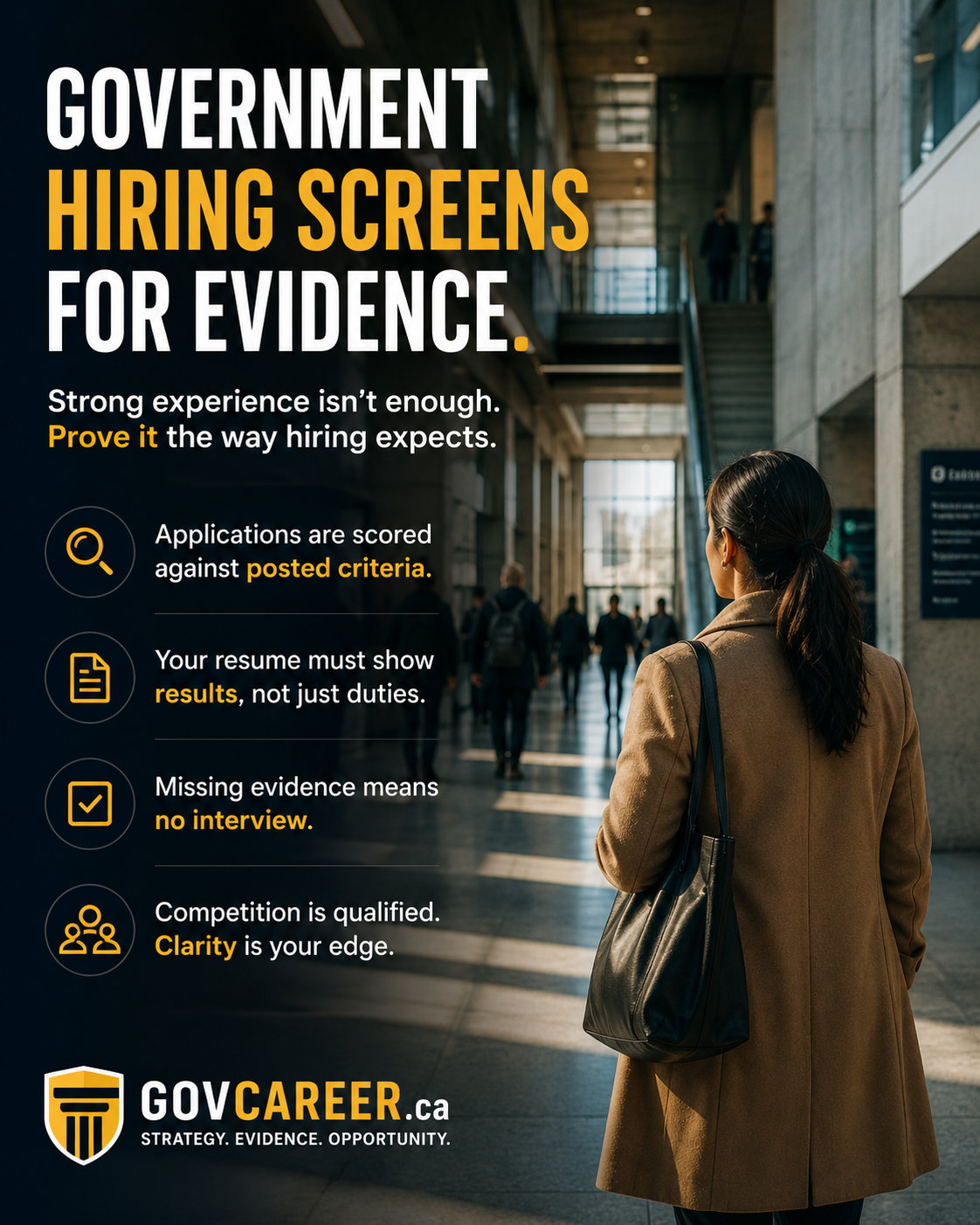
For applicants trying to understand public-sector hiring and the broader government job search in Canada, this distinction matters. Government job applications are not won by attractive wording alone. They are assessed through structured processes where evidence, alignment, clarity, and defensibility matter.
AI Has Absolutely Changed the Bottom of the Resume Market
It would be dishonest to say AI has not changed resume writing.
It has.
The bottom of the market is under real pressure.
Services that mainly offered basic rewriting, nicer formatting, generic bullet improvement, keyword stuffing, and superficial phrasing are becoming much harder to justify. If the only value is making a weak resume sound more professional, AI can often do that quickly and cheaply.
That means many low-cost resume services are vulnerable.
The old model looked something like this:
- send an old resume
- receive a cleaner version
- add stronger verbs
- insert keywords
- improve formatting
- add a professional summary
- make the document look more current
That type of work can still be useful, but it is no longer rare. AI can generate it in seconds.
For many job seekers, that is enough.
If the role is not highly competitive, if the applicant already has an obvious match, or if the employer is not using a demanding structured screening process, an AI-assisted resume may be adequate.
That is the cinema effect.
The mass market now has access to something that looks good enough.
But “Good Enough” Is Not the Same as Competitive
The problem is that many job seekers confuse polished wording with a strong application.
A resume can sound professional and still fail.
It can contain keywords and still fail.
It can match the tone of the job posting and still fail.
It can have a sharp summary, modern formatting, and clean bullets and still fail.
Why?
Because screening is not a writing contest.
In public-sector hiring, the question is usually not, “Does this resume sound impressive?”
The question is closer to:
Does this application clearly show that the candidate meets the stated requirements?
That is a different problem.
A government resume needs to make the right experience visible. It needs to show that the candidate meets the requirements in the posting. It needs to give the hiring team a reasonable basis to shortlist the person for the next stage.
AI can help with language, but language is not the whole issue.
The harder work is deciding:
- what experience matters
- what experience does not matter
- how to translate private-sector experience into public-sector relevance
- where the evidence should appear
- how much context is needed
- what the screener must be able to justify
- how the resume connects to screening criteria
- how the cover letter supports the application
- how the application prepares the candidate for structured interviews
That is where generic AI output often becomes thin.
The Real Split Is Generic Versus Tailored
The future is not simply AI versus humans.
The more useful distinction is generic versus tailored.
AI is strong at generic production.
It can produce a professional-looking resume. It can improve sentence structure. It can identify obvious keywords. It can make weak wording sound more confident. It can create a cover letter that sounds reasonable.
But generic output has limits.
For example, if a job posting asks for experience coordinating complex projects with internal and external stakeholders, AI may produce a bullet like:
“Coordinated cross-functional projects while managing stakeholder relationships and ensuring timely delivery.”
That sounds acceptable.
But it may not answer the real screening question.
The reviewer may still need to know:
- What type of projects?
- What made them complex?
- Who were the stakeholders?
- What was the applicant’s specific role?
- What decisions did the applicant make?
- What was the scope?
- What was the outcome?
- How does this connect to the government job posting requirements?
Without those details, the resume may look polished but remain weak.
A tailored resume does not merely sound aligned. It proves alignment.
Government Applications Require More Than Resume Polish
This is especially important for government jobs and public sector jobs.
Public-sector hiring often follows more formalized processes than many private-sector hiring environments. The exact process varies by federal, provincial, municipal, agency, healthcare, education, and Crown corporation employers, but the underlying pattern is familiar.
Applications are commonly reviewed against stated qualifications.
Those qualifications may include:
- education
- years or type of experience
- technical knowledge
- policy or legislative knowledge
- communication skills
- stakeholder experience
- project coordination
- analytical ability
- leadership or supervisory experience
- service delivery experience
- documentation and reporting experience
- judgement and decision-making
The resume and application must make these elements easy to recognize.
The Government of Canada explains that applicants must show how they meet the required qualifications when applying for federal government jobs through Government of Canada job opportunities. That principle applies broadly across public-sector hiring: the applicant must provide evidence, not simply confidence.
This is where resume tailoring becomes serious work.
A public-sector resume is not just a career summary. It is a structured argument.
It should help the hiring team see why the candidate deserves to move forward.
Why AI Often Produces the Same Resume for Everyone
AI works from patterns.
That is useful.
It is also the danger.
When thousands of job seekers use similar prompts and similar job descriptions, the output begins to converge. The resumes sound smoother, but also more alike.
Common AI-generated resume language includes phrases such as:
- “proven track record”
- “cross-functional collaboration”
- “stakeholder engagement”
- “results-driven professional”
- “demonstrated ability”
- “strong communication skills”
- “dynamic team player”
- “strategic problem-solver”
- “successfully managed”
- “leveraged expertise”
These phrases are not automatically bad.
But when they are not anchored in specific evidence, they become decorative.
The resume begins to sound like a professional mask.
A good public-sector application cannot rely on masks. It needs substance.
A screener should be able to point to the resume and say:
“This is where the candidate shows the required experience.”
That is not the same as saying:
“This resume sounds like the job posting.”
The Theatre Still Exists Because Craft Still Matters
This is where the theatre analogy matters.
Cinema did not kill theatre because theatre offered a different experience.
It was not faster.
It was not cheaper.
It was not more scalable.
But it had qualities cinema did not replace.
It had presence, interpretation, risk, craft, and human attention.
Resume strategy is similar.
AI can generate language, but it does not truly know the applicant. It does not know what the applicant is underplaying. It does not know what the applicant misunderstands about the posting. It does not know which experience would matter most to a public-sector reviewer unless that information is extracted, interpreted, and positioned correctly.
A serious resume advisor does not simply rewrite.
A serious advisor asks:
- What is the employer really screening for?
- Which part of this person’s background satisfies the requirement?
- Which experience is being buried?
- Which claim needs proof?
- Which private-sector title needs translation?
- Which public-sector expectations are being missed?
- Where is the candidate overexplaining?
- Where is the candidate assuming too much?
- What would make this application easier to shortlist?
That is not basic writing.
That is judgement.
The Weak Resume Services Will Be Commoditized
This does not mean every resume writer will survive.
Many will not.
AI will expose weak resume services.
If a resume writer’s value was mainly formatting and better wording, the pressure will be severe.
If a career coach’s advice is mostly generic encouragement, basic interview tips, and common job-search guidance, that is also vulnerable.
AI can already provide:
- resume templates
- cover letter drafts
- interview questions
- STAR answer structures
- LinkedIn profile wording
- career-change suggestions
- job-search checklists
- networking scripts
- basic salary negotiation guidance
Much of that information is now instantly available.
That means applicants will become less willing to pay for generic advice.
They may still pay for expertise, but they will become more sceptical.
The resume services that survive will need a sharper reason to exist.
They will need to offer something AI does not reliably provide on its own:
- specialized domain knowledge
- diagnostic judgement
- personal evidence extraction
- role targeting
- application strategy
- structured hiring interpretation
- interview assessment preparation
- accountability
- ethical accuracy control
- local market understanding
- sector-specific positioning
For GOVCAREER.ca, that is the point.
The business is not built around generic resume writing. It is built around Canadian government and public-sector application development.
Why Public-Sector Resume Work Is More Defensible
Public-sector applications are often more structured than general private-sector applications.
That structure creates complexity.
It also creates opportunity.
If the posting clearly states what is required, the applicant can build an application that responds directly to those requirements.
For example, someone applying to Ontario Public Service jobs should not treat each posting as a generic resume submission. The application should be reviewed against the actual position, qualifications, duties, and screening language.
The same applies to municipal jobs. A candidate applying through City of Toronto jobs or City of Ottawa jobs should assume that the resume must make relevant experience clear to a busy reviewer who may be comparing many candidates against stated criteria.
The candidate may be excellent.
That is not enough.
The application has to show it.
A resume advisor with real public-sector hiring knowledge can help a candidate avoid common mistakes such as:
- treating the resume like a biography
- burying relevant experience under generic duties
- assuming titles explain responsibilities
- overusing private-sector language
- underexplaining public-service-relevant work
- failing to show scope or level
- claiming skills without examples
- ignoring the wording of the posting
- submitting a general resume to a specific competition
AI can identify some of these problems if prompted well. But many applicants do not know what to prompt because they do not know what they are missing.
That is the knowledge gap.
The Candidate Does Not Need Better Writing First
Many applicants think their main problem is writing.
Sometimes it is.
Often, the deeper problem is unclear thinking about their own evidence.
They do not know which parts of their background matter.
They do not know how their experience maps to the posting.
They do not know whether their private-sector experience is transferable.
They do not know how a public-sector screener reads qualifications.
They do not know what to emphasize.
They do not know what to cut.
They do not know how much detail is enough.
They do not know how to make their application defensible.
So they ask AI to “make my resume better.”
AI then improves the surface.
But the underlying application strategy remains weak.
This is similar to painting a house before checking whether the foundation is sound.
The wording may improve.
The argument may still fail.
AI Can Be a Useful Tool Inside Serious Resume Work
The argument is not that AI is useless.
That would be wrong.
AI can be very useful in resume preparation.
It can help:
- compare a resume to a job posting
- identify missing terminology
- simplify dense language
- reduce repetition
- test different summaries
- reorganize bullet points
- convert rough notes into draft language
- create a first version of a cover letter
- prepare interview practice questions
- identify possible transferable skills
The problem is not using AI.
The problem is outsourcing judgement to AI.
A strong applicant can use AI as a tool.
A weak applicant may treat AI as the strategist.
That is where the risk appears.
AI may confidently produce material that sounds strong but is too vague, too inflated, too generic, or not connected to the screening criteria.
For government job applications, this can be damaging.
A public-sector application must remain accurate. It should not invent experience, exaggerate responsibilities, or imply qualifications the candidate does not have.
AI can help express evidence.
It should not manufacture evidence.
The New Value Is Human Judgement Over AI Output
The future of resume work may involve fewer people paying for “write my resume from scratch.”
More people may instead need help with:
- identifying what matters in the posting
- deciding whether they are a realistic candidate
- extracting overlooked experience
- checking whether AI-generated bullets are truthful and useful
- turning generic AI wording into specific evidence
- aligning the resume with structured hiring criteria
- preparing a cover letter that supports the application
- building interview readiness from the same evidence base
This is a different service model.
It is not typing for the client.
It is helping the client understand how the application will be evaluated.
That has greater value.
It also requires more expertise.
The Cover Letter Is Also Changing
AI has made cover letters easier to produce.
That may reduce their value as a writing signal.
If every applicant can generate a polished cover letter, the employer may place less weight on generic enthusiasm and more weight on actual relevance.
A weak AI cover letter often says:
“I am excited to apply for this role because my skills and experience align strongly with the position.”
A stronger public-sector cover letter explains why the applicant’s experience matches the specific role and helps reinforce the most important qualifications.
It should not repeat the resume mechanically.
It should help the reviewer see the application logic.
That is especially useful when the candidate is transitioning from private sector to public sector, moving between fields, or applying to a role where the match is real but not obvious.
Again, the value is not beautiful language.
The value is interpretation.
Interviews Will Also Reveal Weak AI Applications
There is another risk.
A candidate may use AI to produce a resume that sounds stronger than their actual understanding.
They may get shortlisted, but then struggle in the interview.
Structured interviews often test evidence, judgement, examples, decision-making, and role understanding. If the resume was built from generic AI language rather than real experience, the candidate may not be able to defend it.
This is why serious resume tailoring should connect to interview preparation.
The experience used in the resume should also prepare the candidate for structured interviews.
If the resume claims project coordination, stakeholder management, conflict resolution, policy interpretation, or leadership, the candidate should be ready to speak about those experiences in detail.
The application and interview should not be separate worlds.
They should be built from the same evidence base.
What Job Seekers Should Do Now
The practical answer is not to avoid AI.
The answer is to use it carefully.
For public-sector applications, job seekers should treat AI as a drafting assistant, not as the final authority.
Before submitting an AI-assisted resume, ask:
- Does this resume clearly answer the posting?
- Are the required qualifications easy to find?
- Is each major claim supported by real evidence?
- Does the resume show scope and level?
- Are the examples specific enough?
- Is any wording exaggerated or inaccurate?
- Would a screener understand why I should be shortlisted?
- Can I explain these examples in a structured interview?
- Does the resume sound like me, or like a generic applicant?
- Did AI improve the application, or just make it smoother?
Those questions matter more than whether the resume sounds polished.
What Resume Writers and Career Advisors Should Do Now
Resume writers and career coaches also need to adjust.
The old promise of “I will make your resume sound professional” is weakening.
The stronger promise is:
“I will help you build a clear, accurate, role-specific application that shows why you meet the requirements.”
For public-sector career advisors, the work should move toward:
- application diagnosis
- posting interpretation
- evidence extraction
- role targeting
- resume tailoring
- cover letter strategy
- structured interview preparation
- long-term application method
- public-sector career positioning
That is harder to replace.
It is also more honest.
The client is not paying for words only.
The client is paying for judgement.
AI Will Raise the Standard, Not Lower It
As more applicants use AI, employers will see more polished applications.
That may sound good for job seekers.
But it also means polish becomes less distinctive.
If everyone has clean formatting and professional language, the difference will come from evidence, relevance, and clarity.
The strongest applications will not be the ones that sound most AI-polished.
They will be the ones that make the best case.
This is especially true in public-sector hiring, where structured assessment makes vague impressiveness less useful.
The candidate has to show the match.
Final Takeaway
AI is not killing serious resume writing.
It is killing generic resume writing.
It is reducing the value of basic rewriting, formatting, keyword insertion, and standard career advice.
But for government jobs, public sector jobs, and structured hiring processes, applicants still need something AI does not automatically provide: judgement about what evidence matters and how to present it clearly against the stated criteria.
Cinema did not kill theatre.
It separated mass access from live craft.
AI is doing something similar to resume work.
The mass market will use AI for fast, polished, good-enough resumes.
Serious applicants will use AI carefully, but they will still need human judgement when the application is competitive, the role is specific, and the hiring process requires clear evidence.
For public-sector careers, the question is not whether your resume sounds good.
The question is whether your application gives the reviewer a clear reason to move you forward.
For questions or help with government job applications, resume tailoring, screening criteria, structured interviews, interview preparation, and public-sector hiring in Canada, Ontario, Toronto, the GTA, Ottawa, federal government jobs, provincial government jobs, or municipal jobs, contact GOVCAREER.ca.