In Public-Sector Job Search, the Resume Is Often Secondary
Most people approaching government jobs in Canada assume the first thing they need is a better resume.
Usually, that is not the real problem.
In public-sector hiring, many qualified candidates fail long before resume writing becomes the issue. They fail because they apply without strategy, without understanding structured hiring, and without knowing where their experience actually fits inside government systems.
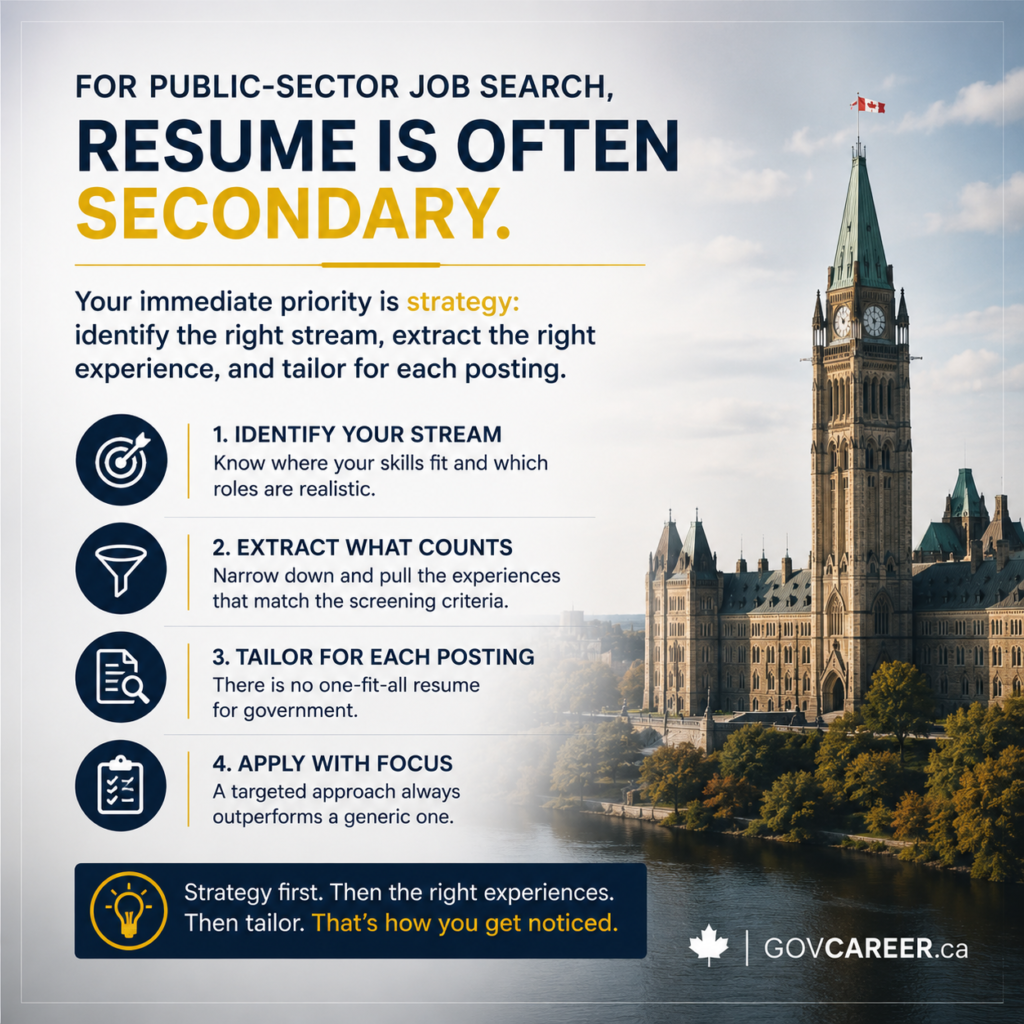
A stronger resume helps. But in many government job applications, the resume is secondary to positioning, targeting, and alignment with screening criteria.
That distinction changes everything.
Why Public-Sector Hiring Works Differently
One of the biggest mistakes candidates make when applying to government jobs in Ontario, Ottawa, Toronto, the GTA, or across Canada is assuming that public-sector hiring works like general private-sector recruitment.
It often does not.
Government hiring is usually structured, merit-based, and heavily tied to screening criteria outlined directly in the job posting requirements.
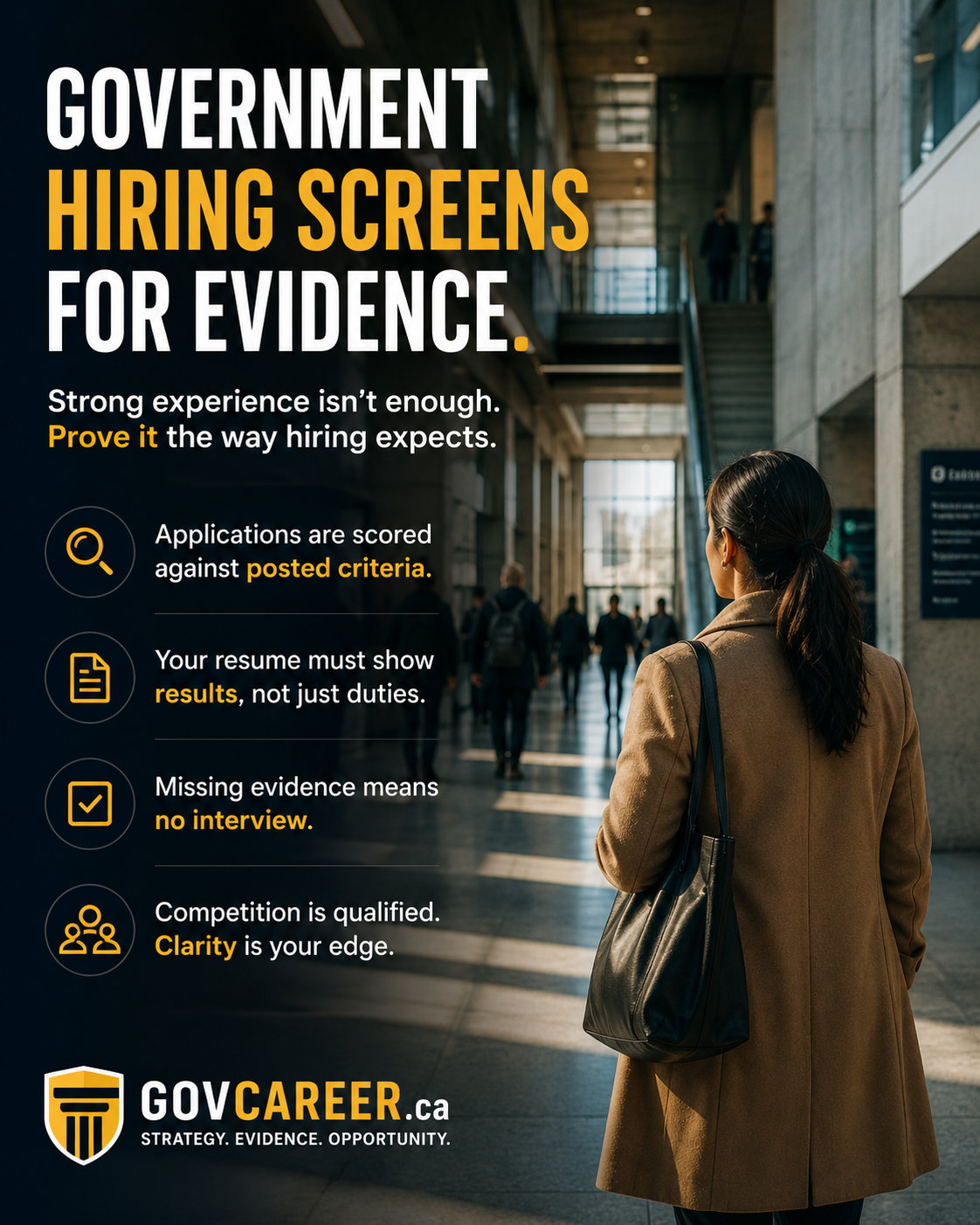
That means hiring managers and HR teams are not simply “looking for talent.” They are looking for evidence that matches the exact requirements of the competition.
In many federal government jobs, provincial government jobs, and municipal jobs, applications are screened literally.
If the posting asks for:
✔ stakeholder communication
✔ records management
✔ policy interpretation
✔ report writing
✔ project coordination
✔ client service
✔ risk assessment
✔ operational support
Then the resume must clearly demonstrate those exact elements.
Not generally.
Not indirectly.
Clearly.
This is one of the reasons many strong candidates struggle with government job applications despite having excellent backgrounds.
Their experience may absolutely qualify them for the role, but their applications are not aligned properly with the structured hiring process.
The Resume Problem Most Candidates Do Not Understand
Many people believe they need one perfect master resume for all public service careers.
That approach rarely works.
In structured hiring environments, there is no true “one-size-fits-all” government resume.
Every posting asks for different evidence.
Every competition emphasizes different competencies.
Every screening panel interprets qualifications through the specific operational needs of the role.
This means resume tailoring is not optional in many public-sector jobs.
It is foundational.
Candidates often spend weeks polishing formatting, adding design elements, rewriting summaries, and optimizing keywords without first asking the more important question:
“What type of government role should I actually target?”
That question should come before resume writing.
Because until the candidate identifies the correct stream, level, and direction, the resume often becomes a generic document trying to appeal to everybody.
And generic resumes perform poorly in structured hiring.
Before Resume Writing Comes Strategy
A successful public-sector job search usually begins with identifying fit.
That means understanding:
✔ which government streams align with your experience
✔ which public service careers are realistic for your background
✔ which levels make sense to target
✔ which competencies transfer properly
✔ which experiences should be emphasized
✔ which experiences may not matter as much in government screening
This is especially important for candidates transitioning from private-sector industries into government jobs in Canada.
Many professionals underestimate how transferable their backgrounds actually are.
For example:
→ project coordination may transfer into program support or operations roles
→ client communication may translate into stakeholder engagement
→ technical reporting may support analyst or compliance positions
→ documentation work may align with records or administrative streams
→ risk assessment may fit operational or regulatory environments
But none of that matters unless the candidate understands where those experiences belong.
That is why strategy matters before document work.
Structured Hiring Rewards Alignment, Not Guessing
Public-sector hiring systems are designed to reduce subjective hiring decisions.
That is one reason government jobs are attractive to many applicants.
Unlike some private-sector recruitment environments, structured hiring and merit-based hiring are intended to evaluate candidates against defined criteria rather than personality alone.
But there is a tradeoff.
The system rewards precision.
A candidate may be highly intelligent, experienced, and capable, but still fail screening because the application did not demonstrate the required qualifications clearly enough.
This is where many applicants become frustrated.
They assume:
“I am qualified. Why am I not hearing back?”
Often the answer is not capability.
The answer is application alignment.
In government job applications, the burden is on the candidate to connect their experience directly to the posting requirements.
The hiring panel will not automatically interpret transferable experience for you.
You must do that work yourself.
Why Many Government Resumes Fail Screening
A weak government resume is not always a bad resume.
Sometimes it is simply misaligned.
Common problems include:
✖ applying with the same resume everywhere
✖ emphasizing impressive but irrelevant experience
✖ failing to mirror job posting language
✖ using vague descriptions instead of concrete examples
✖ focusing on duties instead of demonstrated competencies
✖ ignoring operational terminology used in the posting
✖ assuming the hiring panel will “understand what you mean”
Public-sector screening often rewards clarity over creativity.
This surprises many candidates.
Especially experienced professionals.
People who have built successful careers privately may suddenly struggle when entering federal government jobs or provincial government jobs because the application structure is different from what they are used to.
The Real Goal Is Not a Better Resume
The real goal is application readiness.
That includes:
✔ understanding public-sector hiring systems
✔ identifying realistic target roles
✔ narrowing down the correct streams
✔ recognizing transferable competencies
✔ learning how screening criteria work
✔ extracting the right examples from past work
✔ tailoring responses to each competition
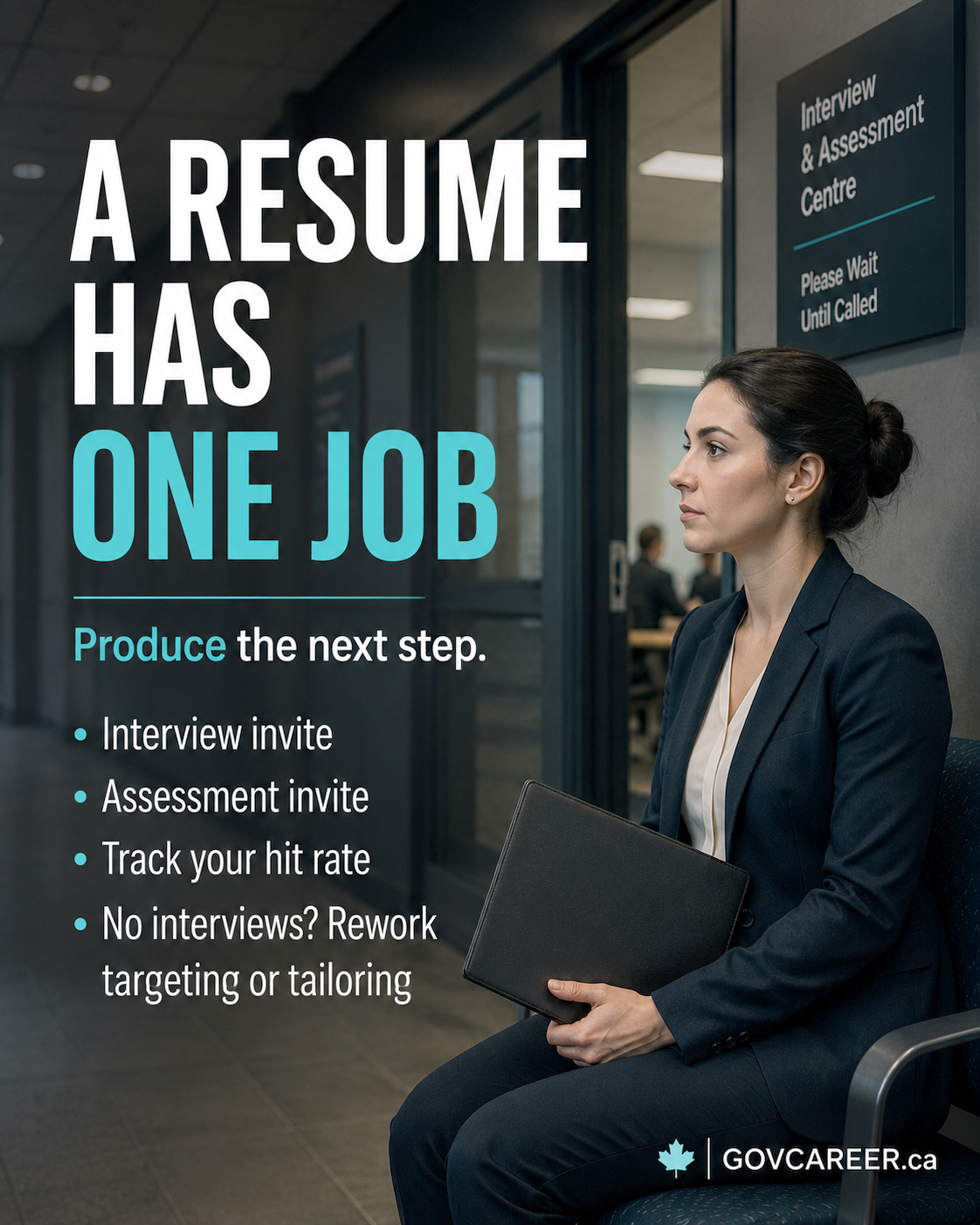
Once those pieces become clear, resume writing becomes much easier.
The candidate stops applying emotionally.
The process becomes strategic.
The resume becomes targeted instead of generic.
And most importantly, the candidate begins building reusable experience examples that can be adapted to multiple public-sector job applications.
Why Resume Tailoring Matters in Government Jobs
In many private-sector environments, a candidate can send a broad resume to dozens of employers and still generate interviews.
Government hiring is usually less forgiving.
Resume tailoring matters because each competition evaluates specific qualifications.
For example, one posting may emphasize:
✔ operational coordination
✔ scheduling
✔ records management
Another posting may prioritize:
✔ stakeholder engagement
✔ policy interpretation
✔ analytical writing
Another may focus heavily on:
✔ client service
✔ conflict resolution
✔ administrative procedures
The same candidate may qualify for all three positions.
But the application emphasis must change for each one.
This is why many public-sector applicants feel overwhelmed.
They realize quickly that government job applications require more preparation than simply uploading one resume repeatedly.
Government Hiring Is Not Impossible
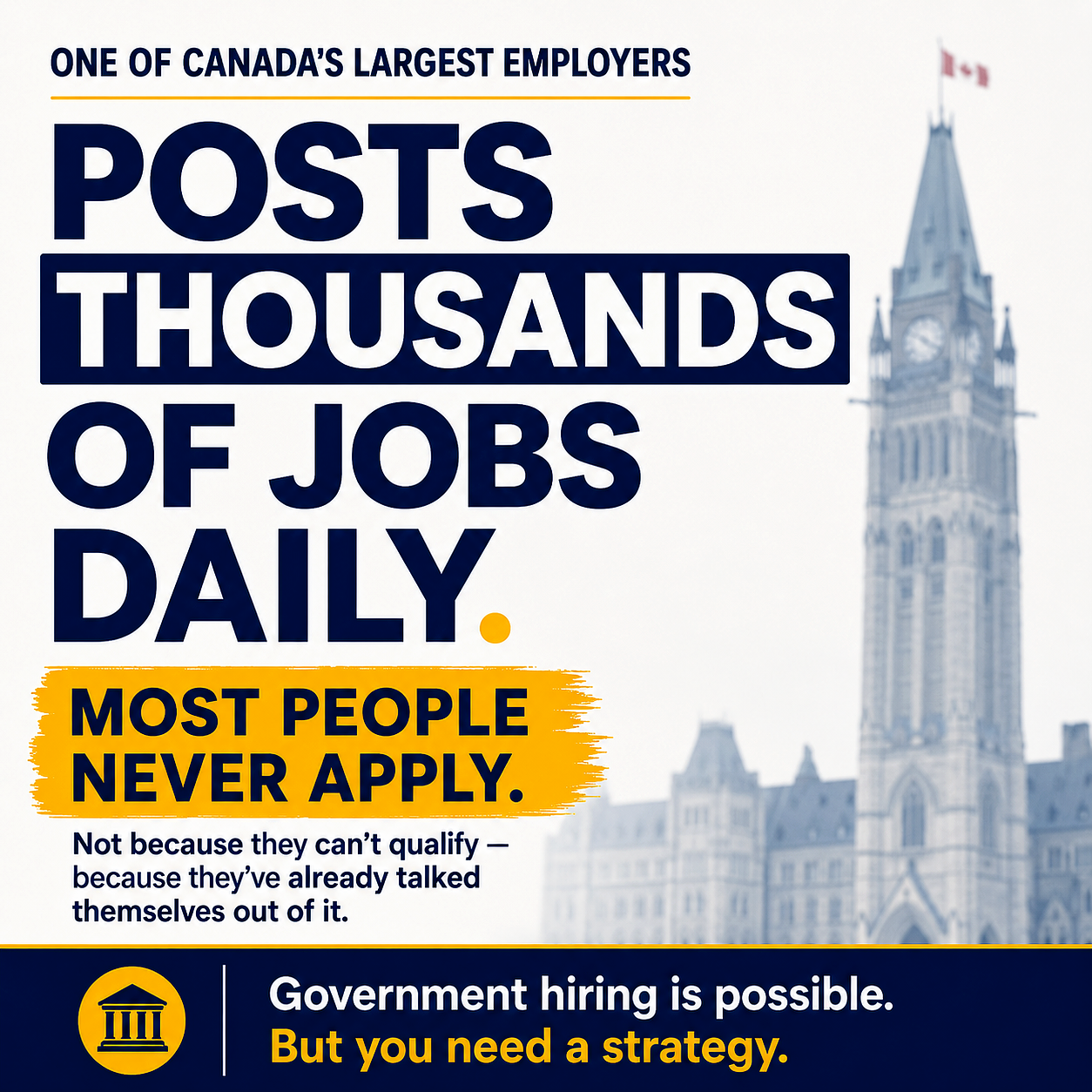
There is a widespread myth that government jobs are impossible to obtain unless someone has inside connections.
That belief discourages many strong candidates from even trying.
The reality is more nuanced.
Yes, public-sector hiring can be competitive.
Yes, processes can move slowly.
Yes, structured hiring requires effort.
But many candidates fail not because the system is closed, but because they approach it incorrectly.
Government hiring rewards preparation.
Candidates who understand the process, identify realistic targets, and tailor applications properly usually perform far better than candidates applying randomly.
This is especially true in Ontario, Ottawa, Toronto, the GTA, and other competitive public-sector markets where large numbers of applicants compete for the same opportunities.
Public Service Careers Require a Different Mindset
One of the biggest mindset shifts candidates must make is understanding that government job search is not purely about self-promotion.
It is about evidence.
Public-sector hiring panels want proof.
Proof that the candidate performed relevant work.
Proof that they meet screening criteria.
Proof that they can operate inside structured environments.
That is why successful applicants learn how to:
✔ extract strong examples from past experience
✔ quantify operational work clearly
✔ describe responsibilities precisely
✔ connect experience directly to posting requirements
✔ tailor applications strategically rather than emotionally
This is not always intuitive.
Especially for people transitioning from specialized industries or private-sector careers.
Final Thoughts
A strong resume absolutely matters in public-sector hiring.
But in many cases, the resume is not the first problem that needs solving.
The first problem is usually strategy.
Until a candidate understands where they fit, what streams to target, how structured hiring works, and how screening criteria are interpreted, resume writing alone often produces disappointing results.
Public-sector hiring rewards alignment.
That means understanding the system first, then building applications that respond directly to it.
The candidates who succeed most consistently in government jobs are usually not the people with the fanciest resumes.
They are the people who understand how the process actually works.
If you are exploring government jobs in Canada, Ontario, Ottawa, Toronto, the GTA, or broader public service careers and want help understanding where your background may fit, feel free to reach out. Sometimes the most important step is not rewriting the resume — it is building the right direction first.