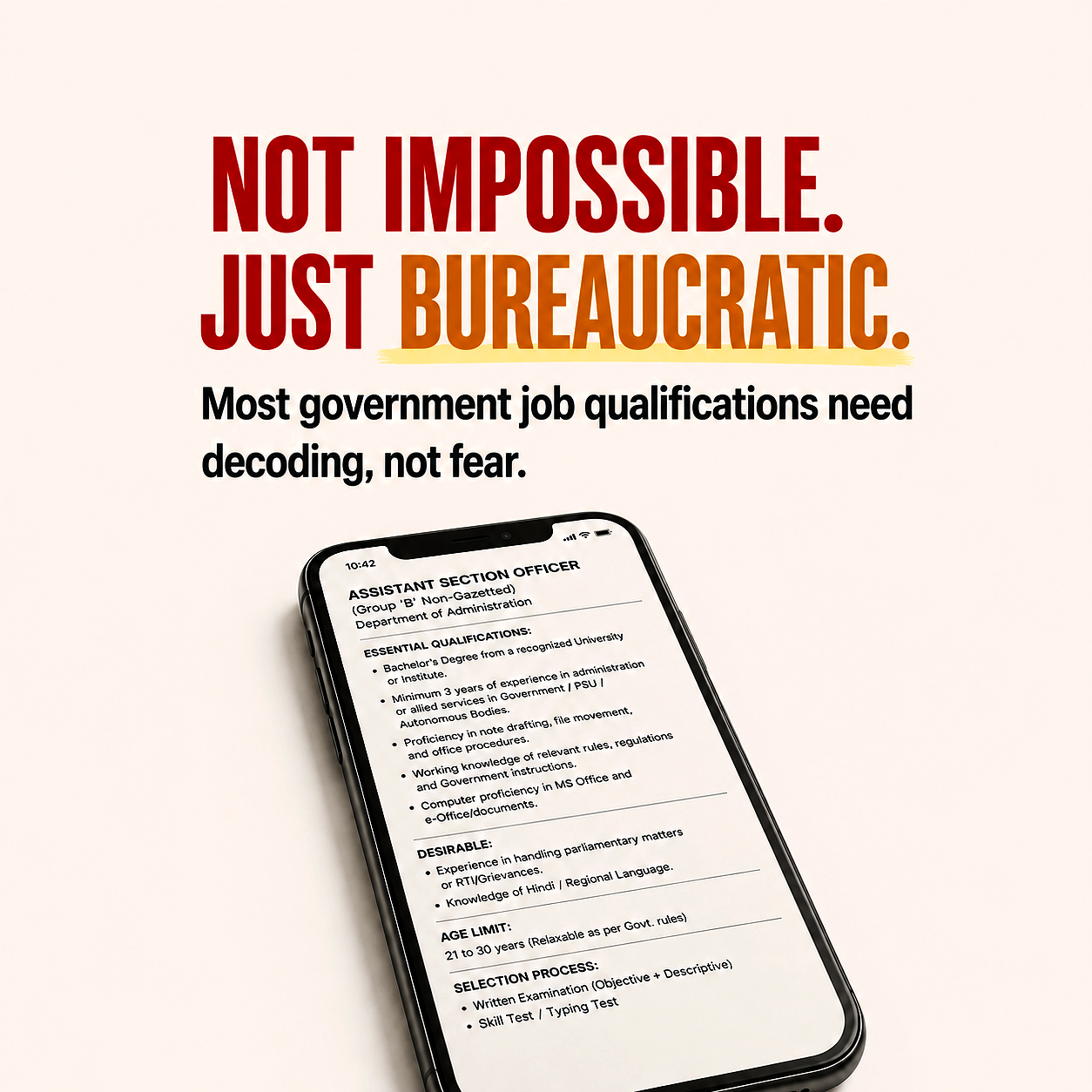
How to Read a Government Job Posting Before You Apply
Learning how to read a government job posting can help you decide whether an opportunity genuinely fits your qualifications before you spend hours rewriting your resume or preparing an application. Start by identifying who is hiring, who may apply, the required qualifications, the evidence you can provide, any additional or preferred qualifications, application instructions and conditions attached to the position.
A lot of job searches go wrong before the resume is even written.
You may have the education, technical knowledge and years of experience. But those strengths have limited value if you keep applying to positions that do not fit your background — or if you start writing the application before understanding what the employer is actually asking for.
That matters especially in a government job search in Canada, where employers may use formal eligibility requirements, qualification criteria, application instructions and assessment processes that differ by jurisdiction, organization and competition.
The first question should therefore not be:
“How do I improve my resume?”
It should be:
“Is this the right opportunity for me to pursue?”
Why the Job Posting Matters Before the Resume
A government or public-sector job posting is more than an advertisement describing an interesting position.
Depending on the employer and competition, it may tell you:
- who is eligible to apply;
- what education or credentials are required;
- what experience must be demonstrated;
- what additional qualifications may be considered;
- what competencies or abilities may be assessed later;
- what conditions of employment apply;
- what documents or screening responses must be submitted;
- where the position is located;
- the closing date; and
- how the application must be submitted.
Those details can directly affect whether you remain in the competition.
For example, the Ontario Public Service hiring process states that applications are screened and rated against the qualifications outlined in the job advertisement. Applicants whose resumes and cover letters best demonstrate how they meet those qualifications may move forward.
Federal hiring has its own terminology and procedures. Current Government of Canada application guidance explains that applicants may need to answer screening questions connected to qualifications such as education and experience and should provide details and examples rather than simply claiming to possess the qualification.
These examples do not mean every public-sector employer follows the same process.
They demonstrate the broader principle: the specific posting and employer instructions should control how you evaluate and prepare for that particular opportunity.
1. Who Is Actually Hiring?
Start with the employer, not the job title.
A title such as Project Coordinator, Policy Advisor, Administrative Assistant, Engineer, Program Officer or Business Analyst can appear across very different organizations.
The work may be similar in broad terms, but the context can be completely different.
A Project Coordinator working for a municipality may support different programs, stakeholders and operational requirements from someone with the same title at a hospital, university, Crown corporation or federal department.
Before applying, identify:
- the actual organization;
- the department, branch or business unit when provided;
- what the organization does;
- who it serves;
- the role’s apparent function inside the organization; and
- whether that environment makes sense for your background and career direction.
Do not assume that recognizing the title means you understand the opportunity.
This is also why a targeted government job search strategy is generally more useful than collecting large numbers of vaguely relevant postings.
You are not trying to find every available job.
You are trying to identify jobs where your qualifications can reasonably compete.
2. Who Is Allowed to Apply?
Before analysing your experience, check whether you are actually eligible for the competition.
Eligibility can vary substantially.
A posting may be open broadly to external applicants, restricted geographically, limited to existing employees, targeted to a particular applicant group or governed by other competition-specific conditions.
Federal advertisements, for example, may define an explicit “Who can apply” area or selection boundary. Other organizations use different wording.
Do not assume that finding the posting means you are eligible for it.
Read the entire advertisement and identify any eligibility restriction before investing significant time in the application.
If you do not meet a genuine eligibility condition, rewriting your resume will not solve that problem.

3. What Qualifications Are Actually Required?
Next, identify the qualifications the employer treats as necessary for the position.
Do not read a government posting as one long undifferentiated list.
Different criteria can have different functions.
For example, federal postings may distinguish essential qualifications from asset qualifications and other organizational or operational requirements. The Treasury Board of Canada Secretariat’s guidance on understanding federal job opportunities explains that candidates must demonstrate the essential qualifications established for the process.
Ontario uses somewhat different terminology. Its official job-ad definitions explain that qualifications include the knowledge, skills, abilities and competencies necessary for the position and that applications must demonstrate how candidates meet them.
Other public-sector employers may use terms such as:
- required;
- mandatory;
- minimum;
- essential;
- preferred;
- asset;
- additional;
- desirable; or
- considered an advantage.
Do not impose terminology from one employer onto another.
Read the categories exactly as the employer presents them and determine which requirements appear to control whether you can advance.
4. Can You Actually Prove the Experience They Want?
This is where many capable candidates overestimate the strength of their match.
They see a familiar title or general function and think:
“I’ve done this kind of work.”
That may be true.
But structured hiring can require something more specific: visible evidence that connects your actual experience to the stated requirement.
Suppose a posting requests experience coordinating projects involving multiple stakeholders.
It may not be enough that your previous title was Project Coordinator.
Ask yourself:
- What projects did I coordinate?
- What was my personal responsibility?
- Which stakeholders were involved?
- What decisions or activities did I coordinate?
- What level of complexity was involved?
- How long or how often did I perform this work?
- What outcome can I credibly describe?
Your title is context.
Your evidence is what demonstrates the qualification.
This distinction becomes particularly important when moving between industries or from private-sector, nonprofit, international or self-employed experience into government and public-sector roles.
Transferable experience can be highly relevant.
But the employer should not have to reconstruct the connection for you.
5. Where Does Your Experience Match the Posting?
Once you understand the requirements, make a simple evidence map before you touch the resume.
Take each important requirement and identify where it appears in your background.
For example:
| Posting requirement | Your possible evidence |
|---|---|
| Project coordination | Coordinated implementation of a two-year operational project |
| Stakeholder communication | Worked with clients, contractors, technical staff and management |
| Report writing | Prepared monthly operational and decision-support reports |
| Data analysis | Analysed service and performance data using Excel and Power BI |
| Policy interpretation | Applied regulatory or organizational requirements to operational decisions |
The objective is not to invent a perfect match.
It is to determine whether a real match already exists.
Look beyond identical job titles.
Relevant evidence may come from:
- employment;
- contract assignments;
- consulting;
- projects;
- professional practice;
- volunteer responsibilities;
- research;
- academic work when appropriate; or
- other legitimate experience permitted by the requirement.
The important question is whether the evidence actually satisfies what the posting asks for.
6. Where Does Your Experience Not Match?
This is equally important.
Job searching becomes expensive when every partial match becomes an application.
Candidates sometimes focus so heavily on the requirements they possess that they stop noticing important requirements they do not possess.
A posting may look attractive because you match six items.
But the seventh may be a mandatory licence you do not hold.
Or a specific type of experience you have never performed.
Or an essential educational requirement you cannot demonstrate.
Or a language requirement that applies to the position.
Do not talk yourself into an opportunity merely because you want the job.
Ask:
- Which requirements do I clearly meet?
- Which requirements can I demonstrate through transferable experience?
- Which requirements are uncertain?
- Which requirements do I genuinely lack?
- Are the missing requirements mandatory, essential, preferred or merely advantageous?
That distinction can save hours.
If the requirement is unclear and materially affects whether you should apply, use the employer’s official contact route when one is provided rather than guessing.
7. What Does the Application Actually Require?
After deciding that the role may fit, examine the application instructions carefully.
Do not assume that every employer wants the same package.
One competition may require a resume.
Another may require a resume and cover letter.
Another may include screening questions.
Another may require information to be entered directly into an online profile.
Application systems and submission requirements vary across employers and even across competitions.
For example, the Ontario Public Service tells applicants to follow the “How to Apply” section of each advertisement because the accepted method can differ by competition.
The City of Ottawa similarly uses an online candidate profile containing education, work or volunteer experience and qualifications, and candidates use that system to apply to posted opportunities. Its official job-search and application guidance describes the information maintained in the candidate profile and application process.
Federal GC Jobs has its own requirements and may ask applicants to complete screening questions while submitting an application.
Therefore, before preparing anything, identify exactly what the particular competition requires.
Then prepare that application.
Not the application you usually send.
Not the package another employer requested.
The one this opportunity requires.
8. Can You Meet the Practical Conditions of the Job?
Qualification fit is not the only consideration.
Review the entire posting for practical conditions that could determine whether the job is realistic for you.
Depending on the opportunity, these may concern:
- work location;
- onsite, hybrid or remote arrangements;
- travel;
- shifts;
- overtime;
- driver’s licence requirements;
- professional licensing;
- language;
- security or background screening;
- physical requirements;
- term or permanent status;
- schedule; or
- other conditions of employment.
A strong professional match is not useful if you cannot satisfy a material condition attached to the position.
Do this check early.
Do not wait until after spending three hours on the application.
9. Is the Opportunity Worth Your Application Time?
Finally, make a decision.
Do not automatically apply because the posting appeared in your search results.
A useful opportunity normally has several things working in its favour:
- you are eligible to apply;
- you meet the important required qualifications;
- you have credible evidence for the experience being requested;
- the work is reasonably aligned with your career direction;
- the practical conditions are acceptable;
- the application requirements are manageable before the deadline; and
- you are willing to invest enough time to prepare the application properly.
This does not mean applying only when you are a perfect candidate.
A perfect match is an unrealistic standard.
It means distinguishing between a realistic competition and an application built mainly on hope.
That is an important difference.
Why Applying to More Jobs Does Not Automatically Improve Your Government Job Search
Application volume feels productive because it creates a measurable number.
Ten applications look better than two.
Fifty look better than ten.
But the number itself says nothing about whether those opportunities fit your background.
Mass applying can create another problem: it reduces the time available to understand each competition and present your evidence properly.
You may end up producing more applications while lowering the quality of each one.
A stronger job search separates two activities:
Discovery: Find a reasonably broad range of potentially relevant opportunities.
Selection: Decide which of those opportunities deserve serious application effort.
If you need to widen your discovery process, start with where to find government jobs in Canada and build a list of official employer career pages relevant to your profession, location and career level.
Then become selective.
The objective is not the largest possible application count.
It is a stronger pipeline of realistic opportunities.
What to Do Before You Start Rewriting Your Resume
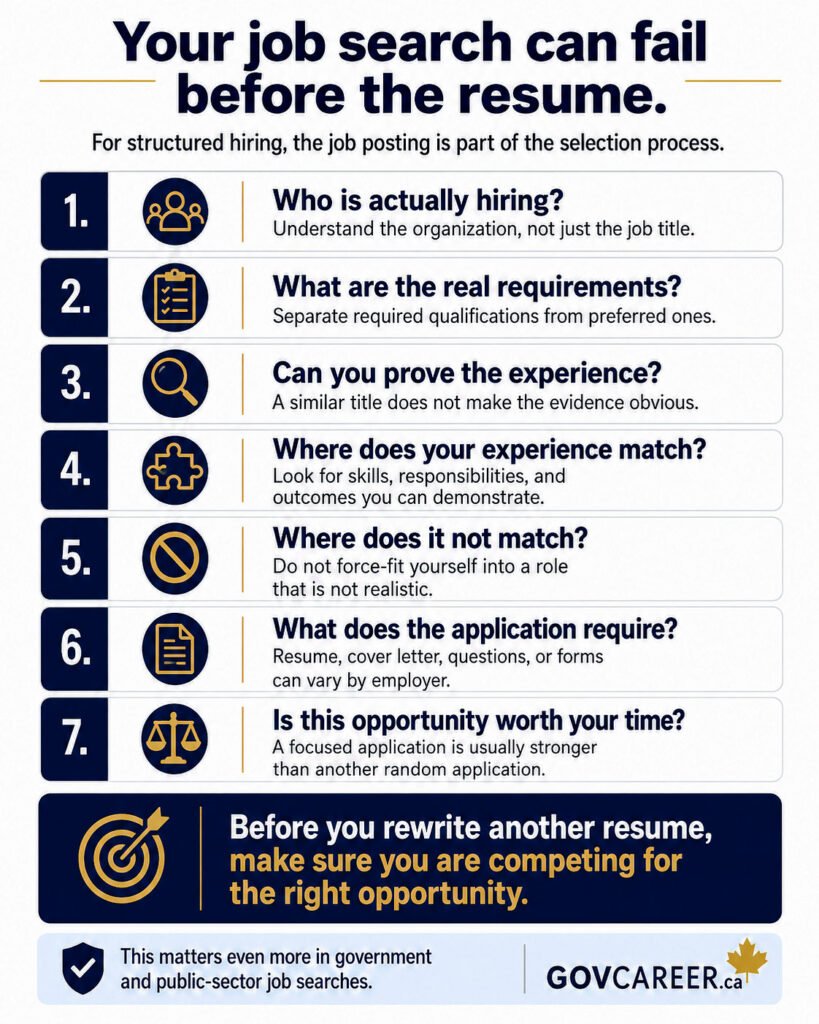
Before tailoring a resume, you should be able to answer seven questions:
- Who is actually hiring?
- Am I eligible to apply?
- What qualifications appear to be required?
- Can I prove the experience being requested?
- Where does my background match?
- Where does it not match?
- What exactly must I submit?
If you cannot answer those questions, you are probably not ready to write the application.
Once the opportunity passes that test, then the resume becomes important.
At that point, you can tailor your resume to the job posting so the relevant qualifications and evidence are easier to recognize.
That sequence matters.
First decide whether the opportunity deserves an application.
Then build the strongest application you can for that opportunity.
Frequently Asked Questions
Should I apply for a government job if I do not meet every qualification?
It depends on which qualification you do not meet. A missing essential or mandatory requirement can prevent you from advancing, while an asset or preferred qualification may play a different role. Use the terminology and instructions in the specific posting rather than assuming every listed qualification has equal status.
Are government job requirements negotiable?
Do not assume that a stated mandatory or essential qualification is negotiable. Government and public-sector employers establish requirements differently, and the specific posting controls. If a requirement is genuinely unclear and an official contact is provided, ask for clarification rather than interpreting it in your favour.
Should I tailor my resume before deciding whether I qualify?
Usually, no. First determine whether you are eligible, whether the opportunity fits your background and whether you can provide credible evidence for the important requirements. Resume tailoring makes more sense after the role has passed that initial evaluation.
Does having a similar job title mean I qualify?
No. A similar title can indicate potentially relevant experience, but it does not establish that you meet the particular requirements of the competition. Compare the actual responsibilities and qualifications with work you can demonstrate.
How many government jobs should I apply to?
There is no useful universal number. Application quality and opportunity fit matter more than an arbitrary application count. A smaller number of realistic, properly prepared applications can be a more rational use of your time than repeatedly applying to weak matches.
Conclusion
Understanding how to read a government job posting changes the starting point of the application process.
Instead of immediately rewriting your resume, first determine whether the opportunity makes sense.
Identify who is hiring. Check eligibility. Separate the important requirements from additional ones. Map those requirements against your actual evidence. Identify the gaps. Read the application instructions. Check the practical conditions. Then decide whether the competition deserves your time.
You may already have strong experience.
The more important question is whether you are pursuing opportunities where that experience genuinely fits — and whether you can make that fit clear through the employer’s actual process.
A stronger government job search starts before the resume.