The Best Career Move You Can Make Has Nothing to Do With Leaving Your Job
Most people treat job searching like a fire alarm. They ignore it until something is actually burning.
If you work in the Canadian public sector — or you’re trying to get in — that approach will cost you more than you think. Not because opportunity disappears, but because the skills you need to compete for it do.
The Real Problem Nobody Talks About
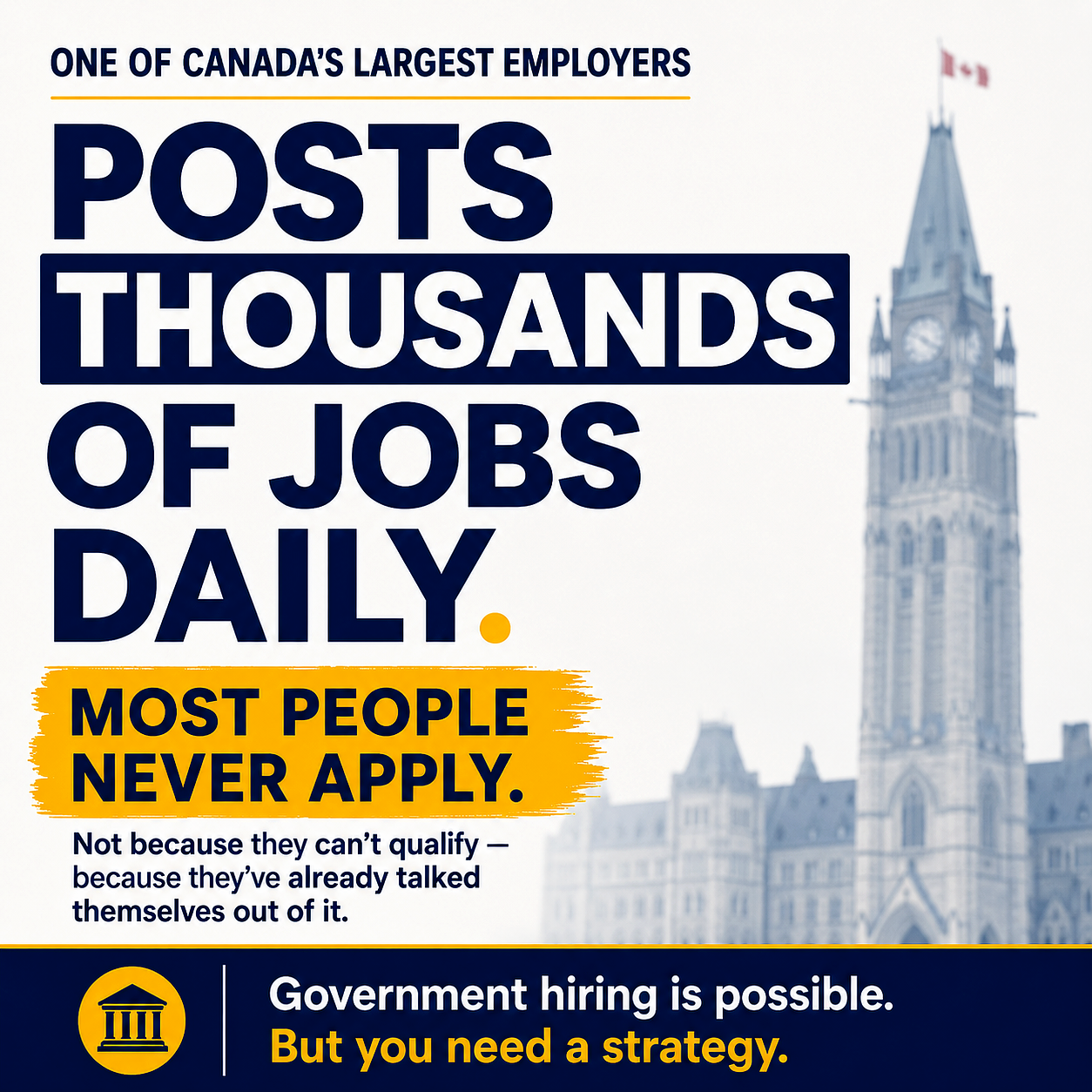
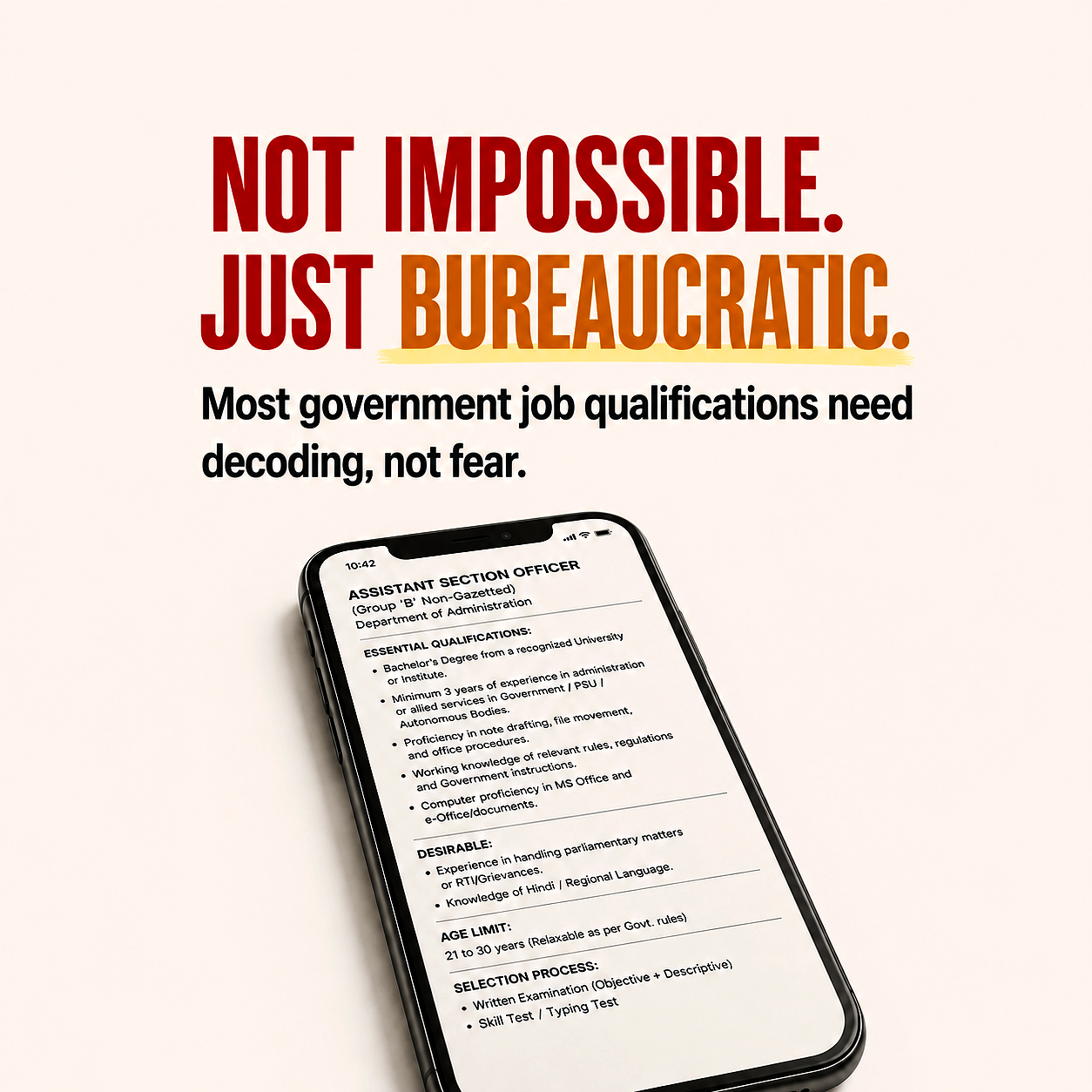
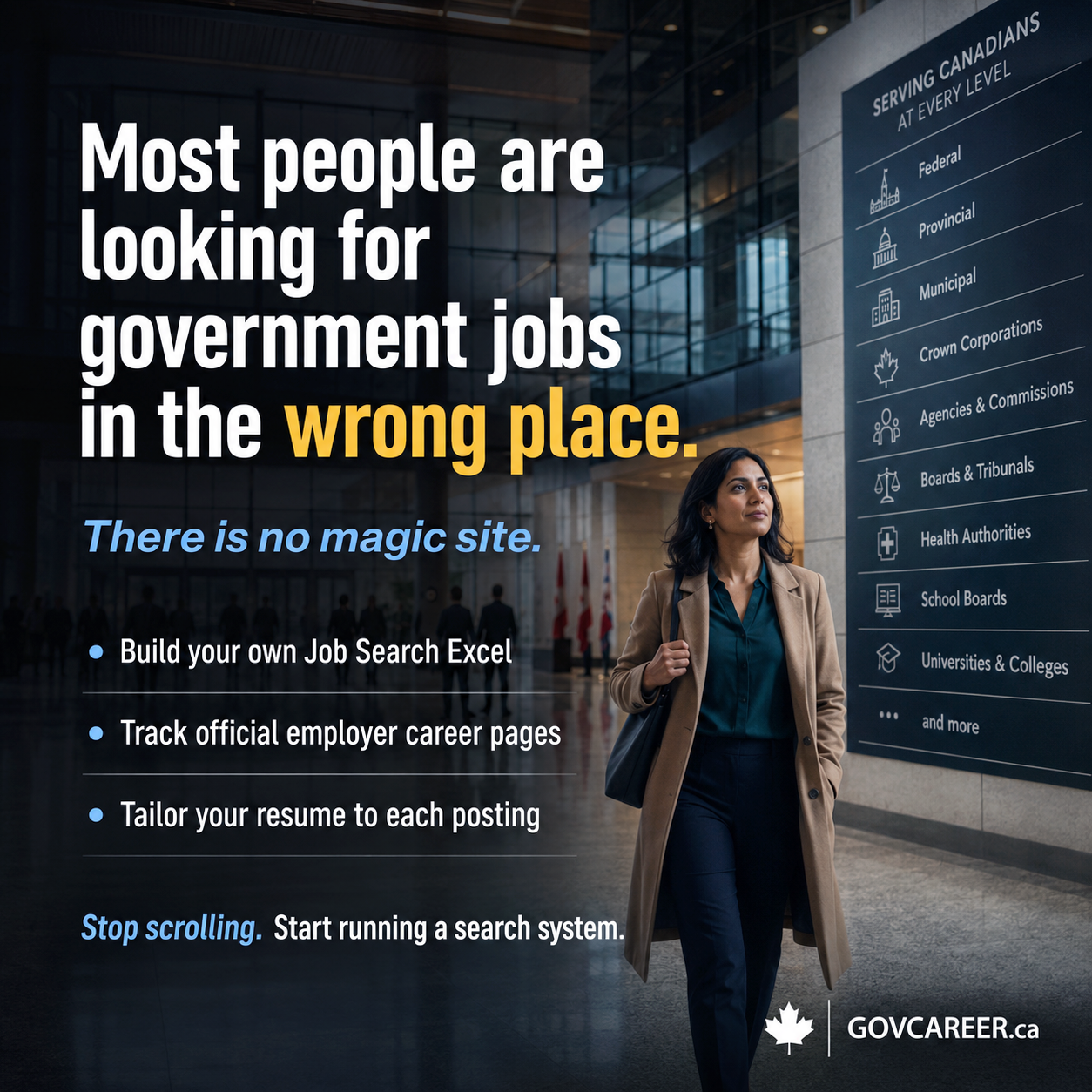
Government and public-sector hiring in Canada — federal, provincial, or municipal — runs on structured, merit-based hiring. That means every resume, every cover letter, every interview answer is evaluated against defined criteria. There is a scoring logic behind every posting, whether it’s a federal role listed on Canada.ca, a position on Ontario’s public service job board, or something posted through your city.
That logic has to be learned. And once learned, it has to be maintained.
The problem is that most people only engage with that logic when they’re desperate. And desperation is the worst possible moment to learn how structured hiring actually works.
Understanding how government job search in Canada operates — how postings get written, how resumes get screened, how interviews get scored — is not something you figure out in a week when you need a new job. It takes real exposure, real practice, and active repetition to stay sharp. If you want a broader foundation for that, this government job search guide for Canada is a good place to start.
What Actually Goes Stale When You Stop
Most people assume their resume is the thing that gets outdated. That is part of it, but it is not the whole picture.
Here is what actually erodes when you stop engaging with the market:
Your resume tailoring skills. Writing a resume that connects your real background to a specific posting’s screening criteria is a skill. It requires reading the job posting carefully, extracting what evaluators are actually scoring, and then presenting your experience in language that makes the connection visible. Do this regularly and it becomes a muscle. Walk away from it for two or three years and you will spend your worst weeks trying to remember how to do it.
Your awareness of what the market values. Job postings are a real-time signal of what skills, roles, and functions are in demand right now. Reading postings regularly — even ones you would never apply to — tells you what is shifting inside your field, what titles are emerging, what experience is being requested in ways it wasn’t two years ago. Most professional development events will not give you that. Postings will.
Your network. Staying connected to people outside your own organization is not disloyalty to your employer. It is basic calibration. When you actively engage with your professional community — even casually, even through conversation — you stay aware of what is happening outside your own team and department. Networks go cold fast when nothing is driving contact, and cold networks are almost useless when you actually need them.
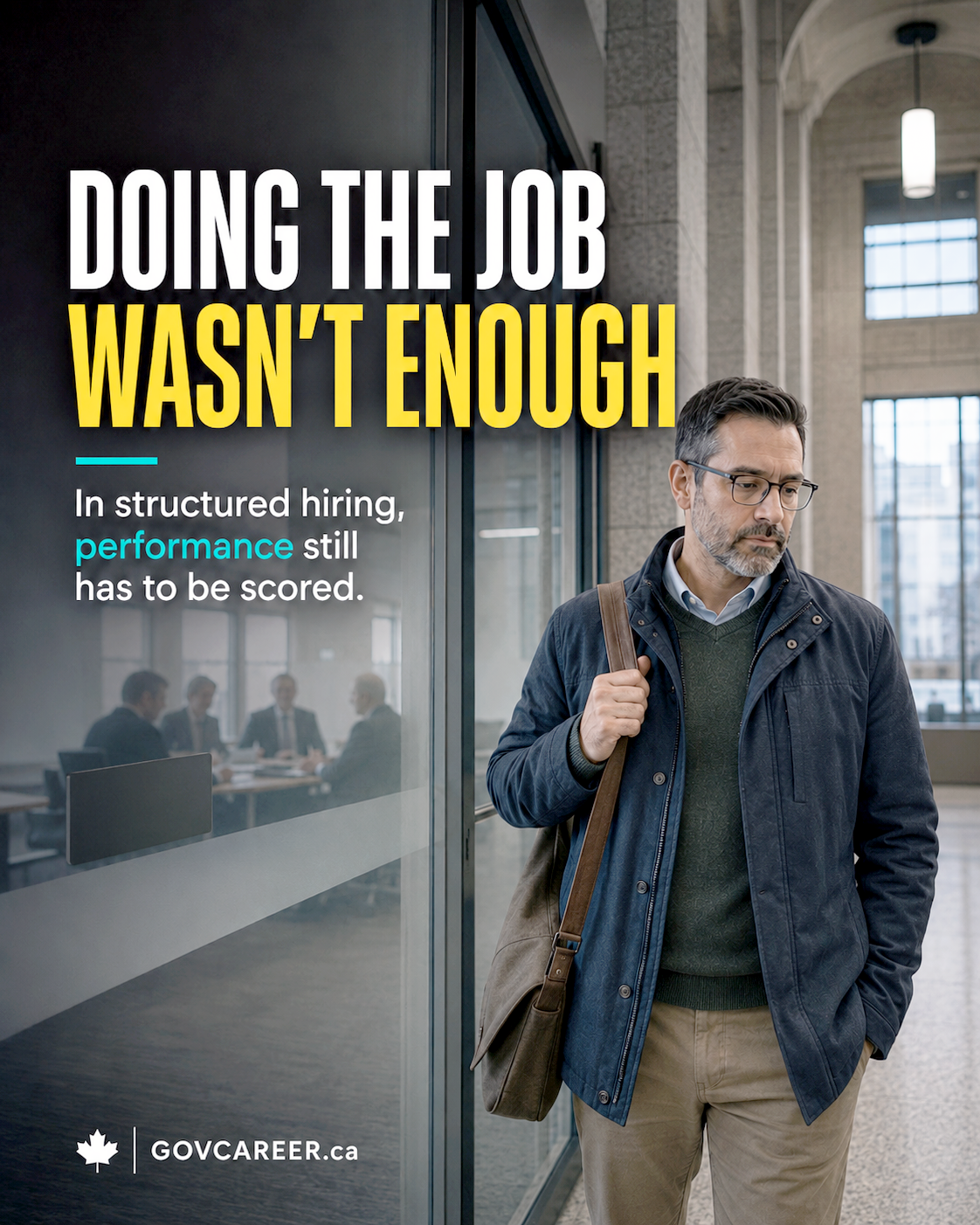
Your interview instincts. Structured government interviews are not casual conversations. They are scored evaluations where you are expected to produce specific evidence, in a specific format, against specific competencies. That takes practice to do well under pressure. If you have not done a structured interview in two or three years, the first one back will feel like starting over. The second one will be better. But you should not be having that experience for the first time when the stakes are real.
Why Applying When You Don’t Have To Is a Better Strategy
Applying to a government or public-sector role when your job is fine and you have nothing to prove is a completely different experience from applying under pressure.
You can take more time with the resume. You can research the role properly. You can tailor the application deliberately rather than reactively. You can prepare for the interview without anxiety distorting the process. And if the result is not what you hoped for, it is information — not a crisis.
That is how people develop real application and interview skill. Not by taking a course about it. By actually doing it, in low-stakes conditions, repeatedly enough that the mechanics become reliable.
The same logic applies to resume writing and cover-letter development. Tailoring a government application is not the same as editing a private-sector resume. Resume tailoring for public-sector roles means mapping your actual experience to the stated criteria — the qualifications, the asset criteria, the context requirements, the preferred competencies — and presenting that map clearly enough that the person screening your file can recognize the match without effort.
That skill gets better with practice. It gets worse with neglect.
The Public Sector Has Its Own Logic — And It Doesn’t Wait
If you are currently working in the public sector and not actively engaging with internal competitions or external postings, you are allowing your application and interview skills to drift at exactly the moment they should be sharpening.
Public-sector hiring — whether federal, provincial, or municipal — operates through structured merit-based processes that do not reward familiarity. They reward preparation. A manager who has been in the same role for five years and applies to a promotion competition without having done any active application development during that time is in a worse position than someone with fewer years who has stayed sharp.
Internal career growth inside the public sector also runs on the same hiring logic. Internal competitions, acting assignments that convert to permanent roles, advancement within your current classification — all of these are evaluated through merit-based hiring processes. Understanding how screening criteria work, how interview panels score responses, and how to position your experience clearly is not just a job-search skill. It is a career-management skill that keeps working long after you get in.
For anyone trying to enter the public sector from the private side — whether through federal government opportunities or municipal postings like those at the City of Toronto or City of Ottawa — staying active with public-sector postings is also one of the most useful ways to understand what transferable experience actually means in this context. Reading postings regularly helps you learn how to frame private-sector experience in the language public-sector screeners recognize.
What Staying Active Actually Looks Like
Staying active in the government job market does not mean applying to fifty roles a month or treating your spare time like a second job.
In practice it looks like:
• Reading relevant postings once or twice a month, even if you have no intention of applying • Going through the full application process for one interesting role every few months — actual tailoring, actual writing, actual submission • Reaching out to one or two people in your professional network every month with something genuinely useful to say • Keeping your resume updated in real time rather than reconstructing it under pressure • Preparing one or two structured interview answers for roles you are targeting, even if the competition has not opened yet
None of this requires dramatic effort. It requires regularity.
The people who move well inside government — who get shortlisted consistently, who advance internally, who make lateral moves when they want to rather than when they have to — are almost always people who never fully stopped engaging with the process. They applied when things were fine. They maintained the skills when the stakes were low. They did not wait until they needed to.
The Moment Most People Regret
There is a moment that comes up regularly in conversations with people looking for help with a government application. They have been in the same role for a few years, something has changed — a restructuring, a difficult manager, a stagnating team — and now they need to move. Quickly.
The resume has not been touched in three years. The last interview was for the current job. Nobody in the network has been contacted in eighteen months. The application is due in two weeks.
That situation is fixable. But it is significantly harder than it needed to be, and the outcome is less predictable than it would have been with a year of steady low-level engagement behind it.
The work of building a strong government application — understanding the posting, extracting the right evidence, writing a resume that passes screening, preparing structured interview answers that score points — is work that compounds over time. It does not compress well into two weeks of panic.
Start Before You Need To
The best time to apply for a government job is when you do not particularly need to.
The second best time is now, whatever your current situation.
If you are already active and simply want to understand how to make your applications stronger — how to read a posting for screening criteria, how to write a resume that a tired section supervisor will actually shortlist, how to prepare interview answers that hold up under structured scoring — the mechanics are learnable. They take some time and some honest assessment of where your application currently stands.
If you want help with that, feel free to reach out. No pressure, no pitch. Just a straightforward conversation about where you are and what might actually help.