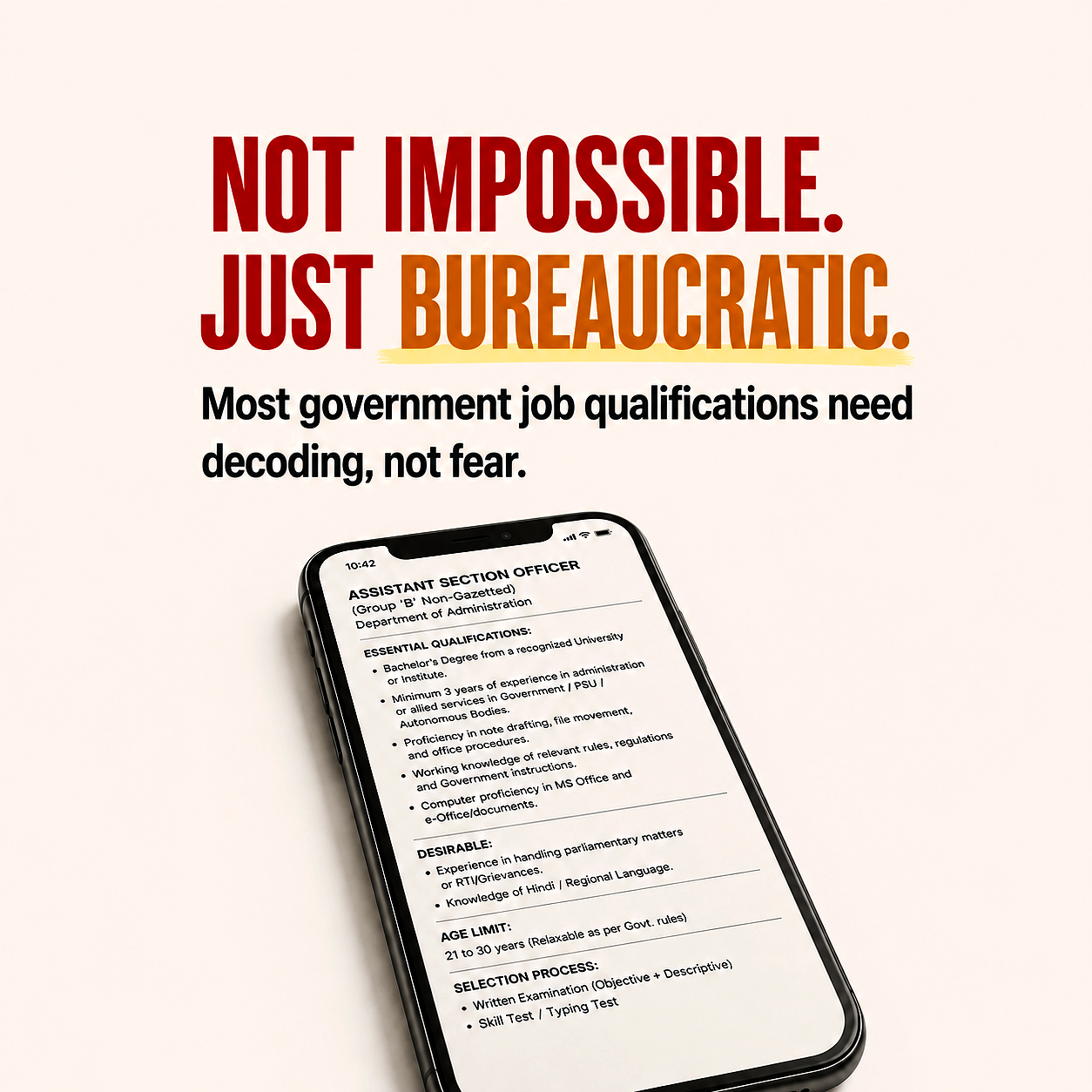
Are Government Jobs Already Spoken For? Why Qualified Candidates Should Still Apply
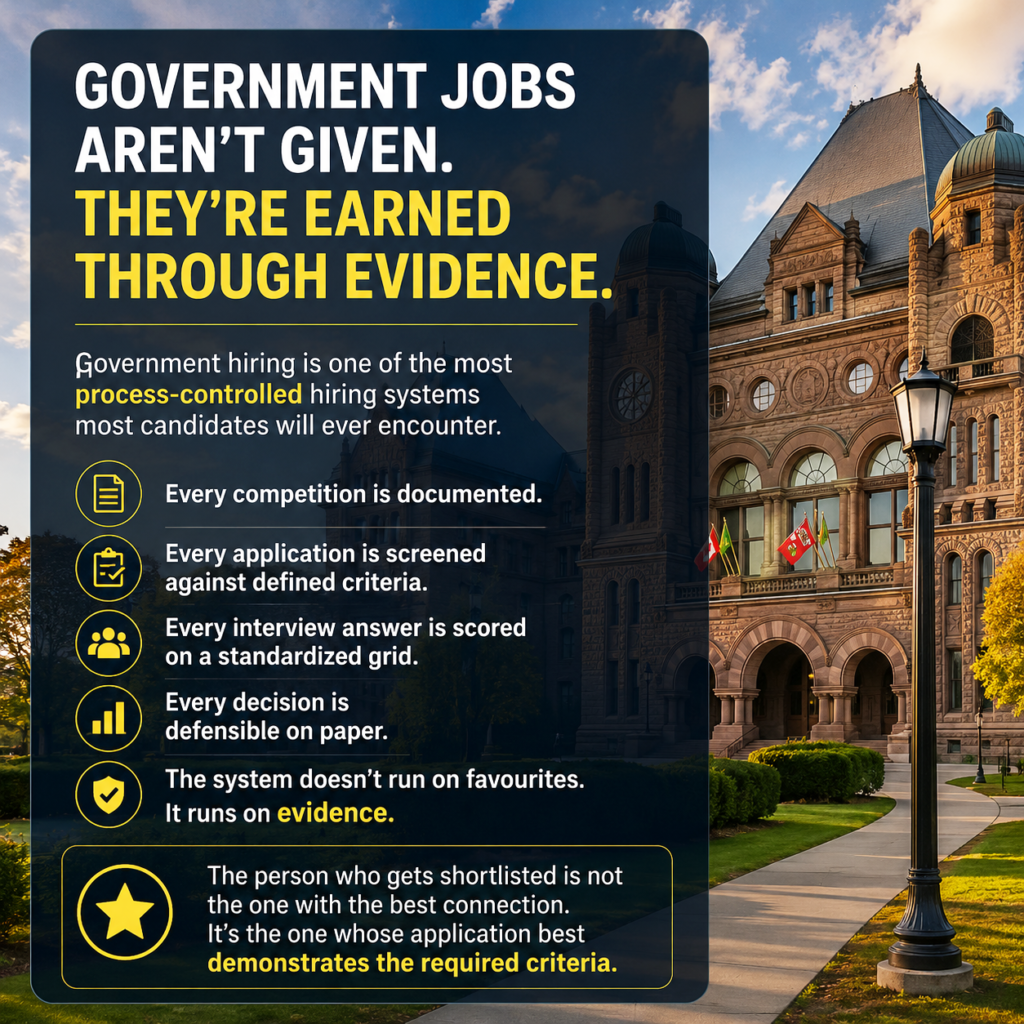
Many people do not avoid government jobs because they are unqualified. They avoid them because they believe the decision has already been made before they apply.
Government jobs in Canada are often misunderstood. Many qualified candidates avoid public sector jobs because they believe hiring is based on connections, internal favourites, or decisions made behind closed doors. In reality, public-sector hiring is usually structured around documented competitions, defined screening criteria, merit-based hiring, resume tailoring, and structured interviews. The system is not perfect, but it is far more process-controlled than many applicants assume.
The Myth That Stops People Before They Apply
Most people I speak with are not rejecting government jobs because they lack experience. They are rejecting them because they believe the system is closed.
They say things like:
“It is who you know.”
“They already have someone in mind.”
“They only hire from inside.”
“The competition is just a formality.”
Those beliefs are powerful because they sound realistic. Many people have seen unfairness in hiring somewhere. Many have applied for jobs and heard nothing back. Many know someone who worked in government and moved into another role. From the outside, it can easily look like the system is locked.
But that assumption causes serious damage. It keeps qualified people from applying to stable, well-paying public service careers. It also creates a false explanation for rejection. Instead of asking whether the application clearly demonstrated the job posting requirements, candidates assume the result was predetermined.
That is where many people lose control of their government job search in Canada. They do not fail because the door is permanently closed. They fail because they do not understand how the door is assessed. If you are new to the process, it helps to start with a clear overview of how government job search works in Canada before assuming the system is impossible to enter.
Government Hiring Is Not Perfect, But It Is Not Random
Let’s be precise. Government hiring is not perfect. No hiring system is perfect because people are still involved. Human judgment, organizational needs, internal movement, budget issues, timing, and operational realities can all affect outcomes.
But that does not mean government hiring is random or purely connection-based.
In many public-sector hiring processes, especially in structured and merit-based hiring environments, the employer must document how candidates are assessed. The competition usually has defined criteria. Applications are reviewed against those criteria. Interviews often use standardized questions and scoring guides. Hiring decisions are expected to be defensible.
That matters.
It means the process is not mainly about charm, personality, or someone “liking” you. It is about whether the evidence in your application and interview shows that you meet the required qualifications.
This is why government job applications must be approached differently from many private-sector applications. In the private sector, candidates are often told to build a strong personal brand, write a persuasive summary, use a modern format, and make the hiring manager interested.
That advice is not automatically wrong. But in public-sector hiring, it is incomplete.
A polished resume that does not clearly answer the screening criteria can still fail. A confident interview answer that does not address the question being scored can still lose points. A qualified candidate who assumes their experience is obvious may never get shortlisted.
What “Merit-Based Hiring” Actually Means for Applicants
Merit-based hiring does not mean the most impressive person always gets the job. It means candidates are assessed against requirements connected to the role.
That distinction is important.
A candidate may have excellent experience, but if the resume does not show the specific qualifications requested in the job posting, the screener may not be able to credit that experience. A candidate may be highly capable, but if the interview answer is too general, the panel may not have enough evidence to score it strongly.
In structured hiring, the issue is not only what you have done. The issue is what you prove.
This is where many government job applications go wrong. Candidates write resumes as career summaries. They describe responsibilities broadly. They use phrases like “managed multiple priorities,” “worked with stakeholders,” “supported operations,” or “contributed to projects.”
Those statements may be true, but they may not be enough.
If the posting asks for experience preparing reports, the resume should show report writing clearly. If it asks for policy interpretation, the resume should show policy interpretation. If it asks for public-facing service, program delivery, case management, inspections, budgeting, administration, technical knowledge, or supervisory experience, the evidence should be visible.
Not implied.
Not buried.
Not left for the screener to infer.
This is why resume tailoring matters so much in public-sector hiring. Resume writing for government jobs is not mainly about sounding impressive. It is about making the match between your background and the job posting requirements easy to verify.
Why Internal Candidates Do Not Mean the Process Is Closed
One of the most common objections is this: “They hire from inside.”
Sometimes, internal candidates do win competitions. That is true. Internal applicants may understand the organization, the terminology, the work environment, and the expectations better than outside candidates. They may also have experience that is directly aligned with the role.
But that does not automatically mean the process is fake.
An internal candidate still has to compete within the process. They still need to demonstrate the required criteria. They still need to perform in the interview. They still need to provide evidence that can be scored and defended.
The real lesson is not “do not apply because internal candidates exist.”
The real lesson is that external candidates must apply intelligently.
An external candidate should not send a generic resume and hope the employer connects the dots. They must study the job posting, identify the required experience, and present their background in a way that speaks directly to the screening criteria.
For candidates targeting federal government jobs, provincial government jobs, or municipal jobs, this mindset is essential. The public sector is not usually looking for a mysterious hidden signal. It is looking for documented evidence that the candidate meets the requirements.
Why People Believe the Myth
The myth that government jobs are already spoken for survives because it is emotionally convenient and partly understandable.
When someone applies and receives no response, they want an explanation. “The system was rigged” feels easier than “my application did not clearly demonstrate the criteria.” It removes personal uncertainty. It makes the rejection feel external and unavoidable.
Sometimes that explanation may feel supported by experience. A person may know someone who applied many times and never got shortlisted. Someone else may have heard that a successful candidate already worked in the department. Another person may have seen a posting that looked unusually specific.
But even when those situations happen, they do not prove that all government hiring is closed.
More often, the problem is much simpler. The application did not pass screening. The resume did not show the required experience clearly enough. The candidate applied to roles that were not a strong match. The application was written like a private-sector resume instead of a structured hiring document.
That is not an insult to the candidate. It is a process issue.
Most people were never taught how public-sector hiring works. They were told to write a good resume. They were not taught how to read screening criteria, map their experience to a job posting, structure evidence, prepare for scored interviews, or understand what a hiring panel is actually evaluating.
The Posting Is Not Just a Job Description
A government job posting is not only describing the role. It is also giving you clues about how your application may be screened.
That is why reading the posting properly is one of the most important parts of government job search strategy.
Many candidates look at the title, salary, location, and general duties. Then they decide whether the job sounds interesting. That is not enough.
You need to look at the posting like an assessment document. What education is required? What experience is required? What knowledge is being requested? What skills are repeated? What words appear in the qualifications section? What competencies appear in the interview or assessment information, if provided?
Those details matter because they tell you what the employer needs to see.
If the posting says “experience coordinating projects,” your resume should not only say that you “supported operational initiatives.” It should show what projects you coordinated, your role, the scope, the stakeholders, the timelines, and the outcome.
If the posting says “experience interpreting legislation, policies, or procedures,” your resume should not simply say that you “ensured compliance.” It should show what you interpreted, how you applied it, and what decisions or actions resulted.
If the posting says “experience providing client service,” your resume should show the type of clients, the setting, the complexity, and the communication involved.
This is not about keyword stuffing. It is about evidence alignment.
Where to Find Official Government Job Postings
Candidates should also use official job boards instead of relying only on general job sites. General job boards can be useful, but official government portals usually provide the most reliable access to current competitions, eligibility details, and application instructions.
For federal opportunities, start with the official Government of Canada job opportunities page. If you are applying federally, it is also useful to understand how to apply for Government of Canada jobs and what candidates can expect during the federal hiring process.
For Ontario candidates, the Ontario Public Service jobs portal is a core source for provincial government jobs. Candidates outside Ontario can also review official provincial portals such as BC Public Service job postings, Government of Alberta jobs, Government of Manitoba jobs, Saskatchewan public service jobs, and Québec public service jobs.
Municipal jobs are also a major part of public service careers in Canada. Depending on location and background, candidates may want to monitor official portals such as City of Toronto jobs, City of Ottawa jobs, City of Vancouver jobs, City of Edmonton jobs, City of Calgary careers, City of Montreal jobs, and City of Winnipeg job postings.
The key is not to apply randomly. The key is to identify realistic role streams, read the posting carefully, and tailor your application to the stated requirements.
Why “No Connections” Does Not Mean “No Chance”
Many people believe they need a government contact before they apply. That belief stops them from even entering the process.
Connections can help in many careers. They can help you learn about organizations, understand role types, and become aware of opportunities. But in structured public-sector hiring, a connection is not a substitute for meeting the requirements and demonstrating them clearly.
This is especially important for immigrants, career changers, private-sector professionals, and people who did not grow up understanding Canadian public service systems. Not having a network can feel like a major disadvantage. But it does not make government jobs impossible.
What matters is whether you can translate your background into the language of the posting.
A newcomer with project experience may be competitive for public-sector project coordination roles if the application clearly demonstrates relevant duties. A private-sector administrator may be competitive for municipal administrative roles if the resume shows scheduling, records, service delivery, process support, and communication clearly. A technical professional may be competitive for regulatory, inspection, engineering, planning, IT, finance, HR, procurement, or analyst roles if the experience is aligned with the criteria.
The problem is often not lack of ability. The problem is poor translation.
Government hiring does not always reward the person who “sounds best.” It tends to reward the person whose application and interview provide the clearest evidence against the requirements.

How Qualified Candidates Accidentally Disqualify Themselves
Qualified candidates often hurt their own chances in predictable ways.
They apply with the same resume to many competitions. They use broad achievement statements instead of criteria-based evidence. They ignore the order and wording of the job posting. They assume titles will explain their experience. They bury important qualifications deep inside old job descriptions. They write summaries that sound confident but do not prove the required experience.
Then, when they do not get shortlisted, they assume the competition was already decided.
Sometimes they may be right that the competition was highly competitive. Sometimes an internal candidate may have been stronger. Sometimes another applicant may simply have matched the criteria more closely.
But in many cases, the candidate never gave themselves a fair chance because the application was not built for screening.
This is the part applicants can control.
You cannot control who else applies. You cannot control whether there is a strong internal candidate. You cannot control the number of vacancies, the timing of the competition, or the organization’s final decision.
But you can control whether your application clearly demonstrates the required criteria. You can control whether your resume is tailored. You can control whether your examples are specific. You can control whether your interview preparation is built around structured answers instead of general confidence.
Structured Interviews Are Also Evidence-Based
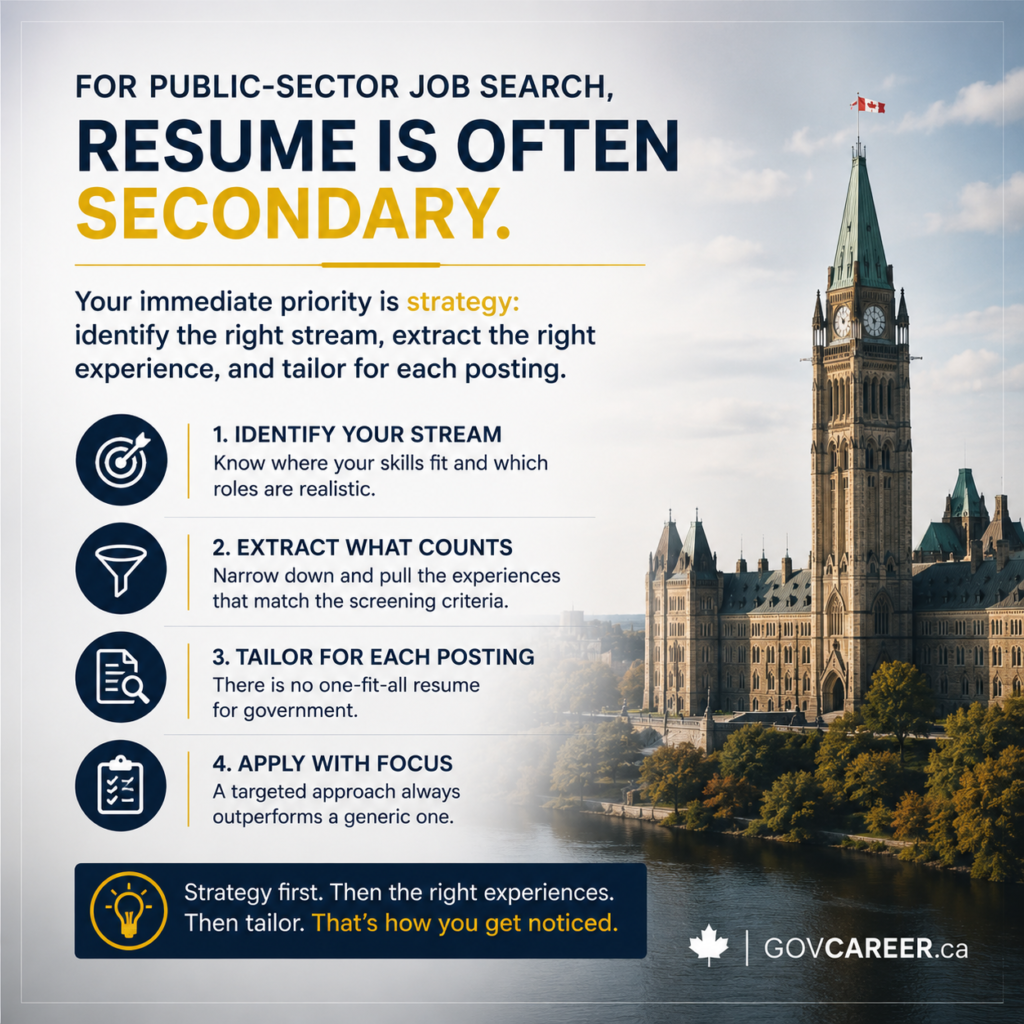
The same logic applies after shortlisting.
Government interviews are often structured interviews. That means candidates may be asked the same or similar questions, and answers may be scored against predefined criteria. The panel is usually not just having a casual conversation. It is collecting evidence.
This is why interview preparation for government jobs must be different from generic interview practice.
A candidate who gives a polished but vague answer may score lower than a candidate who gives a clear, structured example. The panel needs evidence of what you did, how you did it, why it mattered, and what result followed.
For behavioural questions, that usually means using specific examples. For technical or situational questions, it means showing judgment, process, and role-relevant understanding. For leadership, communication, conflict, client service, analysis, or policy questions, it means connecting the answer to the competency being assessed.
Again, the system is not asking you to be perfect. It is asking you to provide evidence that can be evaluated.
That is why the same principle applies from resume to interview:
Do not make the assessor guess.
The Better Way to Think About Government Jobs
The wrong question is:
“Do I know someone?”
The better question is:
“Can I clearly demonstrate that I meet the requirements?”
The wrong question is:
“Is the posting already spoken for?”
The better question is:
“Is this role a realistic match, and can I prove it?”
The wrong question is:
“Does my resume look good?”
The better question is:
“Can a screener quickly see the required experience?”
This shift matters because it gives candidates back some control.
Government hiring can be slow. It can be competitive. It can be procedural. It can be frustrating. But it is not useless to apply simply because you do not have connections.
For many candidates, especially in Canada, Ontario, Toronto, the GTA, Ottawa, and other large public-sector markets, the bigger issue is not that government jobs are impossible to access. The bigger issue is that candidates are applying without understanding the structured hiring process.
Final Thought
The belief that government jobs are already spoken for is costing qualified people real opportunities.
Not because the system is always easy.
Not because every competition is perfect.
Not because every applicant will get shortlisted.
But because many people reject themselves before they ever give the process a serious, properly prepared application.
Government hiring is usually not won by the person with the best myth about how the system works. It is won by the person who understands the process, chooses realistic roles, reads the posting carefully, tailors the resume, prepares for structured interviews, and provides clear evidence.
If you are interested in government jobs, public sector jobs, federal government jobs, provincial government jobs, or municipal jobs, do not start by assuming the door is closed.
Start by learning how the door is evaluated.
If you have questions about your public-sector job search, resume tailoring, screening criteria, or interview preparation, you can contact me through GOVCAREER.ca for practical guidance.