Bilingualism Requirements in Canadian Public Service Jobs: The Reality Most Candidates Miss
“Government jobs are impossible unless you’re bilingual.”
I hear this constantly.
For many job seekers, bilingualism becomes the reason they never seriously explore public-sector careers. They assume that because some government positions require both English and French, the entire public sector is effectively closed to them.
The reality is far more nuanced.
Yes, bilingualism matters.
But it is only one piece of a much larger hiring landscape.
Why This Myth Exists
Many people first encounter government hiring through federal job postings.
They see language requirements such as:
• English Essential
• Bilingual Imperative BBB/BBB
• CBC/CBC
• Various Language Requirements
After seeing several bilingual postings, they assume all government jobs operate the same way.
That assumption is understandable.
It is also often wrong.
The problem is that candidates take a small part of the public-sector job market and treat it as the whole picture.
Government Is Not One Employer
When people say “government jobs,” they often imagine a single system.
In reality, Canada’s public sector includes thousands of organizations operating at different levels:
• Federal government departments and agencies
• Provincial ministries and agencies
• Municipal governments
• Regional governments
• School boards
• Colleges and universities
• Hospitals and healthcare organizations
• Crown corporations
• Transit authorities
• Conservation authorities
• Regulatory bodies
• Public utilities
Each organization hires differently.
Each organization has different operational needs.
And each organization has different language requirements.
Where Bilingualism Is Most Common
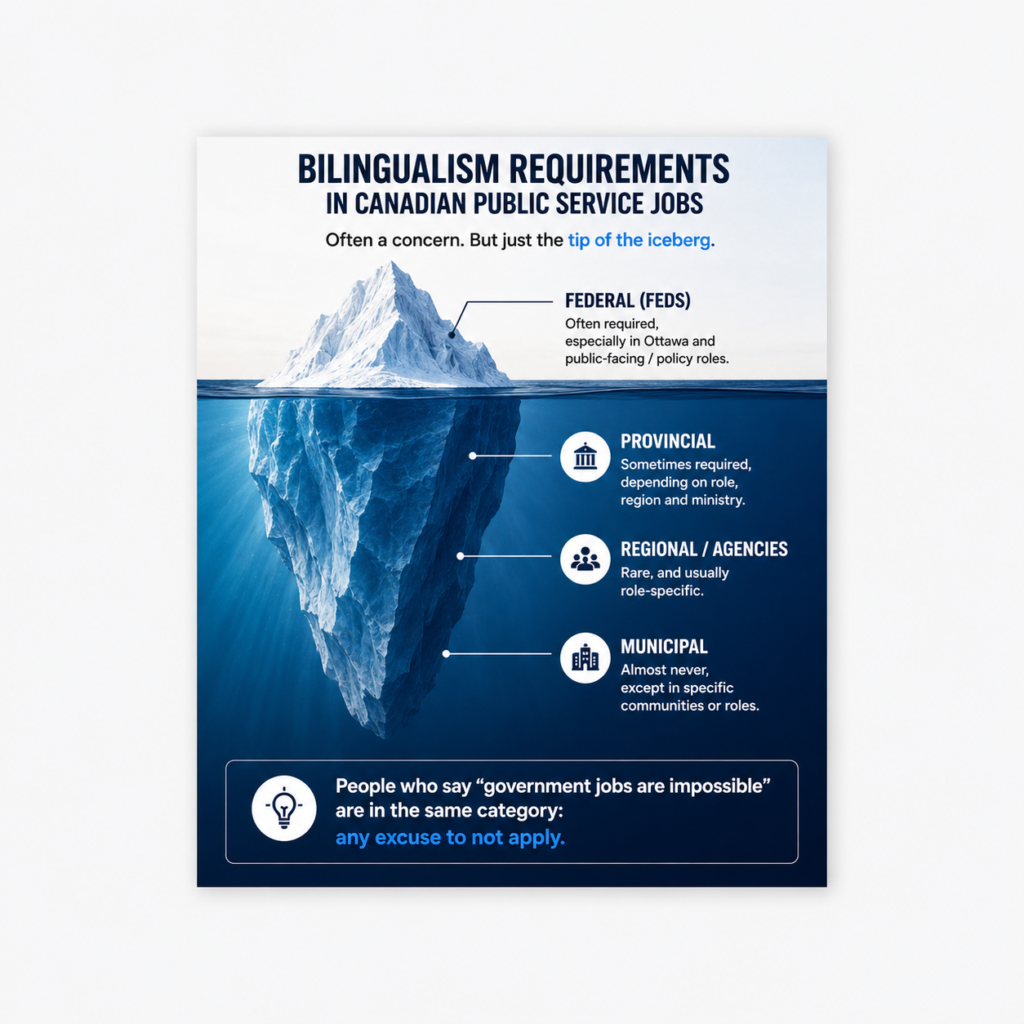
Federal Government
This is where bilingual requirements are most visible.
Many federal positions involve national programs, service delivery, policy development, or communication with Canadians across the country.
As a result, bilingual positions are common, particularly in:
• Ottawa-Gatineau
• Management roles
• Policy positions
• Public-facing roles
• Executive positions
However, even within the federal government, not every role is bilingual.
Many positions remain English Essential.
Provincial Government
Language requirements become much more role-specific.
Some ministries, regions, and service-delivery positions may require bilingualism.
Many do not.
Requirements depend heavily on the role, ministry, and geographic location.
Regional Agencies and Public Organizations
Bilingual positions exist but are generally less common.
Requirements are often tied to specific client groups, service areas, or local demographics.
Municipal Government
This is where many candidates are surprised.
Outside of specific bilingual communities and regions, municipal positions rarely require bilingualism.
Most municipal employers focus on whether the candidate can perform the duties of the position rather than whether they speak both official languages.
The Bigger Problem
The biggest issue is not bilingualism.
The biggest issue is self-rejection.
A candidate sees one bilingual posting and concludes:
“Government jobs aren’t for me.”
They stop searching.
They stop exploring.
They stop applying.
And because they never enter the process, they never discover the hundreds of positions that may have been realistic opportunities.
This is similar to candidates who assume:
• Government only hires insiders
• Government hiring is random
• Government hiring is impossible
• Private-sector experience does not count
• They need a perfect background
These assumptions often eliminate more opportunities than any hiring requirement ever could.
What Candidates Should Do Instead
If you are not bilingual, do not ignore language requirements.
Read them carefully.
Respect them.
But do not assume they apply everywhere.
Expand your search.
Look beyond federal competitions.
Explore provincial opportunities.
Review municipal postings.
Research agencies, boards, commissions, healthcare organizations, educational institutions, and Crown corporations.
Pay attention to the actual language requirement listed in the posting rather than relying on assumptions.
Most importantly, evaluate each opportunity individually.
The Bottom Line
Bilingualism can absolutely expand your opportunities in the Canadian public sector.
There is no question about that.
But the absence of bilingualism does not automatically eliminate you from public-sector employment.
For many candidates, the barrier is not language.
The barrier is believing the door is closed before checking whether it is actually locked.
The public sector is much larger than most people realize.
And many opportunities are missed because candidates stop looking too soon.