
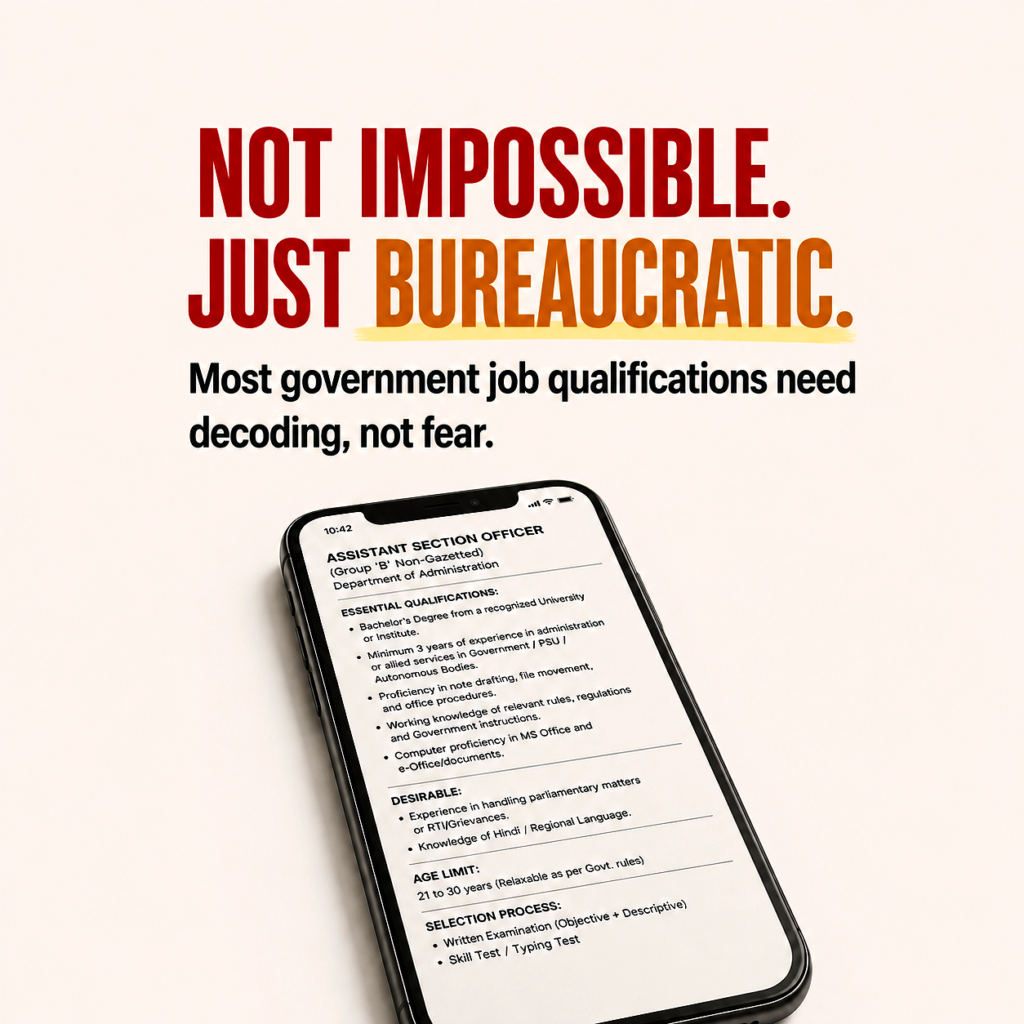
Government Job Qualifications: How to read them?
One of the biggest reasons people never apply for government jobs is simple:
The qualifications look impossible.
I hear this constantly from candidates across Ontario.
“I only meet half the requirements.”
“They probably already know who they want.”
“This looks written for an internal candidate.”
“There’s no way I qualify for this.”
Then they close the posting and move on.
And in many cases, they walk away from jobs they may actually have had a realistic chance of securing.
The problem is not always the qualifications themselves.
The problem is that government job postings are written in bureaucratic language that many people do not understand.
That misunderstanding alone prevents thousands of qualified people from applying.
Why Government Job Postings Feel So Different
Government hiring processes are fundamentally different from most private-sector hiring.
Private companies often recruit based on flexibility, potential, culture fit, or speed.
Government hiring is built around:
- structure
- documentation
- consistency
- fairness
- auditability
- procedural compliance
- defensible decision-making
This changes how job postings are written.
A private company might say:
“We’re looking for someone organized who can manage projects and communicate with stakeholders.”
A government posting may describe the same requirement as:
“Demonstrated experience coordinating multi-stakeholder initiatives, developing procedural documentation, managing competing priorities, and providing strategic communication support within a structured operational environment.”
To many applicants, these sound like completely different skill sets.
Often, they are not.
Government language tends to formalize normal workplace activities into competency-based terminology.
That creates psychological distance between the candidate and the role.
People stop recognizing their own experience.
The Myth That Government Jobs Are “Already Decided”
One of the most persistent myths in public-sector hiring is this:
“Government already knows who they want.”
There are situations where internal candidates may have advantages:
- familiarity with systems
- direct organizational experience
- existing security clearances
- institutional knowledge
- union seniority in some competitions
But many external candidates still get hired every year across municipal, provincial, and federal organizations.
The issue is not usually that the process is fake.
The issue is that most applicants do not understand how screening works.
Government hiring processes are heavily evidence-based.
HR and hiring managers are not supposed to assume what you can do.
They screen based on what you explicitly demonstrate.
If a posting asks for:
- stakeholder management
- policy interpretation
- administrative coordination
- records management
- customer service delivery
- compliance monitoring
- project coordination
…then your application must clearly show evidence of those things.
Not implied.
Not assumed.
Not “kind of mentioned.”
Explicitly demonstrated.
This is where many strong candidates fail.
They actually have relevant experience, but they describe it too vaguely.
Why Qualifications Look Longer Than They Really Are
Another major issue is that government qualifications often repeat the same core competencies in multiple forms.
A posting may contain:
- qualifications
- competencies
- technical knowledge
- experience requirements
- asset qualifications
- organizational fit criteria
- communication requirements
- analytical requirements
To applicants, this can look overwhelming.
But when you break the posting down carefully, many of those sections overlap significantly.
For example:
“Experience coordinating projects.”
“Ability to manage multiple priorities.”
“Demonstrated organizational skills.”
“Experience working within timelines.”
“Ability to support operational planning.”
These may all relate to one underlying competency:
organizational and coordination ability.
Similarly:
- stakeholder communication
- client service
- relationship management
- consultation
- collaboration
- interpersonal effectiveness
…are often variations of the same broader skill category.
Candidates sometimes read postings as if every bullet point requires an entirely separate career background.
That is usually not the case.
Mandatory Qualifications vs Asset Qualifications
This is one of the most misunderstood parts of government hiring.
Many applicants do not distinguish between:
- mandatory qualifications
- preferred qualifications
- asset qualifications
Mandatory qualifications are the core requirements needed to perform the role.
Asset qualifications are additional strengths that may help distinguish candidates but are not always essential for screening.
The problem is that many candidates see one unfamiliar asset qualification and immediately self-reject.
For example:
“Knowledge of municipal procurement legislation considered an asset.”
A candidate may think:
“I don’t have that. I’m not qualified.”
But the actual mandatory requirement may simply be:
“Experience supporting administrative processes in a structured environment.”
Those are very different thresholds.
Government postings often contain ideal-candidate language.
You do not necessarily need to perfectly match every line to be competitive.
The Real Skill Is Decoding the Posting
This is the part most people underestimate.
Government hiring is not only evaluating your experience.
It is evaluating your ability to interpret and respond to formal requirements.
That means you must learn how to:
- slow down
- analyze the wording
- identify recurring themes
- distinguish mandatory from preferred qualifications
- understand competency language
- recognize equivalent experience
- align your resume with screening criteria
This is work.
And many applicants do not want to do it.
They want quick applications.
Quick uploads.
Quick clicks.
Quick responses.
Government hiring generally does not work that way.
The process itself is intentionally structured.
Bureaucratic Language Is Not Random
Many applicants assume government postings are written badly on purpose.
Sometimes they are simply poorly written.
But often, the language exists because public-sector hiring must satisfy multiple institutional requirements.
Job postings may need to:
- align with classification systems
- reflect union agreements
- support equitable hiring standards
- survive audit review
- justify hiring decisions
- define measurable screening criteria
- create legally defensible competition processes
That creates a level of formalization rarely seen in smaller private-sector environments.
The result is language that sounds rigid, repetitive, or overly technical.
But underneath that language are often normal workplace functions.
Many People Already Have Relevant Experience
One of the most important things candidates fail to recognize is this:
Government experience is not always required.
Many people already perform highly transferable work in:
- administration
- operations
- retail management
- customer service
- project coordination
- logistics
- nonprofit organizations
- compliance work
- healthcare administration
- education
- banking
- insurance
- technical support
- scheduling
- records management
The issue is not necessarily lack of experience.
The issue is translation.
For example:
A private-sector operations coordinator may already have experience with:
- documentation
- scheduling
- process compliance
- reporting
- stakeholder communication
- records management
- issue escalation
- procedural consistency
Those are all highly relevant to many public-sector roles.
But candidates often describe their work too casually.
Government hiring processes reward structured evidence.
Why Generic Resumes Fail in Government Hiring
This is another major disconnect.
Many applicants use the same resume for:
- private-sector jobs
- public-sector jobs
- administrative jobs
- technical jobs
- management jobs
Government screening is usually not designed for generic resumes.
A screening officer may review dozens or hundreds of applications against very specific criteria.
If your resume does not clearly demonstrate the required experience, you may simply not pass initial screening.
Even if you could do the job.
This is why tailoring matters so much in government applications.
Candidates often think:
“My experience should speak for itself.”
Unfortunately, that is not how structured screening works.
Your experience must be:
- visible
- explicit
- measurable
- aligned to the posting language
The Application Process Is Part of the Evaluation
This is the part many people dislike hearing.
But it is true.
Government hiring processes are often testing more than technical ability.
They may also be testing:
- attention to detail
- ability to follow instructions
- written communication
- procedural discipline
- patience
- organizational ability
- consistency
- documentation quality
In other words, the process itself reflects the environment you are trying to enter.
Public-sector work is often:
- structured
- policy-driven
- process-oriented
- compliance-heavy
- documentation-based
If a candidate immediately gives up because a posting looks formal or complex, the organization may reasonably question whether that person will function well in highly procedural environments.
That may sound harsh.
But public-sector environments frequently require employees to:
- interpret legislation
- follow policy
- document decisions
- maintain records
- justify actions
- work within regulated frameworks
The hiring process reflects that reality.
Why Many Good Candidates Self-Eliminate
One of the biggest problems in government hiring is not rejection.
It is self-rejection.
Candidates eliminate themselves before the competition even starts.
They assume:
- they are underqualified
- internal candidates automatically win
- government experience is mandatory
- they need 100% qualification matching
- bureaucratic language means elite specialization
Often, none of those assumptions are fully true.
The stronger candidates are frequently not the people with perfect backgrounds.
They are the people who:
- study the process carefully
- understand the language
- tailor their applications properly
- provide evidence clearly
- persist consistently
- improve over time
Government hiring is frequently a process game as much as an experience game.
The Reality About Government Hiring Competition
Government jobs are competitive.
There is no point pretending otherwise.
Stable pay, pensions, benefits, hybrid work options, union protections, and long-term career growth attract large numbers of applicants.
But competition does not mean impossibility.
The candidates who perform best usually understand that government hiring is its own professional skill set.
They do not treat applications casually.
They learn:
- screening language
- competency frameworks
- STAR interview structure
- evidence-based examples
- scoring systems
- application tailoring
- behavioral interview expectations
Over time, they become better at navigating the process.
Government Hiring Is Often Misunderstood — Not Impossible
There are certainly flawed postings.
Some competitions are poorly designed.
Some managers write confusing requirements.
Some processes are slow.
Some roles may favor internal experience.
But many applicants still misunderstand the core issue.
The qualifications are not always impossible.
They are often badly interpreted.
And for candidates who are serious about public service careers, learning to decode that language is not an obstacle separate from the job.
In many ways, it is the first demonstration that you can operate inside the environment itself.
Because public-sector work is built around:
- systems
- process
- documentation
- structure
- accountability
- procedural thinking
Learning how to navigate formal hiring requirements is part of entering that world.
Final Thoughts
If you are considering government work, do not immediately disqualify yourself because a posting feels intimidating.
Slow down.
Read carefully.
Separate the true requirements from the intimidating wording.
Translate the language into actual workplace functions.
Look for overlap between your experience and the competencies being requested.
Most importantly:
do not assume you are unqualified simply because the posting sounds bureaucratic.
Very often, the issue is not lack of ability.
It is lack of interpretation.
And once candidates learn how government hiring language actually works, many opportunities that once seemed impossible suddenly become realistic.