
How to Use the STAR Method for Government Interviews Without Giving the Wrong Evidence

The STAR method for government interviews helps candidates organize behavioural examples into Situation, Task, Action and Result. However, the structure alone does not produce a strong answer. Your example must also provide clear evidence of the qualification being assessed and demonstrate the judgment, accountability, collaboration and respect for process expected in the position.
That distinction matters because a well-organized answer can still be the wrong answer.
You may describe a genuine accomplishment. You may explain it confidently. You may show that you solved a difficult problem and achieved a strong result.
Yet the panel may still struggle to award a strong score.
Why?
STAR gives your answer a shape. It does not decide what evidence belongs inside that shape.
Candidates preparing for government interview questions in Canada must do more than memorize a four-part response formula. They must understand what the interview question is assessing, select an example that fits that qualification and make the relevant evidence visible to the panel.
What Is the STAR Method in a Government Interview?
The STAR method is a framework for answering behavioural interview questions by describing a specific Situation, the Task or responsibility involved, the Actions you took and the Result you achieved.
The four components are:
- Situation: The context, problem or event you faced
- Task: Your responsibility, objective or required outcome
- Action: The specific steps you personally took
- Result: What happened because of those actions
The Government of Canada’s guidance for tests and interviews advises candidates to focus on the qualifications being assessed and use the STAR method to identify examples that demonstrate those qualifications.
The order of that advice matters.
The qualification comes first. STAR comes second.
Do not begin by collecting several dramatic career stories and forcing them into different questions. Begin by identifying the competency, ability, knowledge area or behaviour being assessed. Then choose the example that provides the strongest evidence.
Why Can a Good STAR Answer Still Score Poorly?
A STAR answer can score poorly when it describes a real accomplishment but fails to provide the specific evidence required by the interview question.
Government and broader public-sector interviews are often structured. Candidates may receive the same core questions, while panel members evaluate answers against defined qualifications or assessment criteria.
The precise process varies by employer and competition. However, the Public Service Commission’s structured-interview guidance explains that structured interviews are intended to support merit-based federal public-service appointments.
The panel is therefore not simply deciding whether your story sounds impressive.
It is determining whether your answer demonstrates the qualification being assessed.
Consider a question assessing judgment and collaboration.
A candidate might describe how they:
- recognized an urgent problem
- acted without waiting for approval
- persuaded a resistant client
- bypassed a slow internal process
- delivered the result ahead of schedule
- exceeded a commercial target
In a private-sector context, this example may demonstrate initiative, speed and commercial effectiveness.
In a government interview, the same answer may create unanswered questions:
- Did the candidate understand the limits of their authority?
- Did they follow the applicable requirements?
- Did they consult the people who needed to be involved?
- Did they consider risk, fairness, access or public impact?
- Was the decision documented?
- Could the approach be applied consistently in comparable situations?
- Did the candidate solve the immediate problem while creating a larger institutional risk?
Government employers do not reject initiative or strong results. However, initiative may need to operate within defined authority, public responsibility and a defensible process.
A positive result does not automatically prove that the decision-making process was sound.
STAR Is an Answer Structure, Not a Scoring Strategy
STAR helps you tell a story in a logical order. It does not tell you which story to choose, which details matter or how the panel may interpret the evidence.
This is where many candidates make a serious preparation error.
They spend most of their preparation time improving delivery:
- making the story sound smoother
- reducing hesitation
- memorizing the sequence
- improving eye contact
- adding a stronger result
- practising the same example repeatedly
Those activities may improve communication. They do not correct a weak evidence choice.
Before practising delivery, ask:
- What qualification is this question assessing?
- What behaviours would demonstrate that qualification?
- Which example provides the strongest evidence?
- What facts must the panel hear to recognize that evidence?
- What parts of the story are irrelevant and should be removed?
The panel cannot assess what you leave implied.
Saying that you “worked collaboratively” does not show how you identified stakeholders, sought input, handled disagreement, clarified responsibilities or incorporated relevant perspectives.
Saying that you “followed policy” does not show which requirement affected your approach, how you verified it or what you did when the correct path was unclear.
Saying that you “used good judgment” is not evidence of judgment.
The panel needs to hear the decision process.
What Do Government Interview Panels Look for in STAR Answers?
Government interview panels generally look for direct, relevant and sufficiently detailed evidence that the candidate meets the qualification being assessed.
The exact indicators depend on the employer, role, level and competition.
A technical position may focus heavily on job knowledge and technical decisions. A leadership role may place greater weight on strategic judgment, people management, accountability and stakeholder relationships. A public-facing role may emphasize service, communication, conflict resolution, consistency and accessibility.
The City of Toronto’s interview guidance explains that panel members may ask specific job-related and behavioural questions and advises candidates to provide answers that are specific, detailed, thoughtful and succinct.
Depending on the question, a strong government interview answer may need to demonstrate:
- sound analysis
- appropriate use of authority
- accountability for decisions
- compliance with relevant requirements
- fair and consistent treatment
- service to the public or organizational mandate
- collaboration with internal or external stakeholders
- awareness of operational and reputational risk
- accessibility and inclusion
- responsible use of public resources
- clear documentation
- learning and corrective action
- measurable or observable results
Do not insert all these ideas into every answer. That would produce long and artificial responses.
Identify what the question is actually assessing and provide the evidence relevant to that qualification.
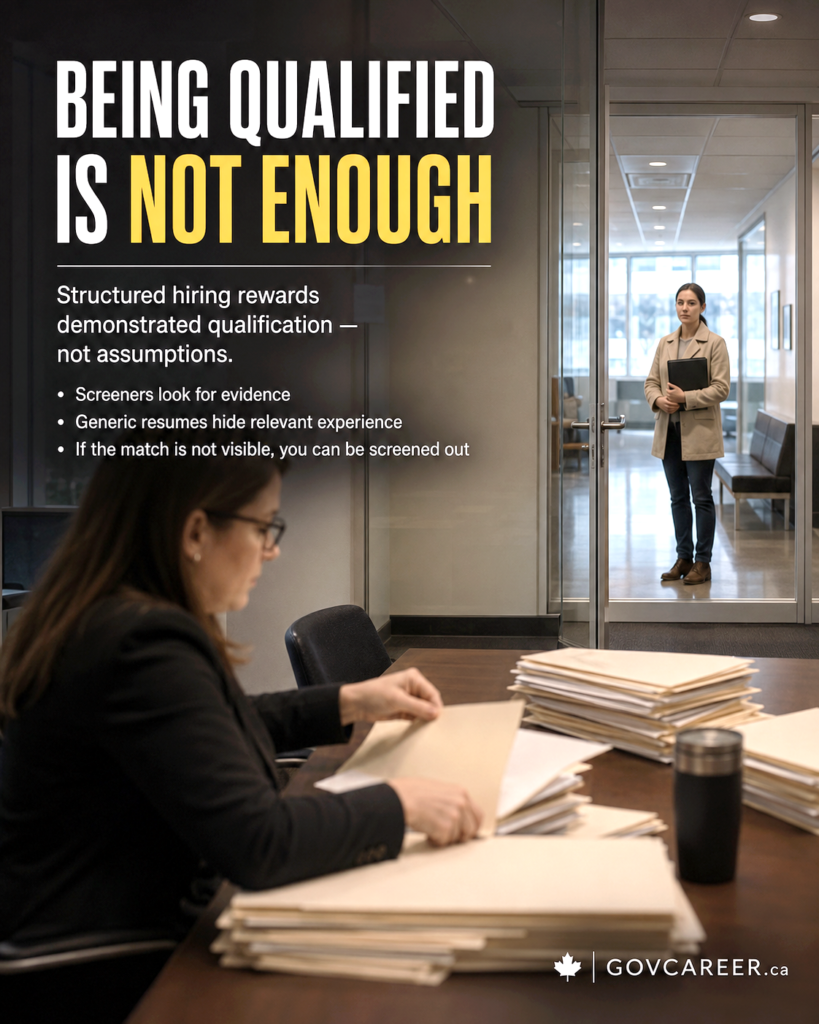
How Do You Choose the Right STAR Example?
Choose an example that directly matches the assessed qualification and provides enough complexity to demonstrate it without requiring excessive background explanation.
A useful example should pass five tests.
1. The example directly matches the qualification
If the question assesses conflict resolution, choose a genuine conflict that required you to manage disagreement.
Do not select an example in which everyone agreed and claim that it demonstrates conflict resolution merely because several people were involved.
If the question assesses judgment, select an example involving a real decision, competing considerations, incomplete information or meaningful risk.
If it assesses collaboration, choose an example in which other people’s knowledge, responsibilities or perspectives materially affected the outcome.
2. Your personal role is clear
The panel must understand what you personally did.
Team examples are valid, and collaboration is often important. However, repeatedly saying “we” can conceal your contribution.
The National Research Council’s behavioural-interview guidance advises candidates to be specific and use “I” statements because the interview is concerned with the candidate’s personal experience.
Clarify:
- what responsibility belonged to you
- what analysis you completed
- what recommendation you made
- what conversations you led
- what decision you were authorized to make
- what you escalated
- what you documented
- how you influenced the team’s direction
You do not need to portray yourself as the lone hero. You do need to make your contribution assessable.
3. The situation has enough substance
A weak example may be too routine to demonstrate the expected level of the qualification.
Resolving a minor scheduling misunderstanding may not provide enough evidence for a senior role requiring complex stakeholder management.
Substance can come from:
- complexity
- risk
- competing priorities
- variety of stakeholders
- ambiguity
- organizational impact
- sensitivity
- resource constraints
- time pressure
- public consequences
- need for analysis or judgment
The example does not need to be dramatic. It needs to be appropriately demanding for the level of the position.
4. Your actions reveal your reasoning
Candidates often move too quickly from the problem to a list of activities:
“I called the client, spoke to my manager, reviewed the information, held a meeting and resolved the issue.”
This tells the panel what happened. It does not explain why the candidate selected those actions.
A stronger answer makes the reasoning visible:
- What information did you need?
- What risks did you identify?
- Which requirement controlled the decision?
- Why did you consult particular stakeholders?
- What alternatives did you consider?
- Why did you reject another option?
- How did you balance urgency with process?
- When did you escalate, and why?
- How did you maintain consistency or fairness?
For many government interview questions, this reasoning contains the strongest evidence.
5. The result connects to the qualification
The Result section must do more than close the story.
“Everyone was happy” is usually too vague.
“Senior management approved the recommendation” may be relevant, but approval alone does not prove that the approach was effective.
Where possible, explain:
- what changed
- what was delivered
- what risk was reduced
- what service improved
- what deadline was met
- what error was prevented
- what stakeholder concern was resolved
- what process became more consistent
- what lesson was applied afterward
- whether the solution remained effective
Use measurable results when they are genuine and relevant. Do not invent numbers merely to make the answer sound stronger.
How Should You Structure a STAR Answer for a Government Interview?
A strong answer should provide enough context to understand the example, then devote most of its substance to your actions, reasoning and result.
There is no universal time formula for every government interview. Question complexity, interview format and employer instructions vary.
However, the Situation and Task should normally establish context rather than consume most of the answer.
Situation
Briefly explain:
- where you were working
- what was happening
- why the issue mattered
- what made it difficult or important
Avoid giving a long history of the organization, project or team.
Task
Clarify:
- your role
- your responsibility
- the expected outcome
- any relevant constraint or authority limit
The Task section should help the panel understand what you were accountable for.
Action
Explain the specific actions you took and why you took them.
Depending on the qualification, this may include:
- analyzing the issue
- reviewing requirements
- identifying affected parties
- consulting stakeholders
- comparing options
- evaluating risk
- making or recommending a decision
- communicating the decision
- documenting the process
- monitoring implementation
- correcting problems
This is usually the most important part of the answer because it reveals your behaviour and reasoning.
Result
Explain the outcome and connect it to the question.
Include:
- the immediate result
- the broader impact
- what you learned
- what you would repeat or improve
- how the result demonstrates the qualification
A learning point should not be added mechanically. It is most useful when the question concerns judgment, adaptability, failure, development or continuous improvement.
Weak and Strong STAR Answer Examples
Consider this behavioural question:
Tell us about a time you had to make a difficult decision while balancing competing stakeholder needs.
Weak STAR answer
“In my previous role, two departments disagreed about the project schedule. I was responsible for keeping the project moving. I spoke with both managers, reviewed the schedule and decided that the faster option was best. I convinced both departments to accept it, and we completed the project on time.”
The answer contains all four STAR components. It is still incomplete.
The panel does not know:
- what each stakeholder needed
- what made the decision difficult
- what criteria the candidate used
- whether policy, risk, cost, access or service consequences were considered
- whether the candidate had authority to make the decision
- how the disagreement was handled
- whether the solution was fair and sustainable
Stronger STAR answer direction
A stronger response might explain that one department needed an accelerated schedule to meet a public commitment, while another identified safety, procurement or operational constraints.
The candidate could then describe how they:
- clarified the non-negotiable requirements
- verified their decision-making authority
- met with the affected leads
- identified the operational consequences of each option
- reviewed relevant policy or technical requirements
- developed alternatives rather than forcing a binary choice
- documented the trade-offs
- recommended an option with mitigation measures
- communicated the rationale consistently
- established follow-up controls
The result could include meeting the critical deadline while preserving the required controls, reducing disruption and maintaining stakeholder support.
The stronger version is not better because it sounds more bureaucratic.
It is better because it makes the candidate’s judgment visible.

Common STAR Method Mistakes in Government Interviews
Choosing the most impressive story instead of the most relevant one
Your largest accomplishment is not automatically your best interview example.
A smaller example may provide stronger evidence when it closely matches the qualification and allows you to explain your actions clearly.
Spending too much time on the situation
Candidates sometimes use half the answer explaining the organization, project, personalities and history.
The panel needs enough context to understand the challenge. It does not need every detail.
Describing the team without identifying your contribution
Government work often requires collaboration. Acknowledge the team honestly while making your own role visible.
Use “we” for genuinely collective actions and “I” for your decisions, analysis, communication and responsibilities.
Treating speed as the only positive result
Fast action can be valuable. It can also create risk.
Explain how you balanced urgency with accuracy, consultation, authorization and procedural requirements.
Presenting rule-breaking as initiative
Bypassing an established process may sound decisive, but it can also suggest poor judgment.
When a process was inadequate, explain how you raised the concern, obtained appropriate authorization, managed the risk and documented the exception.
Making yourself the lone hero
A story in which everyone else failed and you personally rescued the organization may undermine evidence of collaboration, respect and judgment.
You can show leadership without diminishing colleagues or pretending that no one else contributed.
Using public-sector language without evidence
Words such as fairness, accountability, transparency, inclusion and service do not earn credit by themselves.
Show what you did that reflected those principles.
Memorizing the answer word for word
Over-rehearsed answers can become rigid. Candidates may continue delivering a prepared story even when the actual question asks for something different.
Prepare the evidence, sequence and critical details. Listen carefully to the question and adapt.
Should STAR Answers Focus on Individual or Team Results?
STAR answers should make your individual contribution clear while accurately recognizing the team context.
The panel needs evidence about you. It must identify your judgment, behaviour, skills and decisions.
At the same time, many government and public-sector roles depend on collaboration, consultation and shared accountability.
A strong answer can show both:
- “I developed the initial options analysis.”
- “I consulted legal, operational and service-delivery colleagues.”
- “Based on their input, I revised my recommendation.”
- “The team implemented the agreed approach.”
- “I monitored the outcome and reported the results.”
This demonstrates individual responsibility without pretending the outcome was achieved alone.
How Long Should a STAR Answer Be?
A STAR answer should be long enough to provide assessable evidence and short enough to remain focused on the question.
There is no universal answer length because government interview formats differ. Some employers provide time limits, advance-review periods or multi-part questions. Follow the instructions for your specific competition.
The City of Toronto notes in its job-application and interview tips that candidates may receive time to review interview questions before answering and that responses should be specific, detailed, thoughtful and succinct.
During preparation, practise using a controlled structure:
- brief context
- clear responsibility
- detailed actions and reasoning
- specific result
- concise learning point where relevant
Do not shorten an answer by removing the evidence the panel needs.
Remove background, repetition and irrelevant detail first.
How to Prepare STAR Examples Before a Government Interview
Start with the job posting, statement of qualifications and interview invitation.
Create a preparation table containing:
- qualification or competency
- possible interview question
- strongest example
- your role
- key actions
- decision rationale
- result
- public-sector considerations
- backup example
Prepare more than one example for important competencies. One story may not fit the wording or complexity of every question.
Your examples may need to cover areas such as:
- judgment
- communication
- collaboration
- conflict resolution
- service
- planning
- adaptability
- leadership
- problem-solving
- accountability
- technical competence
- learning from error
Use only the areas relevant to the position.
Then test each example:
- Does it answer the likely question?
- Is the example substantial enough?
- Can I explain my personal contribution?
- Are my actions specific?
- Is my reasoning visible?
- Does the result demonstrate the qualification?
- Is there any detail that creates an avoidable concern?
- Can I explain the example without excessive background?
- Do I have another example if the question is framed differently?
Small words in an interview question can materially change the evidence required.
The National Research Council’s example behavioural competency question asks candidates to describe an “important problem” and explains that the answer must demonstrate both the problem and why it was important.
Do not answer only the general subject of the question.
Answer every material part.
Frequently Asked Questions
What is the STAR method for government interviews?
The STAR method for government interviews is a framework for answering behavioural questions through Situation, Task, Action and Result. It organizes your example, but you must still select evidence that directly demonstrates the qualification being assessed.
Do all government interviews use the STAR method?
No. Interview formats vary by employer, position and competition. STAR is commonly useful for behavioural and competency-based questions, but an interview may also include technical, situational, knowledge-based, presentation or case-study components.
Why did my STAR answer receive a low score?
A STAR answer may receive a low score when the example is irrelevant, vague, below the expected level of complexity or missing evidence of the assessed qualification. A clear structure cannot compensate for incomplete evidence.
Can I use private-sector examples in a government interview?
Yes. A private-sector example can be effective when it demonstrates the required qualification and is explained in a way relevant to the public-sector position. The panel needs to understand your transferable judgment, actions and results.
Should I mention public-sector values in every STAR answer?
No. Do not insert public-sector values mechanically into every response. Identify the qualification being assessed and demonstrate the relevant behaviours through your decisions, actions and result.
Can I reuse the same STAR example for several questions?
You can reuse an example when it genuinely provides the required evidence, but relying on one story for many questions is risky. Prepare several examples so you can respond to different competencies, question wording and levels of complexity.
STAR Must Make the Right Evidence Visible
The STAR method for government interviews is useful because it keeps an answer organized and helps the panel follow what happened.
Its value ends when candidates mistake the framework for the substance of the answer.
The panel still needs to hear why your example fits the question, what you personally did, how you made decisions and what the result demonstrates.
Do not prepare only to tell a polished story.
Prepare to make the required evidence visible.
, but it deserves separate attention because many candidates stop too early. They read the organization’s About page. They memorize the mission. They scan a few programs. Then they move directly to practising STAR answers. That is surface research. The more useful question is: **What does the specific group I may join actually exist to accomplish — and how does this role help it do that?** That is where interview research becomes useful. ## Why Government Interview Research Should Go Beyond the Homepage The job posting tells you what qualifications the employer is seeking. Research helps you understand the environment in which those qualifications will be used. That distinction matters. Suppose the posting asks for: * project management * stakeholder engagement * analytical skills * communication * judgment Those requirements can appear in thousands of jobs. A project manager delivering municipal infrastructure operates in a different context from a project manager implementing a public-health program. An analyst supporting regulatory decisions faces different pressures from an analyst preparing internal operational reports. A communications professional serving the public may need to think differently from one marketing a private product. The underlying professional skill may transfer. The operating context changes what good performance looks like. That is why strong public-sector interview preparation should include both: **Can I demonstrate the qualification?** and: **Do I understand how that qualification will be used in this particular environment?** Current Government of Canada candidate guidance gives a federal example of this principle. The Public Service Commission advises applicants to research the department’s mission and priorities and consider how their skills can help achieve them. Ontario provides an even more explicit example. Current Ontario Public Service candidate guidance tells interview candidates to conduct research on the ministry, branch and program before the interview. The City of Toronto similarly advises candidates to research the position, division values and business plan before attending an interview. Those are employer-specific examples, not proof that every Canadian public-sector employer expects the same preparation. But they support a broader practical principle: **Research the actual environment in which the job exists.** ## What to Research Before a Government Interview: Start With the Organization Begin broad. You should be able to explain, in normal language, what the organization does and why it exists. Depending on the employer, useful sources may include: * official About or mandate pages * legislation establishing the organization * strategic plans * annual reports * departmental or ministry plans * budgets * business plans * program descriptions * service pages * organizational charts * recent official reports or announcements Do not collect facts merely because they are available. Look for information that helps you understand the work. ### Understand the Mandate Ask: **What is this organization responsible for?** A ministry may develop policy and administer programs. A municipality may deliver infrastructure, emergency, regulatory and community services. A public agency may have a specialized regulatory, operational or service mandate. A hospital, university, board, commission or Crown corporation may operate under a different governance structure altogether. Do not reduce the answer to a slogan. Understand the actual function. If you cannot explain why the organization exists, it will be harder to explain why your experience matters to it. ### Understand Who Is Being Served Public-sector work ultimately affects people, organizations, communities, businesses or other institutions. That does not mean every job is frontline public service. A financial analyst, engineer, policy advisor, procurement specialist, IT professional or internal HR advisor may rarely interact directly with the public. But their work still supports an organizational function. Ask: * Who relies on this organization? * Who uses its services? * Who is affected by its decisions? * Which internal groups depend on this team? * Which external stakeholders matter? * What public or organizational outcome is the work supposed to support? This helps move your preparation from job duties to purpose. ## Go One Level Deeper: Research the Department, Branch, Division or Team This is the part candidates often skip. Knowing the organization is not the same as understanding the work unit. A large government organization can employ thousands of people doing radically different work. Research the most specific organizational level you can identify from legitimate public information. Depending on the employer, that might be: * ministry * department * branch * division * directorate * program * service area * office * agency * business unit * team The terminology varies. The principle does not: **Get as close as you reasonably can to the actual function of the position.** ### What Does the Group Actually Do? Do not settle for its name. “Strategic Services.” “Operations.” “Corporate Services.” “Program Delivery.” “Engineering Services.” “Policy and Planning.” Those labels tell you something, but not enough. Look for the work behind the title. Does the group: * develop policy? * deliver services? * administer funding? * regulate? * inspect? * build or maintain infrastructure? * manage contracts? * provide technical advice? * conduct research? * manage data? * support internal operations? * respond to public inquiries? * oversee compliance? * prepare recommendations? * coordinate programs? Once you understand that function, the job posting becomes easier to interpret. A requirement such as “stakeholder management” is no longer abstract. You can begin to understand which stakeholders may matter and why. ## Research Current Priorities — But Do Not Become a News Archivist Current priorities can provide useful context. Look for major initiatives, service changes, strategic objectives, operational pressures, public reports or other developments that materially affect the group. But research needs discipline. You do not need to know everything that happened to the organization during the last five years. Ask whether the information helps you understand: * what the group is trying to accomplish * what problems it may be solving * what pressures it faces * what outcomes matter * why the advertised role may be important For example, if a program is implementing a major modernization initiative and you are interviewing for a project role within that program, that context may affect the examples you prepare. If the organization is responding to increased service demand and you are interviewing for an operational leadership position, capacity, prioritization and service continuity may be particularly relevant. Do not invent conclusions from limited public information. Research gives you context. It does not give you insider knowledge. ## Research the Organization’s Values and Ethics Expectations Values matter, but they should not become slogans in your answers. For the federal public sector, the Values and Ethics Code identifies five core values: * respect for democracy * respect for people * integrity * stewardship * excellence The code also describes expected behaviours connected to those values. Ontario uses its own current mission and organizational values, including inclusion, integrity and excellence. Other governments, municipalities, agencies and public institutions may use different frameworks. Research the framework that actually applies to the organization you are interviewing with. Then ask: **What would this value look like in the work of this position?** Integrity may involve accurate advice, impartial decision-making or appropriate handling of conflicts. Stewardship may involve responsible use of public money, assets, information or staff resources. Respect for people may affect service delivery, workplace conduct, consultation or communication. Excellence may involve improving processes, delivering reliable service or exercising professional judgment. Do not add the word “integrity” to an answer merely because you found it on the employer’s website. Show behaviour. That is much stronger. ## Research the Public-Service Impact of the Work A public-sector role exists inside a larger system. Understanding that system can improve how you frame your experience. Consider an engineer working on municipal infrastructure. The technical work matters. But so may: * public safety * service continuity * accessibility * environmental impact * procurement requirements * budgets * stakeholder coordination * disruption to residents * regulatory obligations * long-term asset stewardship A policy analyst may need to consider: * evidence * affected groups * implementation * legal authority * cost * unintended consequences * stakeholder views * fairness * administrative feasibility A client-service role may involve: * accessibility * consistency * procedural accuracy * difficult interactions * service standards * privacy * escalation * clear communication None of these considerations should be inserted mechanically into every interview response. Their relevance depends on the actual role and question. This is one important difference between generic interview preparation and preparation for the [public-sector interview context](https://govcareer.ca/public-sector-interview-vs-private-sector-interview/). ## Use Research to Choose Better Interview Examples Research becomes valuable when it changes your preparation. Imagine you have six project-management stories. Which one should you prepare most deeply? Do not automatically choose: * the largest project * the biggest budget * the most senior title * the most dramatic problem * the result you are proudest of Choose the example that best demonstrates what the target role appears to require. If the group works heavily with multiple public stakeholders, an example showing consultation and competing interests may be stronger than a technically larger project completed mostly inside one team. If the role involves regulated work, an example showing sound judgment within rules and authority may be more relevant than one where you moved quickly by bypassing normal process. If service continuity matters, an example showing how you balanced speed, risk and public impact may become more useful. This is why organizational research and evidence preparation should not be separate exercises. Research helps you [choose the right interview example](https://govcareer.ca/star-method-for-government-interviews/). ## Use the Employer’s Language — Without Becoming a Parrot Every organization develops its own vocabulary. You may see recurring language around: * clients * residents * service users * stakeholders * partners * program delivery * policy outcomes * service excellence * operational excellence * stewardship * accountability * modernization * accessibility * reconciliation * compliance * public trust Use relevant language naturally when it accurately describes your own experience. Do not copy the website into your answers. Do not insert phrases you do not understand. And do not pretend you already know the organization from the inside. The objective is recognition. If the employer talks about “service delivery” and your experience genuinely involved delivering services, use that language. If the posting repeatedly refers to “clients,” you do not need to replace it with “customers” merely because that was the terminology at your previous employer. Translate your experience into language the panel can immediately connect to the work. ## How Research Improves “Why Are You the Best Candidate?” One common mistake is answering this question entirely from the candidate’s side. “I have ten years of experience.” “I am an excellent communicator.” “I have managed complex projects.” “I have strong leadership skills.” Those statements describe you. They do not yet explain why those qualities matter to this employer. A stronger preparation approach asks: **What does this group need the successful candidate to accomplish?** Then connect your evidence to that need. For example: “I bring seven years of infrastructure project experience, but the part most relevant to this role is coordinating projects where construction had to proceed while facilities remained operational. From what I understand, this group manages projects in active public facilities, so my experience balancing contractor work, safety, service continuity and stakeholder requirements would be directly relevant.” The example is hypothetical, but notice the structure. The candidate is not reciting employer facts. The research changes the meaning of the experience. That is the objective. ## Research Should Shape More Than One Interview Answer Do not save your organizational research for: “Why do you want to work here?” Its value is broader. Relevant context may strengthen answers about: * judgment * service * stakeholder management * project management * leadership * communication * problem-solving * prioritization * risk * conflict * technical decision-making * change management Suppose you are asked how you would prioritize competing requests. The answer should primarily demonstrate your decision-making. But understanding the organization’s service responsibilities may help you identify relevant factors such as urgency, public impact, statutory requirements, safety, resource constraints or service disruption. The research does not replace the answer. It makes the answer more informed. ## Do Not Force Organizational Facts Into Every Response There is an opposite mistake. Candidates research heavily and then try to prove it in every answer. They mention the strategic plan when nobody asked. They quote organizational values. They force a recent initiative into an unrelated STAR story. They repeatedly tell the panel what the panel already knows about its own organization. That is not the objective. Research should mostly change how **you think and prepare**. Use it explicitly when it genuinely helps answer the question. Otherwise, let it operate in the background. A good interview answer should still sound like your experience. Not a memorized annual report. ## Understand What the Panel Is Actually Assessing Research does not earn points merely because you did it. The interview still requires evidence. In structured public-sector interviews, the panel may be assessing defined qualifications or competencies rather than awarding general credit for enthusiasm. That is why understanding [what public-sector interview panels assess](https://govcareer.ca/government-interview-scoring-canadian-hiring/) remains important. Research helps you prepare relevant evidence. It does not substitute for evidence. If the question assesses conflict resolution, you still need to demonstrate conflict resolution. If it assesses technical knowledge, you need to demonstrate the required knowledge. If it assesses judgment, your reasoning has to become visible. The research gives you context for presenting that evidence appropriately. ## How Much Research Is Enough? There is no universal number of hours. Stop measuring research by volume. Measure it by whether you can answer the important questions. Before the interview, you should ideally understand: * what the organization does * what the relevant department, branch, division or program does * who or what that group serves * the main responsibilities of the role * relevant current priorities or issues * organizational values when material * how your experience connects to the work * which examples best demonstrate that connection * what thoughtful questions you may want to ask That is usually more useful than collecting fifty facts. The strongest preparation is selective. ## Where Should You Get the Information? Start with authoritative sources. Depending on the employer, these may include: * official organization website * job posting * ministry or departmental pages * program pages * official organizational chart * strategic plan * annual or business plan * budget documents * council or board reports * legislation or regulations * public reports * service standards * values or code-of-conduct pages * official news releases Current federal candidate guidance recommends researching the department’s mission and priorities before the interview. Ontario specifically tells candidates in one current program to research the ministry, branch and program. The City of Toronto advises interview candidates to research the position, division values and business plan. The mechanism varies, but the message is consistent: Know more than the job title. ## Frequently Asked Questions ### What should I research before a government interview? Start with the employer’s mandate, the specific ministry, department, branch, division or program connected to the role, current priorities, services, stakeholders, applicable values and how the advertised position contributes to that work. ### Should I memorize the organization’s mission statement? No. Understand the mandate well enough to explain it in normal language. Memorizing a sentence from the website is less useful than understanding what the organization actually does and why the target role matters. ### Should I read public-service values before the interview? Yes when a values framework applies to the employer, but do not memorize values merely to recite them. Understand the behaviours associated with the values and identify genuine examples from your experience where those behaviours are relevant. ### Should I mention my research directly in interview answers? Only when it helps answer the question. Research should improve your understanding and example selection. It should not become a forced reference to the organization in every response. ### How do I research a branch or team when little information is public? Use what is legitimately available: the job posting, organizational charts, departmental pages, reports, program descriptions and related official material. Do not guess at internal arrangements or claim knowledge that is not public. ### Is researching the department enough for a government interview? It is a good start, but go as close as possible to the actual work unit and role. A large government organization may contain many functions, so understanding the specific branch, division, program or team can make your preparation substantially more relevant. ## Conclusion: Research the Work, Not Just the Employer Knowing **what to research before a government interview** is not about memorizing more facts than the other candidates. It is about understanding the environment well enough to prepare relevant evidence. The organization tells you the broader mandate. The department or team tells you what work is actually being done. The priorities and values help explain the environment in which that work occurs. The job posting tells you what the employer needs from the person entering the role. Bring those pieces together before you choose your examples. Then your interview preparation stops being generic. You are no longer preparing only to prove that you are an experienced professional. You are preparing to demonstrate how your real experience can contribute to the work in front of you.](https://govcareer.ca/wp-content/uploads/2026/09/Organisational-reserch-government-jobs-public-sector-jobs-resume-interview-canada-ontario-toronto-govcareer-ai-generated.jpg)