Government Jobs Are Not Only for Internal Candidates. The Real Barrier Is Different.

“Government only hires internally” sounds convincing because people see internal candidates move ahead. But that does not mean the door is closed.
Many people give up on government jobs because they believe public sector jobs are already decided before the competition starts. In Canada, especially in Ontario, Toronto, the GTA, Ottawa, and other large public-sector markets, internal candidates often have advantages, but government job applications are still assessed through structured hiring, screening criteria, job posting requirements, and merit-based hiring processes. The real problem for many external candidates is not that government only hires internally. The real problem is that they apply with a private-sector resume strategy to a public-sector hiring process that is built around evidence, criteria, scoring, and structured interviews.
If you are trying to understand how government job search works in Canada, this myth matters. It shapes how people read postings, how they write resumes, how they prepare for interviews, and how quickly they assume rejection means the process was unfair.
There is a grain of truth inside the myth. Internal candidates may understand the organization better. They may know the language, the structure, the internal systems, and the operational culture. They may have relationships with managers or colleagues. They may already understand how public-sector hiring works because they have gone through it before. Those are real advantages.
But advantage is not monopoly.
Government hiring does not stop because someone internal applies. Public-sector organizations still need to fill vacant roles, backfill positions, replace retiring workers, create new teams, deliver new programs, and respond to changing service demands. Federal government jobs, provincial government jobs, municipal jobs, Crown corporation roles, healthcare administration roles, education-sector positions, and agency jobs continue to open because public institutions are not static.
The more useful question is not, “Do internal candidates have an advantage?”
They often do.
The better question is, “What does an external candidate need to show clearly enough to compete within a structured hiring process?”
That is where most applicants lose ground.
Why the “Government Only Hires Internally” Myth Feels True
This belief exists because people are not imagining everything. Many public-sector roles are won by people who already work inside government or inside a related public-sector organization. That is especially common for promotional roles, specialized technical roles, unionized environments, and positions where internal operational knowledge matters.
A current employee may already know the department’s mandate. They may understand internal terminology. They may know the policies, reporting structures, software systems, service standards, and approval processes. They may also know how to answer structured interview questions with the kind of examples panels expect.
From the outside, that can look like the competition was never real.
But that conclusion is often too simple.
A hiring panel may select an internal candidate because that candidate scored better against the posted criteria. The person may have described their experience more clearly. They may have used examples that matched the competency questions. They may have shown stronger evidence of judgment, communication, accountability, technical ability, stakeholder management, or leadership. They may simply have understood the process better.
That is not the same thing as the role being closed to external candidates.
It means the external candidate needs to compete properly.
Internal Movement Does Not Eliminate External Hiring
Here is the simple logic people often miss.
If one internal employee wins a new role, their previous seat may become vacant. That seat may then need to be filled. If someone else internal moves into that seat, another vacancy may open. Public-sector labour markets create chains of movement.
A promotion does not erase the need for workers. It often creates another hiring requirement somewhere else.
That is especially true in larger public-sector employers: federal departments, provincial ministries, municipalities, public agencies, hospitals, colleges, universities, school boards, transit agencies, utilities, and Crown corporations. These organizations have layers of roles. People retire, resign, transfer, move into acting assignments, return from leaves, change departments, or leave for other employers.
The Government of Canada, for example, continues to post opportunities through Government of Canada job opportunities, and the federal process has its own application steps, screening, testing, pools, and assessment practices. Ontario applicants can also monitor Ontario Public Service jobs for provincial opportunities, while municipal candidates in the GTA may regularly watch City of Toronto jobs and City of Ottawa jobs depending on their target market.
These postings exist because hiring continues.
The better issue is whether your application is built for how these employers screen.
The Public Sector Is Not a Fixed Room With No New Chairs
Another weakness in the “internal only” myth is that it treats government like a frozen headcount. That is not how public-sector work operates.
Public institutions change because the work changes. New programs are created. Legislation changes. Funding changes. Service demand grows. Technology changes. Reporting requirements expand. Data, cybersecurity, finance, infrastructure, climate adaptation, housing, public health, transportation, procurement, project management, and service modernization all create new staffing needs over time.
A municipality may need more planners, engineers, inspectors, analysts, by-law staff, program coordinators, project managers, system specialists, finance staff, communication advisors, or policy analysts. A provincial ministry may need analysts, caseworkers, policy staff, compliance officers, program managers, and administrative professionals. A federal department may need people in operations, grants and contributions, call centres, procurement, IT, finance, enforcement, regulation, or program delivery.
Some openings are backfills. Some are temporary. Some are permanent. Some are project-based. Some are seasonal. Some are new roles connected to new service priorities.
The point is simple: public-sector hiring does not depend only on internal reshuffling.
There are real openings. But the competition is usually structured, documented, and criteria-driven.
Why External Candidates Still Get Hired
External candidates are hired into public-sector roles every day. That includes people coming from private companies, non-profits, consulting firms, regulated industries, healthcare organizations, educational institutions, municipal vendors, community agencies, and other public-sector bodies.
They get hired when their application and interview answers make the connection between their background and the posting clear.
That is the part many people underestimate.
A candidate may have excellent experience and still fail at the screening stage because the resume does not clearly show the required qualifications. Another candidate may be less experienced overall but better aligned on paper. In structured hiring, the panel or screening reviewer is not supposed to guess what you meant. They are looking for evidence against stated criteria.
This is where private-sector habits hurt people.
In private-sector hiring, a resume may work well if it is concise, polished, achievement-oriented, and written for quick impression. In government job applications, clarity against criteria often matters more than style. The question is not only whether the resume sounds strong. The question is whether it gives the reviewer enough evidence to screen you in.
That evidence usually includes:
• relevant duties and responsibilities
• direct connection to the job posting requirements
• required education, licences, certifications, or equivalencies
• years or depth of experience where required
• technical skills, systems, legislation, programs, or methods
• examples of judgment, coordination, communication, and accountability
• supervisory, project, policy, analytical, financial, operational, or client-service experience where applicable
A broad resume that says “managed stakeholders,” “led projects,” or “supported operations” may not be enough. The resume has to show the kind of work the posting is asking for.
The Real Barrier Is Criteria Matching
The largest barrier for many external candidates is not a locked door. It is poor criteria matching.
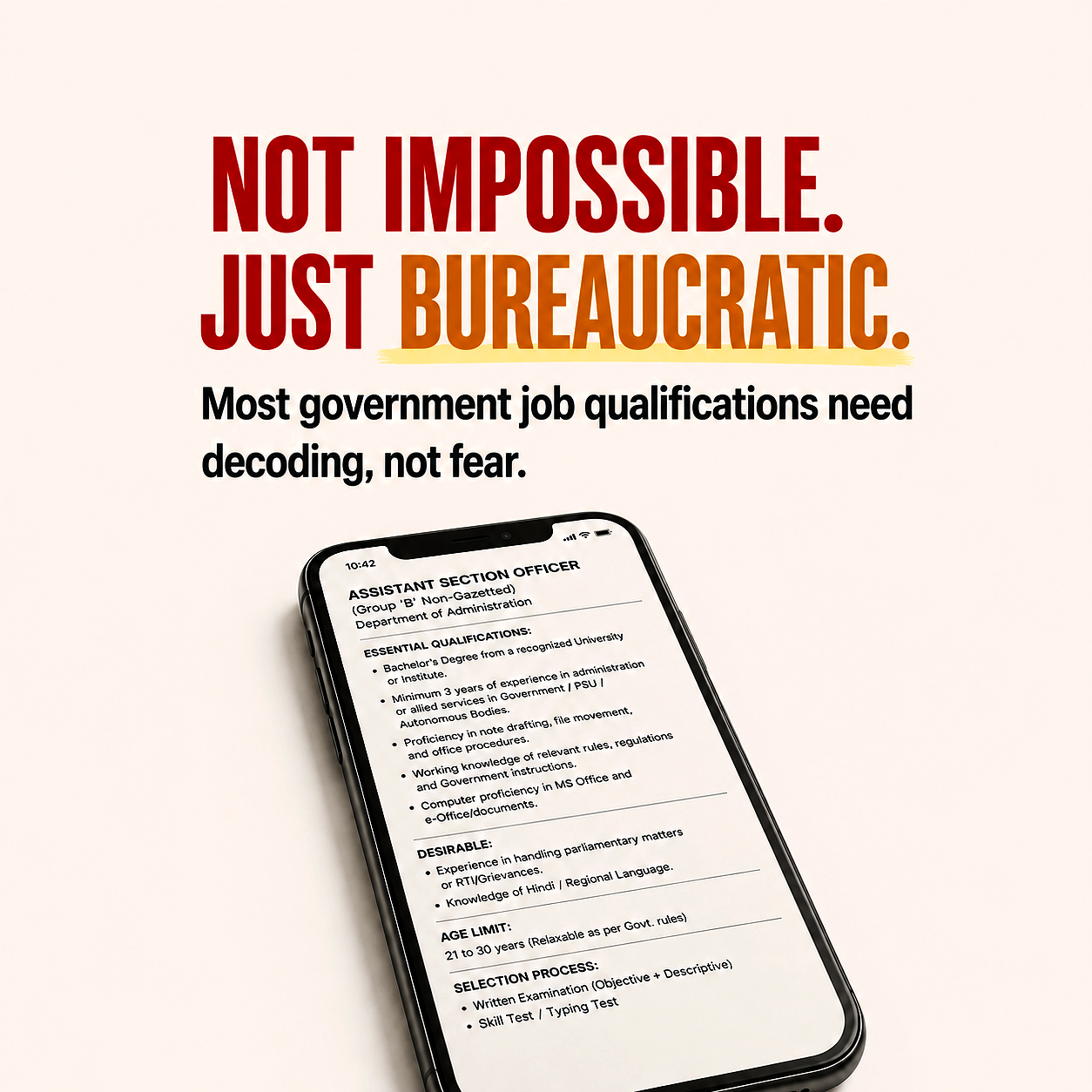
Government job postings usually tell you more than people realize. They may look long, dry, and bureaucratic, but they contain the screening logic. The duties, qualifications, knowledge requirements, skills, competencies, and assets often signal what the resume and cover letter need to prove.
If the posting asks for experience analyzing business requirements, your resume should show business requirements work clearly. If the posting asks for project coordination, your resume should show project coordination in the language of the role. If the posting asks for policy analysis, stakeholder consultation, report writing, financial monitoring, data analysis, service delivery, inspection, compliance, case management, procurement, or program administration, the application should make those connections explicit.
The issue is not keyword stuffing. It is evidence alignment.
Resume tailoring for public-sector hiring is not about sprinkling words from the posting into a generic resume. It is about understanding what the employer is actually testing for at screening and showing the relevant evidence in a way that can be recognized.
That is why many qualified people do not get interviews.
They are qualified in real life, but not clearly qualified on paper.
“Best Candidate” and “Best Scored Candidate” Are Not Always the Same Thing
This is one of the hardest parts for applicants to accept.
In structured hiring, the selected candidate is often the candidate who best demonstrates the required criteria through the process. That does not always mean the person with the most total experience wins. It does not always mean the person who would be best in the job wins. It means the candidate who meets the assessed requirements and scores strongly through the documented process has the advantage.
That distinction matters.
A hiring panel may not be able to give credit for experience you did not clearly state. They may not be able to assume that a private-sector title included public-sector-equivalent responsibilities. They may not be able to infer that your consulting work involved stakeholder management, budget tracking, policy interpretation, client service, compliance, or reporting unless the application makes that clear.
This is especially important for people moving into government from private-sector roles.
A private-sector candidate may write a resume for status, not evidence. They may focus on employer names, broad accomplishments, management scope, revenue impact, and executive language. Some of that matters, but public-sector hiring often needs more direct proof against the stated requirements.
For example, “Senior Operations Manager” may sound impressive. But if the government posting asks for experience developing procedures, coordinating cross-functional projects, analyzing service metrics, preparing reports, managing staff, and resolving escalated client issues, the application needs to show those things clearly.
The title alone will not do the work.
Internal Candidates Can Also Lose
The myth says internal candidates always win. That is false.
Internal candidates lose competitions too.
Sometimes they assume the panel already knows their work. They give short interview answers. They skip details. They speak casually because they have been doing the job already. They assume their reputation will carry them. In a structured interview, that can be a serious mistake.
Panels often need candidates to answer the question directly and provide complete evidence. If the interview is scored, the panel needs enough information to assign points. A weaker candidate who gives a complete, structured answer can outscore a stronger candidate who gives a vague answer.
This is where external candidates can compete.
A strong external candidate may have no internal relationships and no institutional history, but they can still score well if they prepare properly, understand the posting, give evidence-rich answers, and connect their experience to the role.
That is why interview preparation matters. Structured interviews are not casual conversations. They are assessment events.
Candidates who treat structured interviews like informal chats often leave points behind.
How Public-Sector Screening Actually Works
Every employer has its own process, but many public-sector hiring systems share a common logic. The posting defines the role. The application is reviewed against the qualifications. Candidates who meet the screening criteria may move to the next stage. The next stage may include written tests, practical exercises, interviews, presentations, reference checks, security checks, or other assessments.
For federal applicants, the Public Service Commission explains how to apply for Government of Canada jobs and what applicants can generally expect in the process through Government of Canada hiring information. Provincial and municipal systems vary, but the same broad principle often applies: the employer is assessing whether the candidate meets the requirements and can demonstrate the competencies.
Screening is not mind reading.
If a requirement is essential, the application needs to address it. If the posting asks for a specific type of experience, the resume should not leave the reviewer to guess. If a cover letter or questionnaire is required, it should be treated as part of the assessment, not a formality.
Many applicants fail because they submit the same general resume to multiple government jobs. That strategy may feel efficient, but it often creates weak alignment. Government job applications usually need more deliberate matching to the posting.
Why the Myth Hurts Serious Applicants
The “government only hires internally” belief damages applicants because it encourages the wrong conclusion.
Instead of asking, “How can I compete better?” the applicant concludes, “There is no point.”
That conclusion can become expensive.
A person may stop applying too early. They may avoid jobs where they actually have transferable experience. They may only apply to lower-level roles because they assume anything better is already reserved. They may blame rejection on internal preference when the real issue was a weak application, unclear evidence, poor role targeting, or interview underperformance.
This is not about blaming candidates. Most people were never taught how public-sector hiring works. They write resumes the way they were told to write resumes generally: short, polished, broad, and achievement-focused. Then they apply to structured hiring systems that require something more specific.
That mismatch creates frustration.
Someone may apply to twenty public sector jobs and hear nothing. They assume the system is closed. But if the same resume is being used again and again without serious tailoring, the result may not reveal anything about the candidate’s actual competitiveness. It may only reveal that the application strategy is not aligned with public-sector screening.
External Candidates Need a Different Application Strategy

External candidates should not try to pretend they are internal. They should compete on clear evidence.
That means the application has to translate private-sector, non-profit, community, regulated-industry, or broader public-sector experience into the language of the posting without exaggeration or distortion.
This is especially important for transferable experience.
A candidate from banking may have relevant experience for finance, compliance, risk, client service, policy, operations, or program administration roles. A candidate from construction or engineering consulting may have relevant experience for municipal infrastructure, project coordination, procurement, inspection, asset management, planning support, or contract administration roles. A candidate from healthcare administration may have experience in scheduling, service delivery, records, privacy, client communication, reporting, and operational coordination. A newcomer with international experience may have strong technical or professional background but need to present it in a way Canadian public-sector screening can recognize.
The application has to make the bridge visible.
That is the work.
Not hype. Not tricks. Not keyword stuffing. Not pretending to have government experience.
Clear evidence.
What a Strong Public-Sector Resume Needs to Do
A strong public-sector resume should not simply describe where you worked. It should help the reviewer see how your experience matches the job posting requirements.
For government jobs and public sector jobs, that usually means the resume must show:
• the type of work you performed
• the level of responsibility you carried
• the tools, systems, policies, programs, or methods you used
• the people or groups you worked with
• the problems you solved
• the decisions, analysis, coordination, or documentation involved
• the connection between your background and the posting’s requirements
This is where resume writing becomes strategic.
A resume for a municipal jobs posting in Toronto may need to highlight service delivery, public interaction, by-law, infrastructure, planning, operations, administration, or project experience depending on the role. A resume for Ottawa public-sector work may need to show federal, municipal, non-profit, policy, program, administrative, technical, or bilingual-service relevance depending on the job. A resume for provincial government jobs may need to show policy interpretation, case management, stakeholder coordination, program delivery, analysis, compliance, or leadership.
The exact content depends on the posting.
That is why generic resume tailoring often fails. The posting is the map.
Job Posting Requirements Are Not Just a Description
Many applicants read the job posting as general information. That is a mistake.
The job posting is often the closest thing the candidate has to the assessment map. It tells you the duties, qualifications, knowledge areas, skills, competencies, and sometimes the assessment method. Even when the posting is not perfect, it usually gives enough information to identify the evidence the application should emphasize.
A serious applicant should read the posting in layers.
First, identify the essential qualifications. These are usually the non-negotiables. If you do not show them clearly, you may not pass screening.
Second, identify the major responsibility clusters. Is the role mainly about analysis, client service, operations, compliance, policy, finance, project management, supervision, technical delivery, administration, or stakeholder coordination?
Third, identify the language of evidence. Does the posting ask for experience “developing,” “implementing,” “coordinating,” “analyzing,” “monitoring,” “preparing,” “advising,” “leading,” “supporting,” or “evaluating”? Those verbs matter because they indicate the level and type of work.
Fourth, identify the public-sector context. Does the role involve legislation, policy, public accountability, service standards, equity, accessibility, privacy, procurement, budgets, council reports, ministerial briefings, public consultation, records, or risk? These context signals can matter in both the resume and the interview.
This kind of reading turns a posting from a wall of text into an application strategy.
The Role of Cover Letters and Questionnaires
Some government job applications require cover letters, screening questions, or written responses. Candidates often treat these as secondary. That can be a mistake.
If the employer asks you to explain how you meet the qualifications, that response may be used for screening. It may carry more weight than applicants realize. A generic cover letter that says you are interested, hardworking, and excited about public service careers is not enough.
A useful cover letter or screening response should connect your background to the specific requirements. It should not simply repeat the resume. It should make the match easier to see.
For example, if the role requires experience working with business users, documenting requirements, supporting software implementation, and maintaining systems, the application should clearly show those elements. If the role requires policy analysis, stakeholder consultation, and briefing material, the application should show those elements. If the role requires supervisory experience, budget responsibility, or operational decision-making, the application should make that evidence concrete.
This is especially important for applicants trying to move from private sector jobs into public service careers. The employer may not automatically understand how your background transfers. You have to make it legible.
Structured Interviews Are Where the Myth Often Breaks
Many external candidates who reach interviews discover that government hiring is different from what they expected.
Structured interviews often use pre-set questions. Candidates may be asked behavioural, situational, technical, or competency-based questions. Panel members may take notes. Answers may be scored. The same questions may be asked of every candidate. Follow-up questions may be limited. The panel may need to assess the answer against a rubric.
This can feel rigid if you are used to private-sector interviews.
But it also creates opportunity.
A well-prepared external candidate can compete if they understand how to answer with specific evidence. The answer should usually show the situation, the task or problem, the action taken, the reasoning behind the action, the result, and the learning or relevance. The exact structure may vary, but the principle is the same: give enough evidence for the panel to score.
Internal candidates sometimes lose here because they rely on familiarity. External candidates can win here because they prepare carefully.
This is why interview preparation should be connected to the posting, not treated as generic STAR-answer practice. The interview will usually test the same underlying requirements that appeared in the job posting.
Where Internal Candidates Really Have an Edge
To compete honestly, external candidates should understand where internal candidates may be stronger.
Internal candidates may have:
• direct knowledge of the employer’s systems and procedures
• understanding of internal terminology
• relationships with people in the organization
• examples that closely match the role
• knowledge of current priorities and service pressures
• experience working under public-sector rules, policies, or accountability standards
• comfort with structured interviews and internal competitions
Those advantages matter.
But they are not impossible to counter.
External candidates can compete by being clearer, more prepared, more evidence-based, and more precise in how they present their experience. They can show transferable experience. They can demonstrate judgment. They can explain their work in public-sector terms. They can prepare strong examples for structured interviews. They can target roles where their background has a realistic connection to the posting.
The goal is not to erase the internal advantage. The goal is to stop giving away points unnecessarily.
Better Questions Than “Do They Hire Externally?”
A better job search starts with better questions.
Instead of asking, “Does government only hire internally?” ask:
• Does this posting clearly match my experience?
• Can I prove the essential qualifications on paper?
• Am I relying on my title, or am I showing evidence?
• Does my resume match the screening criteria?
• Have I addressed the job posting requirements directly?
• Can I explain my transferable experience clearly?
• Am I applying to the right level of role?
• Am I prepared for structured interviews if I get screened in?
• Am I using one generic resume for too many different postings?
• Does my application make the reviewer’s job easy?
These questions are more useful because they put the applicant back in control of the parts they can improve.
No candidate controls who else applies. No candidate controls whether an internal candidate is strong. No candidate controls the panel. But a serious applicant can control targeting, resume tailoring, application evidence, cover letter alignment, and interview preparation.
That is where effort should go.
Where to Look for Government and Public-Sector Jobs
Candidates should also understand that government hiring is spread across many systems. There is no single job board that captures everything.
Federal roles are commonly posted through the federal jobs platform, and applicants should review official guidance before applying. Provincial roles vary by province. Ontario applicants may use the Ontario Public Service site, while candidates elsewhere may look at sources such as BC Public Service job postings, Government of Alberta jobs, Government of Manitoba jobs, Saskatchewan public service jobs, or Québec public service jobs.
Municipal roles are also posted separately. Someone targeting municipal jobs may need to check individual city sites such as City of Vancouver jobs, City of Edmonton jobs, City of Calgary careers, City of Montreal jobs, or City of Winnipeg job postings, depending on geography and career goals.
This matters because many applicants only look in one place, apply to a few roles, get rejected or ignored, and then conclude that the system is closed.
A better approach is more deliberate: target the right level, read the posting carefully, tailor the application, and track which types of roles are producing responses.
The Myth Can Become an Excuse
There is another uncomfortable part of this topic.
Sometimes “they only hire internally” becomes a way to avoid looking at the application itself.
That does not mean the applicant is lazy or unqualified. It means the myth protects them from a harder question: “Did my application actually prove what the posting required?”
That question is uncomfortable because it moves the issue from the system to the strategy.
A candidate may be strong and still have a weak public-sector application. A candidate may have relevant experience and still present it poorly. A candidate may have excellent private-sector achievements that do not match the government posting closely enough. A candidate may apply to roles where the level is wrong. A candidate may fail to show required experience because they assume the title or employer name explains it.
Those are fixable problems.
The myth is not fixable because it turns the system into a closed wall.
A weak application strategy can be improved. A closed-wall belief usually leads people to stop trying.
What External Candidates Should Do Differently
If you are an external candidate applying for government jobs in Canada, the practical move is not to obsess over whether internal candidates exist. They do. The practical move is to build applications that can survive structured screening.
That means:
• choose roles where your experience has a real connection to the posting
• read the job posting as an assessment document
• identify the essential and asset qualifications
• tailor your resume to show direct evidence
• avoid relying only on private-sector titles or broad achievements
• use cover letters or screening responses to connect evidence clearly
• prepare interview examples against the likely competency areas
• track results and adjust your targeting if you are not getting screened in
This is not a promise that every strong application will get an interview. Public-sector competitions can be highly competitive. Some roles attract hundreds of applicants. Some roles may have strong internal candidates. Some processes move slowly. Some postings may be cancelled, delayed, or changed.
But that is different from saying the door is closed.
A strong, criteria-matched application gives you a real chance. A generic application gives you very little information about your true competitiveness.
The Better Way to Think About Government Hiring
Government hiring is not magic. It is not always fast. It is not always perfectly transparent from the outside. It can be frustrating. It can feel formal, slow, and overly procedural.
But it is usually not the simple conspiracy people imagine.
The better way to think about it is this:
Public-sector hiring rewards clear evidence against defined requirements.
That is the core principle.
If your resume does not show the evidence, you may not get screened in. If your interview answers do not provide the evidence, you may not score well. If your application does not connect your background to the posting, the reviewer may not make that connection for you.
Being qualified is not enough. Your qualifications have to be recognizable inside the hiring process.
That is the gap most applicants need to close.
Final Thought
Internal candidates may have advantages, but government jobs are not reserved only for insiders. Public-sector employers still need external talent, transferable experience, technical skill, operational judgment, leadership, administration, policy knowledge, project experience, client service, financial analysis, IT support, and many other forms of professional capability.
The real issue is whether your application shows the match clearly enough.
If you are applying for government jobs, public sector jobs, federal government jobs, provincial government jobs, municipal jobs, or broader public service careers in Canada, do not build your strategy around the belief that the door is closed. Build it around the posting, the screening criteria, the job requirements, and the evidence you can show.
If you have questions about your public-sector application strategy, resume tailoring, resume writing, structured interviews, or interview preparation, you can contact me through GOVCAREER.ca. I can help you look at the process more clearly and decide whether your current approach is giving you a fair chance.