Micromanagement in the Public Sector: What Workplace Structure Changes
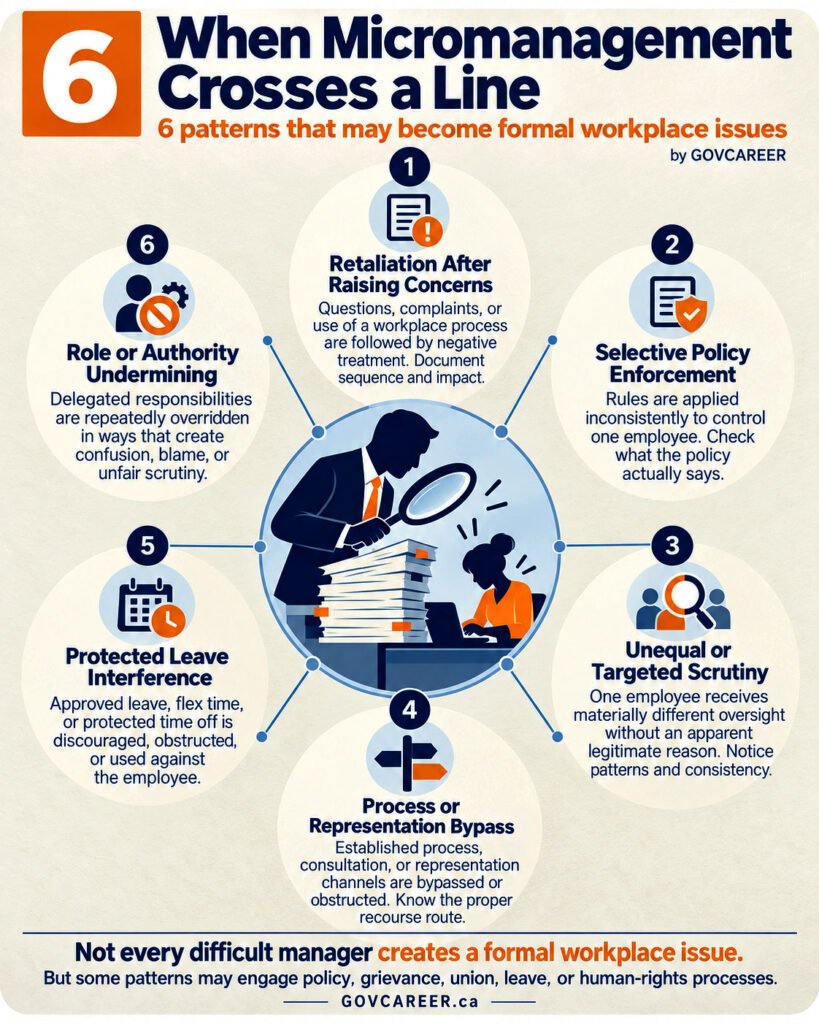
Micromanagement in the public sector can happen just as management problems can occur in any workplace. What may differ is the structure around the employment relationship. Depending on the employer, jurisdiction, position and bargaining status, an employee may work under collective agreements, workplace policies, conflict-management systems, grievance procedures and other defined processes.
That distinction matters.
A government job does not guarantee a good manager.
It does not guarantee perfect communication, a strong team, sensible delegation or the management style you personally prefer.
But when you are considering a long-term government job search in Canada, it is worth understanding that the employment environment may be more structured than the simple choice between tolerating a difficult manager and leaving the job.
The important question is not:
“Does government protect me from a bad boss?”
It does not.
The more useful question is:
“If I have a workplace problem, what structure applies to this position and what options actually exist?”
That is a much more realistic way to think about workplace protection.
Why Micromanagement in the Public Sector Is Still a Management Problem
Micromanagement is usually a management-style problem before it is anything else.
A manager may:
- ask for updates too frequently
- become overly involved in routine decisions
- require unnecessary approvals
- redo delegated work
- schedule more check-ins than the work appears to require
- focus heavily on how work is completed rather than the agreed result
That can be frustrating.
It can also reduce the employee’s sense of autonomy and create unnecessary administrative work.
But the word micromanagement does not automatically tell you what formal workplace mechanism applies.
That is an important distinction.
A manager is allowed to manage.
Managers can set expectations, review work, monitor deadlines, provide direction, establish reporting requirements and address performance.
Employees can also reasonably disagree with how much oversight is necessary.
The fact that an employee dislikes a management approach does not automatically make that approach a formal workplace issue.
Start with the facts.
What is the manager actually requiring?
How often?
For what reason?
Is the expectation clear?
Is it connected to the work?
Has the reporting requirement changed?
Does it affect your ability to complete your responsibilities?
Those questions are more useful than immediately trying to attach a formal label to the situation.
What Public-Sector Workplace Structure Can Change
The strongest distinction is not that public-sector employees never have management problems.
It is that some public-sector employment relationships operate inside highly defined systems.
Those systems can include:
- legislation
- collective agreements
- employer policies
- codes of conduct
- classification structures
- documented responsibilities
- informal conflict-management resources
- grievance procedures
- bargaining-agent representation
- health and safety requirements
- human-rights obligations
- employer-specific complaint or review processes
Not every employee has every one of these mechanisms.
Not every issue falls under them.
And public-sector employers across Canada do not operate under one employment system.
The federal public service, Ontario Public Service, municipalities, Crown corporations, hospitals, universities, school boards, agencies and other public institutions can be governed by different legislation, collective agreements and internal procedures.
That is consistent with the broader principle that government and public-sector systems vary by jurisdiction and employer.
The practical implication is simple:
Do not assume that a process exists merely because you work in government. Check what actually governs your position.
A Federal Public-Service Example
The federal core public administration provides a useful example of what a structured workplace can look like.
Under section 207 of the Federal Public Sector Labour Relations Act, deputy heads in the core public administration must establish an informal conflict-management system and inform employees of its availability.
The Government of Canada describes these systems as mechanisms intended to help manage and resolve workplace conflict constructively, including through approaches such as coaching, facilitated discussion and mediation.
That does not mean every management disagreement should enter a formal process.
In fact, the existence of an informal system illustrates the opposite point: structured workplaces may provide several levels of response before a matter becomes formal.
The same legislation also establishes an individual-grievance mechanism. Section 208 of the Act provides grievance rights for covered federal employees within the statutory conditions and limitations set out there.
Federal employees may also be covered by a collective agreement. Treasury Board maintains the current collective agreements for the federal public service, which can address working conditions, terms and conditions of employment, leave and other employment matters.
Those are federal examples.
They should not be treated as a universal template for every public-sector employee in Canada.
An Ontario Public-Service Example
Ontario uses a different framework.
For Crown employees covered by Ontario’s Crown Employees Collective Bargaining Act, the legislation establishes collective-bargaining structures and continues the Grievance Settlement Board. The Act also provides that collective agreements relating to Crown employees contain mechanisms for resolving differences arising from the interpretation, application, administration or alleged violation of those agreements.
Ontario employment is also subject to applicable provincial legal requirements. For example, the Ontario Human Rights Code applies to employment and contains accommodation requirements within its defined legal framework.
Again, the important point is not that an employee automatically has a claim whenever a manager becomes difficult.
The point is that the employment relationship may operate inside defined rules.
Knowing those rules is different from assuming that every unpleasant workplace experience activates them.
Not Every Management Problem Is a Grievance
This is where employees can make the wrong move in either direction.
One mistake is to assume:
“My manager is difficult, so I must have a formal case.”
The other is:
“My manager is my boss, so there is nothing I can do.”
Both are too simplistic.
A management issue might be best addressed through:
- clearer expectations
- a direct conversation
- a different reporting schedule
- clarification of responsibilities
- an informal conflict-management resource
- advice from a bargaining representative
- review of an applicable policy
- a formal process when the actual facts and governing rules support one
Which path makes sense depends on the situation.
The existence of formal workplace protections does not mean they should be the first response to every disagreement.
Likewise, trying to resolve something informally does not mean formal rights disappear when they actually apply.
The skill is understanding the difference.
Start by Clarifying the Work Expectations
Before deciding that you are being micromanaged, make the manager’s expectations explicit.
For example, ask:
- What decisions am I expected to make independently?
- What decisions require approval?
- How often do you want progress updates?
- What information should an update contain?
- What would make you comfortable reducing the frequency of check-ins?
- Which deliverables matter most?
- What risks are you trying to monitor?
This can reveal something important.
Sometimes the problem is excessive control.
Sometimes expectations were never properly agreed upon.
Sometimes a manager is reacting to a specific risk, deadline or performance concern.
Sometimes the employee and manager simply have different communication styles.
You cannot respond intelligently until you understand what the manager believes the oversight is accomplishing.
Separate the Management Style From the Workplace Rule
The next step is to identify whether the concern is mainly about management preference or whether a specific workplace rule is involved.
That distinction matters.
Suppose a manager asks you to provide a short update every Friday.
You may consider it unnecessary.
But a preference for less reporting is different from a question about whether the manager is applying an established policy, changing a defined working condition or acting in an area governed by a collective agreement.
Do not start with the strongest possible interpretation.
Start with the actual requirement.
Then check the document that governs it.
Depending on your workplace, that could mean reviewing:
- your job description
- the applicable policy
- your collective agreement
- organizational procedures
- terms and conditions of employment
- the employer’s conflict-management resources
- guidance provided by your bargaining representative
This is why public-sector structure can matter.
You may not have to guess what the rules are.
If You Are Unionized, Check the Collective Agreement
A unionized public-sector job can add another layer to the employment relationship.
The collective agreement may address matters such as hours, leave, scheduling, working conditions, assignment provisions, discipline, grievance mechanisms or other terms.
The exact content varies substantially.
Do not assume that being unionized means every disagreement is a union issue.
Instead, ask a narrower question:
Does the concern involve something the collective agreement actually governs?
If you are unsure, a bargaining representative can help you understand the agreement and the available process.
The key is to consult the actual agreement rather than relying on what a coworker remembers from another department, another bargaining unit or another employer.
Use Informal Resolution When It Fits
Formal structure does not mean every problem needs a formal response.
A productive conversation may solve an issue more effectively than escalation.
You might be able to agree on:
- one scheduled update instead of several interruptions
- a clearer approval threshold
- a shared project tracker
- defined decision authority
- an agreed deadline before follow-up
- a different communication method
- a trial period with greater autonomy
This turns a vague complaint about micromanagement into a specific operational question.
Instead of:
“You micromanage me.”
the conversation can become:
“Could we agree that I will send one progress update Wednesday afternoon unless a material issue arises before then?”
That is easier to discuss.
It also makes the requested change concrete.
Document the Work, Not a Narrative About the Manager
If the issue continues, keep objective records.
That does not mean building a dramatic file about every interaction.
Record what is useful:
- assignment
- instruction
- date
- requested deadline
- reporting requirement
- changes in direction
- approvals requested
- decisions made
- relevant written communication
- impact on deliverables when material
Avoid turning documentation into speculation about motives.
“Manager asked for three separate status updates on Tuesday” is an observable fact.
“Manager does not trust anyone” is an interpretation.
Facts are more useful whether you later speak with the manager, a senior manager, an informal conflict-management resource, a bargaining representative or another appropriate workplace contact.
Know What Structure Does — and Does Not — Give You
Public-sector workplace structure can be valuable.
But it should not be romanticized.
A collective agreement cannot guarantee that you will like your manager.
A policy cannot guarantee perfect communication.
A grievance procedure cannot guarantee that every concern will fall within its scope.
An informal conflict-management system cannot guarantee that two people will suddenly work well together.
Structure gives you rules, channels and points of reference.
It does not remove the human part of work.
That distinction is important for Stability Seekers who may associate government employment with predictability and workplace protection.
Those can be legitimate reasons to value a public-sector career.
But protection should not be interpreted as insulation from ordinary management and workplace problems.
Sometimes the Question Is Career Fit
There is another possibility.
You may understand the rules correctly.
You may have tried reasonable communication.
Nothing may be formally wrong.
And you may still conclude that you do not want to work for this manager or inside this particular team.
That is a career decision.
Not every workplace problem needs to become a formal workplace matter before you are allowed to decide that the environment is not right for you.
When comparing future opportunities, consider management, team and organizational fit alongside salary, classification, employment status and career potential.
And do not wait until a workplace becomes intolerable before rebuilding your career options. There is value in continuing to keep your public-sector career options active even when you are not urgently trying to leave.
Career mobility is also a form of protection.
A Practical Check Before You Escalate
If you are dealing with micromanagement in the public sector, work through these questions in order:
- What exactly is the manager doing?
Describe observable behaviour rather than a label. - What work expectation is involved?
Identify the reporting, approval, communication or performance requirement. - Have expectations been clarified directly?
Make sure both sides understand what is required. - What workplace document applies?
Check relevant policies, collective agreements, job expectations or employment terms. - Is there an informal resource available?
Depending on the workplace, this could include a senior manager, conflict-management service, bargaining representative or another designated resource. - Does a formal process actually apply?
Determine that from the governing framework rather than assuming it. - Is the underlying problem really career fit?
A valid career decision does not always require a formal workplace dispute.
This sequence prevents two expensive mistakes:
Treating every difficult manager as though a formal process is required.
And assuming that working for a manager means you have no structured options at all.
Frequently Asked Questions
Is micromanagement in the public sector automatically a formal workplace issue?
No. Micromanagement in the public sector is normally a management-style concern first. Whether a formal workplace process applies depends on the actual behaviour, employer, jurisdiction, bargaining status, workplace rules and facts involved.
Are all government employees unionized?
No. Union coverage depends on the employer, position, bargaining unit and applicable labour-relations structure. Some public-sector positions are unionized and governed by collective agreements; others are excluded, management, non-union or governed differently.
Can a union help with micromanagement?
Potentially, particularly if the issue involves a provision of the applicable collective agreement or if you need help understanding your workplace options. A bargaining representative can explain the agreement and processes that apply to your bargaining unit.
Does the federal public service have a workplace conflict process?
For the federal core public administration, section 207 of the Federal Public Sector Labour Relations Act requires deputy heads to establish an informal conflict-management system and inform employees of its availability. Other federal public-sector organizations may operate under different arrangements.
Should I file a grievance against a micromanaging manager?
Do not decide from the label alone. First determine what actually occurred, whether a collective agreement or other governing provision applies, and what informal or formal process is appropriate in your specific workplace.
Is the public sector more protected than the private sector?
That is too broad to answer as a universal rule. Private-sector employees can also work under legislation, collective agreements, employer policies and formal workplace procedures. The relevant comparison is between the actual positions and employers you are considering, not simply “public” versus “private.”
Conclusion: Structure Changes the Options, Not the Manager
Micromanagement in the public sector should not be romanticized or exaggerated.
A government job can still come with a manager whose working style does not suit you.
The more useful distinction is that some public-sector jobs operate inside formal employment structures that give employees clearer documents, defined processes and identifiable places to seek guidance when a workplace concern develops.
That does not automatically turn a management problem into a grievance.
It gives you a better question to ask:
What exactly is happening, what framework governs this workplace, and which response fits the facts?
That is a more realistic understanding of workplace protection — and a better way to evaluate the kind of public-sector career you actually want.