
Why Situational and Behavioral Questions Are Really Testing the Same Thing
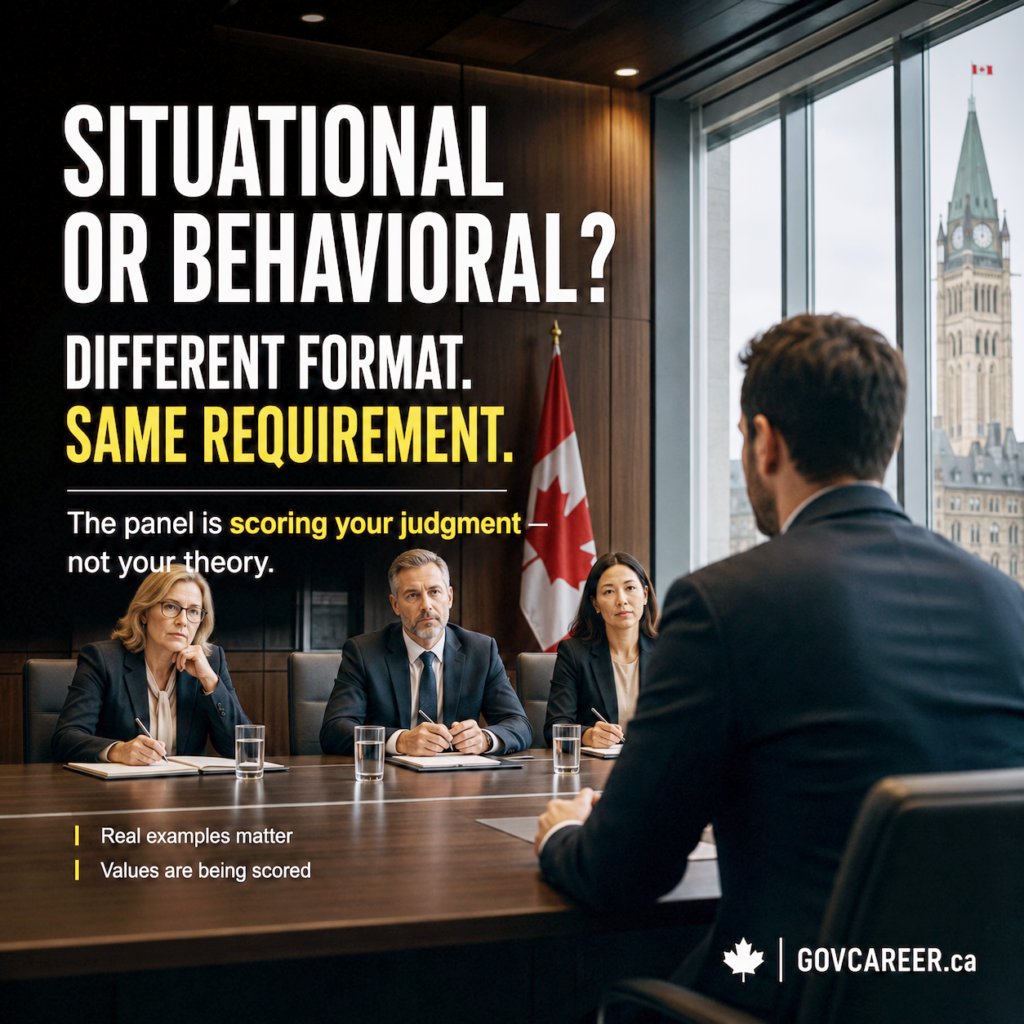
Most candidates prepare for situational and behavioral interview questions as if they are two separate worlds. They build one strategy for hypothetical scenarios and another for past-experience questions. That sounds organized, but in government and other structured hiring environments, it often sends people in the wrong direction.
If you understand what public-sector panels are actually scoring, the divide becomes much less important. The wording may change. The scoring logic usually does not.
If you are trying to break into government jobs or grow within public service careers, this matters more than many candidates realize. In structured interviews, the panel is rarely impressed by polished theory alone. They are trying to assess judgment, accountability, service mindset, communication, and how your behavior aligns with the role. That is why strong interview preparation for government job applications should focus less on memorizing question types and more on building a bank of real examples you can adapt in different ways.
For a broader overview of how government job search in Canada works, including where to find public sector jobs and how structured hiring differs from the private sector, it helps to understand the full system first. Once you see how screening criteria, structured interviews, and merit-based hiring work together, interview prep becomes much more logical.
Why this distinction confuses so many candidates
The advice most candidates receive goes something like this:
- behavioral questions ask about the past
- situational questions ask about the future
- behavioral answers should use examples
- situational answers should explain what you would do
Technically, that is not wrong. The problem is that it is incomplete.
It leads people to believe that the panel is evaluating two different abilities. One ability for talking about past events. Another ability for handling made-up scenarios. In many government interviews, that is not what is happening at all.
The panel is usually not separating your answer the way training articles and generic career blogs do. They are not sitting there thinking, “This is a behavioral question, so I only care about the person’s past,” and then switching gears to think, “This is a situational question, so I only care about theory.”
What they are typically doing is scoring evidence against criteria.
That difference is important.
In public-sector hiring, especially in Canada, structured interviews are usually designed to assess predetermined competencies, qualifications, and behavioral indicators. The panel may use different question formats to get at those competencies, but the underlying goal is the same: determine whether you have demonstrated the judgment, professionalism, and job-relevant behavior needed for the role.
That is why people who over-focus on question labels often prepare badly. They spend too much time categorizing questions and not enough time building useful content.
What is a situational interview question?
A situational interview question gives you a hypothetical scenario and asks how you would respond.
For example:
- “You receive a call from a resident who is upset about a decision that was not yours to make. How would you handle it?”
- “What would you do if two departments gave you conflicting priorities at the same time?”
- “If a stakeholder challenged your recommendation in a meeting, how would you respond?”
These questions are common in government jobs, public sector jobs, and large organizations that use structured hiring. They are especially common in roles involving service delivery, public contact, policy implementation, communications, administration, supervision, compliance, and cross-functional coordination.
Candidates often think the goal is to invent the most reasonable hypothetical answer possible.
So they say things like:
- “I would stay calm.”
- “I would listen carefully.”
- “I would clarify the issue.”
- “I would follow procedure.”
- “I would escalate if needed.”
- “I would document the interaction.”
None of those steps are wrong. In fact, they are often sensible. The problem is that these answers are generic. Almost any prepared candidate can say them. A panel hears that kind of theory all day.
A situational answer becomes much stronger when it is grounded in real behavior.
What is a behavioral interview question?
A behavioral interview question asks you to describe something you actually did in the past.
For example:
- “Tell me about a time you dealt with a difficult client.”
- “Describe a situation where you had to manage competing priorities.”
- “Give an example of a time when you had to explain an unpopular decision.”
- “Tell us about a conflict you handled within a team.”
These questions are easier for many panels to score because they force candidates to provide evidence. Instead of talking about what they imagine they would do, they have to describe what they did do.
That is why behavioral questions are often recommended so heavily in interview preparation. They generate concrete examples. They reveal how a person tends to act. They make it easier to assess patterns of judgment and performance.
But here is the key point: situational questions are often trying to draw out the same qualities.
The difference is in the wrapper, not the scoring intent.
In government interviews, the question type is not the main event
Government hiring is usually not designed around conversational chemistry or informal impressions. It is designed around criteria.
A posting defines requirements. A screening process checks evidence against those requirements. If shortlisted, candidates move into structured interviews, written exercises, presentations, or other assessment tools. Each stage is intended to generate evidence.
That is why government interview panels are often evaluating:
- judgment
- communication
- service orientation
- accountability
- collaboration
- professionalism
- problem solving
- conflict management
- respect for process
- ability to work within policy or legislative boundaries
These qualities may be called competencies, qualifications, dimensions, or values depending on the organization. The labels vary. The logic is very similar.
In other words, the panel is rarely obsessed with whether you correctly identified a question as “situational” or “behavioral.” What they care about is whether your answer demonstrates the competency they are scoring.
That is why a candidate who gives a clean theoretical answer to a situational question may still score lower than a candidate who grounds that answer in lived experience.
The stronger candidate gives the panel something usable.
What public-sector panels are often really scoring
Every public sector organization has its own language, but most are trying to identify a version of the same core qualities.
Across federal government jobs, provincial government jobs, municipal jobs, and broader public-sector hiring, the values often include some combination of:
- integrity
- respect
- service
- accountability
- collaboration
- good judgment
- equity and professionalism
- effective communication
- sound decision-making under pressure
The exact wording may differ between the Government of Canada, the Ontario Public Service, a municipality, a hospital, a school board, or an agency. But the spine is similar.
That is why candidates do themselves a disservice when they treat interview prep as a game of memorizing separate boxes.
If the panel asks a situational question about an angry client, they are not only checking whether you can list good customer service steps. They are also trying to surface evidence of:
- emotional control
- professionalism
- fairness
- service orientation
- communication style
- understanding of role boundaries
- judgment about escalation
- ability to represent the organization appropriately
A purely theoretical answer often stays too abstract to prove those things.
Why behavioral grounding makes situational answers stronger
This is the point many candidates miss.
A situational answer does not need to be purely hypothetical.
You still answer the scenario you were given. You still explain what you would do. But the answer becomes far more credible when you connect it to behavior you have already demonstrated.
A stronger pattern often sounds like this:
- Briefly answer the scenario directly.
- Explain the principle behind your response.
- Ground it in a real example from your experience.
- Bring it back to the scenario.
That structure gives the panel both judgment and evidence.
For example, imagine the question is:
“You receive a call from a client who is upset about a decision that was not yours to make. How would you handle it?”
A weak answer might be:
“I would stay calm, listen to the client, show empathy, explain the situation, and escalate if necessary.”
That is generic. It sounds fine, but it is thin.
A stronger answer might be:
“I would first stay calm and let the client explain the concern fully so they feel heard. Then I would clarify what I can and cannot address directly, explain the decision or process as clearly as possible, and look for the most appropriate next step, whether that is providing information, documenting the issue, or escalating it to the right person. I approach those situations that way because I have handled similar interactions before. In one of my previous roles, I dealt with a client who was frustrated about a policy decision outside my control. I listened, clarified the limits of my role, explained the reasoning behind the process, and made sure the concern was directed to the correct decision-maker. The situation de-escalated because the client felt they were treated respectfully and not brushed off. So in this scenario, I would use that same approach: calm communication, clear boundaries, and a service-focused response.”
Now the panel has more to score.
They are no longer hearing only a theory. They are hearing how you think and why they should believe you.
The myth that situational means “no examples”
One of the most damaging pieces of generic interview advice is the idea that you should answer situational questions with an entirely imagined response and save all examples for behavioral questions.
That may work in low-structure interviews where the conversation is informal and the hiring manager is just looking for a general impression. It is weaker in structured interviews.
Panels in merit-based hiring environments want evidence. Real examples help provide that evidence.
That does not mean every situational answer needs a long STAR story. You do not want to hijack every scenario and turn it into a rambling autobiography. But strategic behavioral grounding can raise the quality of your answer significantly.
Think of it this way:
- the situational part shows your framework
- the behavioral part shows your credibility
When combined well, they show both judgment and proof.
Why this matters so much in government jobs
Private-sector interviews can vary wildly. Some are structured. Some are casual. Some are driven almost entirely by the hiring manager’s style. Some are little more than chemistry checks.
Government interviews are usually less random than that.
The exact process differs by organization, but public-sector hiring often involves:
- formal job posting requirements
- specific screening criteria
- predetermined interview questions
- rating guides or scoring scales
- multiple panel members
- comparative assessment across candidates
That is one reason why how to apply for Government of Canada jobs and what to expect when applying for Government of Canada jobs can feel very different from a typical private-sector application process. In structured hiring, your application and interview responses need to generate evidence that can be scored, not just create a favorable impression.
The same logic applies whether you are pursuing Government of Canada job opportunities, Ontario Public Service jobs, City of Toronto jobs, or City of Ottawa jobs. The organizations differ, but the common thread is that hiring is usually more criteria-driven than many candidates expect.
If your interview prep is based mainly on generic online advice, you may walk into a structured interview with polished but weak answers.
The real preparation shift: build a bank of evidence
Once you understand that situational and behavioral questions are often testing the same underlying qualities, your preparation method changes.
Instead of preparing two disconnected systems, you build a flexible bank of examples that demonstrate your competencies.
That bank should include stories showing things like:
- handling conflict
- dealing with difficult clients or stakeholders
- managing competing priorities
- solving a problem under pressure
- communicating bad news professionally
- working across teams
- demonstrating accountability
- improving service or process
- responding to ambiguity
- making a judgment call within policy or role limits
Each example should be strong enough to use in more than one way.
One example about dealing with an angry client might support questions about:
- customer service
- communication
- conflict resolution
- professionalism
- judgment
- dealing with pressure
One example about a project deadline might support questions about:
- planning
- prioritization
- teamwork
- accountability
- adaptability
That is how stronger candidates prepare. They do not memorize dozens of rigid answers. They build a small library of high-quality examples and learn how to deploy them across many formats.
How to build better examples for structured interviews
A good example is not just a memory. It is evidence shaped for scoring.
When preparing examples for government interview questions, focus on five things:
1. Relevance
Choose examples that connect clearly to the competencies the job is likely to assess. A story may be interesting but still weak if it does not show the right behavior.
2. Clarity
The panel should be able to understand the situation quickly. If you spend too long setting up context, you lose time and scoring value.
3. Your role
Make it obvious what you did. This is where many candidates weaken otherwise good stories. They describe a team effort so vaguely that the panel cannot tell what part was theirs.
4. Judgment
Do not only describe actions. Show why you chose those actions. That is often what the panel is really trying to hear.
5. Outcome and reflection
State what happened and what it shows. If relevant, explain what you learned or how you would apply the same approach again.
Common mistakes candidates make with these question types
Candidates often lose points not because they are unqualified, but because their preparation method is off. Here are common mistakes I see.
Treating situational questions like a theory exam
Candidates give neat, textbook answers that sound reasonable but generic. The panel learns very little about the candidate as a person.
Treating behavioral questions like storytelling exercises
Candidates tell long stories with too much background and not enough emphasis on their own actions, decisions, and results.
Preparing separate examples for every possible question
This creates unnecessary complexity. It also makes candidates sound robotic because they try to recall pre-scripted answers instead of adapting.
Ignoring the competency behind the question
Candidates focus on the surface topic instead of the underlying assessment. A question about a difficult client may actually be testing judgment, communication, and accountability more than customer service alone.
Giving answers with no values signal
In public sector jobs, the panel is often listening for values in action: fairness, service, respect, collaboration, professionalism, process awareness, and sound judgment. Candidates often show the action but fail to surface the value.
A more useful way to answer both question types
Here is a practical way to think about it.
For behavioral questions
Use a real example and shape it clearly.
A simple structure is:
- Situation: what happened
- Task: what needed to be addressed
- Action: what you did and why
- Result: what happened
- Reflection: what it shows or what you learned
You do not need to say the STAR labels out loud, but your answer should still contain those elements.
For situational questions
Use a hybrid structure.
- State how you would approach the scenario
- Explain your reasoning
- Connect briefly to a real example or prior behavior
- Return to the scenario and close with your likely outcome or next step
This gives the panel both future-facing judgment and past evidence.
How this applies across federal, provincial, and municipal interviews
The exact interview style can vary.
A federal competition may involve very tightly framed competency questions. A provincial role may emphasize specific behavioral dimensions tied to the position. A municipal interview may combine service orientation, role-specific judgment, and public-facing communication. Hospitals, agencies, and broader public-sector employers may also include questions about equity, teamwork, and client service.
But the broader pattern remains.
Across Canada, structured interviews in public-sector hiring tend to reward candidates who can:
- provide evidence
- answer clearly
- show judgment
- connect behavior to role requirements
- demonstrate alignment with institutional values
That is why this preparation shift is useful across different public service careers, whether you are targeting federal government jobs, provincial government jobs, municipal jobs, or other structured large-organization opportunities.
What candidates should do instead of memorizing “question types”
If I were simplifying interview preparation for candidates, I would tell them to spend less time categorizing questions and more time doing the following:
- identify the core competencies likely to be assessed
- build 8 to 12 strong examples from real experience
- map each example to multiple competencies
- practice explaining the judgment behind your actions
- learn how to adapt an example to both behavioral and situational formats
- rehearse concise delivery without sounding memorized
That preparation method is far more useful than trying to predict every possible question and creating separate canned responses for each one.
It also reflects how structured interviews actually work. The panel is not rewarding you for naming the question type correctly. They are rewarding evidence of fit.

What this means for interview preparation in practice
A lot of candidates think interview preparation means reading lists of common questions and drafting polished answers. That can help a little, but it often stays too surface-level for government job applications and structured interviews.
Real preparation is more diagnostic.
It asks:
- What is this job likely to score?
- Which values or competencies are most important?
- What examples from my experience actually demonstrate those things?
- Where are my stories weak, vague, or missing evidence?
- How do I present my examples in a way that makes scoring easier for the panel?
That is the kind of preparation that changes results.
It is also why generic advice often fails candidates in public-sector hiring. Generic advice usually teaches interview style. Structured hiring requires interview evidence.
Final thoughts: the panel is scoring more than your answer
Situational and behavioral interview questions do look different on the surface. But in many government interviews, they are both trying to uncover the same thing: who you are when work gets real.
How do you think?
How do you act?
What do you default to when things get uncomfortable?
What values show up in your decisions?
Can the panel trust your judgment in the role?
That is why a situational answer with no behavioral grounding is often too weak. It stays theoretical. The panel hears the words but gets very little proof.
When you prepare around real examples instead, the whole process becomes clearer. You stop obsessing over whether a question is situational or behavioral and start focusing on what the panel actually needs from you: evidence of competence, judgment, and values in action.
That shift matters for anyone pursuing government jobs, public sector jobs, and other roles that rely on structured hiring, merit-based hiring, screening criteria, and structured interviews. It is one of the most practical ways to strengthen interview preparation for Canada, Ontario, Toronto, GTA, Ottawa, and public service careers more broadly.
If you want help making your examples stronger, understanding how structured interviews are usually scored, or preparing more effectively for government job applications, feel free to contact me. I help candidates cut through generic advice and prepare in a way that reflects how public-sector hiring actually works.
, but it deserves separate attention because many candidates stop too early. They read the organization’s About page. They memorize the mission. They scan a few programs. Then they move directly to practising STAR answers. That is surface research. The more useful question is: **What does the specific group I may join actually exist to accomplish — and how does this role help it do that?** That is where interview research becomes useful. ## Why Government Interview Research Should Go Beyond the Homepage The job posting tells you what qualifications the employer is seeking. Research helps you understand the environment in which those qualifications will be used. That distinction matters. Suppose the posting asks for: * project management * stakeholder engagement * analytical skills * communication * judgment Those requirements can appear in thousands of jobs. A project manager delivering municipal infrastructure operates in a different context from a project manager implementing a public-health program. An analyst supporting regulatory decisions faces different pressures from an analyst preparing internal operational reports. A communications professional serving the public may need to think differently from one marketing a private product. The underlying professional skill may transfer. The operating context changes what good performance looks like. That is why strong public-sector interview preparation should include both: **Can I demonstrate the qualification?** and: **Do I understand how that qualification will be used in this particular environment?** Current Government of Canada candidate guidance gives a federal example of this principle. The Public Service Commission advises applicants to research the department’s mission and priorities and consider how their skills can help achieve them. Ontario provides an even more explicit example. Current Ontario Public Service candidate guidance tells interview candidates to conduct research on the ministry, branch and program before the interview. The City of Toronto similarly advises candidates to research the position, division values and business plan before attending an interview. Those are employer-specific examples, not proof that every Canadian public-sector employer expects the same preparation. But they support a broader practical principle: **Research the actual environment in which the job exists.** ## What to Research Before a Government Interview: Start With the Organization Begin broad. You should be able to explain, in normal language, what the organization does and why it exists. Depending on the employer, useful sources may include: * official About or mandate pages * legislation establishing the organization * strategic plans * annual reports * departmental or ministry plans * budgets * business plans * program descriptions * service pages * organizational charts * recent official reports or announcements Do not collect facts merely because they are available. Look for information that helps you understand the work. ### Understand the Mandate Ask: **What is this organization responsible for?** A ministry may develop policy and administer programs. A municipality may deliver infrastructure, emergency, regulatory and community services. A public agency may have a specialized regulatory, operational or service mandate. A hospital, university, board, commission or Crown corporation may operate under a different governance structure altogether. Do not reduce the answer to a slogan. Understand the actual function. If you cannot explain why the organization exists, it will be harder to explain why your experience matters to it. ### Understand Who Is Being Served Public-sector work ultimately affects people, organizations, communities, businesses or other institutions. That does not mean every job is frontline public service. A financial analyst, engineer, policy advisor, procurement specialist, IT professional or internal HR advisor may rarely interact directly with the public. But their work still supports an organizational function. Ask: * Who relies on this organization? * Who uses its services? * Who is affected by its decisions? * Which internal groups depend on this team? * Which external stakeholders matter? * What public or organizational outcome is the work supposed to support? This helps move your preparation from job duties to purpose. ## Go One Level Deeper: Research the Department, Branch, Division or Team This is the part candidates often skip. Knowing the organization is not the same as understanding the work unit. A large government organization can employ thousands of people doing radically different work. Research the most specific organizational level you can identify from legitimate public information. Depending on the employer, that might be: * ministry * department * branch * division * directorate * program * service area * office * agency * business unit * team The terminology varies. The principle does not: **Get as close as you reasonably can to the actual function of the position.** ### What Does the Group Actually Do? Do not settle for its name. “Strategic Services.” “Operations.” “Corporate Services.” “Program Delivery.” “Engineering Services.” “Policy and Planning.” Those labels tell you something, but not enough. Look for the work behind the title. Does the group: * develop policy? * deliver services? * administer funding? * regulate? * inspect? * build or maintain infrastructure? * manage contracts? * provide technical advice? * conduct research? * manage data? * support internal operations? * respond to public inquiries? * oversee compliance? * prepare recommendations? * coordinate programs? Once you understand that function, the job posting becomes easier to interpret. A requirement such as “stakeholder management” is no longer abstract. You can begin to understand which stakeholders may matter and why. ## Research Current Priorities — But Do Not Become a News Archivist Current priorities can provide useful context. Look for major initiatives, service changes, strategic objectives, operational pressures, public reports or other developments that materially affect the group. But research needs discipline. You do not need to know everything that happened to the organization during the last five years. Ask whether the information helps you understand: * what the group is trying to accomplish * what problems it may be solving * what pressures it faces * what outcomes matter * why the advertised role may be important For example, if a program is implementing a major modernization initiative and you are interviewing for a project role within that program, that context may affect the examples you prepare. If the organization is responding to increased service demand and you are interviewing for an operational leadership position, capacity, prioritization and service continuity may be particularly relevant. Do not invent conclusions from limited public information. Research gives you context. It does not give you insider knowledge. ## Research the Organization’s Values and Ethics Expectations Values matter, but they should not become slogans in your answers. For the federal public sector, the Values and Ethics Code identifies five core values: * respect for democracy * respect for people * integrity * stewardship * excellence The code also describes expected behaviours connected to those values. Ontario uses its own current mission and organizational values, including inclusion, integrity and excellence. Other governments, municipalities, agencies and public institutions may use different frameworks. Research the framework that actually applies to the organization you are interviewing with. Then ask: **What would this value look like in the work of this position?** Integrity may involve accurate advice, impartial decision-making or appropriate handling of conflicts. Stewardship may involve responsible use of public money, assets, information or staff resources. Respect for people may affect service delivery, workplace conduct, consultation or communication. Excellence may involve improving processes, delivering reliable service or exercising professional judgment. Do not add the word “integrity” to an answer merely because you found it on the employer’s website. Show behaviour. That is much stronger. ## Research the Public-Service Impact of the Work A public-sector role exists inside a larger system. Understanding that system can improve how you frame your experience. Consider an engineer working on municipal infrastructure. The technical work matters. But so may: * public safety * service continuity * accessibility * environmental impact * procurement requirements * budgets * stakeholder coordination * disruption to residents * regulatory obligations * long-term asset stewardship A policy analyst may need to consider: * evidence * affected groups * implementation * legal authority * cost * unintended consequences * stakeholder views * fairness * administrative feasibility A client-service role may involve: * accessibility * consistency * procedural accuracy * difficult interactions * service standards * privacy * escalation * clear communication None of these considerations should be inserted mechanically into every interview response. Their relevance depends on the actual role and question. This is one important difference between generic interview preparation and preparation for the [public-sector interview context](https://govcareer.ca/public-sector-interview-vs-private-sector-interview/). ## Use Research to Choose Better Interview Examples Research becomes valuable when it changes your preparation. Imagine you have six project-management stories. Which one should you prepare most deeply? Do not automatically choose: * the largest project * the biggest budget * the most senior title * the most dramatic problem * the result you are proudest of Choose the example that best demonstrates what the target role appears to require. If the group works heavily with multiple public stakeholders, an example showing consultation and competing interests may be stronger than a technically larger project completed mostly inside one team. If the role involves regulated work, an example showing sound judgment within rules and authority may be more relevant than one where you moved quickly by bypassing normal process. If service continuity matters, an example showing how you balanced speed, risk and public impact may become more useful. This is why organizational research and evidence preparation should not be separate exercises. Research helps you [choose the right interview example](https://govcareer.ca/star-method-for-government-interviews/). ## Use the Employer’s Language — Without Becoming a Parrot Every organization develops its own vocabulary. You may see recurring language around: * clients * residents * service users * stakeholders * partners * program delivery * policy outcomes * service excellence * operational excellence * stewardship * accountability * modernization * accessibility * reconciliation * compliance * public trust Use relevant language naturally when it accurately describes your own experience. Do not copy the website into your answers. Do not insert phrases you do not understand. And do not pretend you already know the organization from the inside. The objective is recognition. If the employer talks about “service delivery” and your experience genuinely involved delivering services, use that language. If the posting repeatedly refers to “clients,” you do not need to replace it with “customers” merely because that was the terminology at your previous employer. Translate your experience into language the panel can immediately connect to the work. ## How Research Improves “Why Are You the Best Candidate?” One common mistake is answering this question entirely from the candidate’s side. “I have ten years of experience.” “I am an excellent communicator.” “I have managed complex projects.” “I have strong leadership skills.” Those statements describe you. They do not yet explain why those qualities matter to this employer. A stronger preparation approach asks: **What does this group need the successful candidate to accomplish?** Then connect your evidence to that need. For example: “I bring seven years of infrastructure project experience, but the part most relevant to this role is coordinating projects where construction had to proceed while facilities remained operational. From what I understand, this group manages projects in active public facilities, so my experience balancing contractor work, safety, service continuity and stakeholder requirements would be directly relevant.” The example is hypothetical, but notice the structure. The candidate is not reciting employer facts. The research changes the meaning of the experience. That is the objective. ## Research Should Shape More Than One Interview Answer Do not save your organizational research for: “Why do you want to work here?” Its value is broader. Relevant context may strengthen answers about: * judgment * service * stakeholder management * project management * leadership * communication * problem-solving * prioritization * risk * conflict * technical decision-making * change management Suppose you are asked how you would prioritize competing requests. The answer should primarily demonstrate your decision-making. But understanding the organization’s service responsibilities may help you identify relevant factors such as urgency, public impact, statutory requirements, safety, resource constraints or service disruption. The research does not replace the answer. It makes the answer more informed. ## Do Not Force Organizational Facts Into Every Response There is an opposite mistake. Candidates research heavily and then try to prove it in every answer. They mention the strategic plan when nobody asked. They quote organizational values. They force a recent initiative into an unrelated STAR story. They repeatedly tell the panel what the panel already knows about its own organization. That is not the objective. Research should mostly change how **you think and prepare**. Use it explicitly when it genuinely helps answer the question. Otherwise, let it operate in the background. A good interview answer should still sound like your experience. Not a memorized annual report. ## Understand What the Panel Is Actually Assessing Research does not earn points merely because you did it. The interview still requires evidence. In structured public-sector interviews, the panel may be assessing defined qualifications or competencies rather than awarding general credit for enthusiasm. That is why understanding [what public-sector interview panels assess](https://govcareer.ca/government-interview-scoring-canadian-hiring/) remains important. Research helps you prepare relevant evidence. It does not substitute for evidence. If the question assesses conflict resolution, you still need to demonstrate conflict resolution. If it assesses technical knowledge, you need to demonstrate the required knowledge. If it assesses judgment, your reasoning has to become visible. The research gives you context for presenting that evidence appropriately. ## How Much Research Is Enough? There is no universal number of hours. Stop measuring research by volume. Measure it by whether you can answer the important questions. Before the interview, you should ideally understand: * what the organization does * what the relevant department, branch, division or program does * who or what that group serves * the main responsibilities of the role * relevant current priorities or issues * organizational values when material * how your experience connects to the work * which examples best demonstrate that connection * what thoughtful questions you may want to ask That is usually more useful than collecting fifty facts. The strongest preparation is selective. ## Where Should You Get the Information? Start with authoritative sources. Depending on the employer, these may include: * official organization website * job posting * ministry or departmental pages * program pages * official organizational chart * strategic plan * annual or business plan * budget documents * council or board reports * legislation or regulations * public reports * service standards * values or code-of-conduct pages * official news releases Current federal candidate guidance recommends researching the department’s mission and priorities before the interview. Ontario specifically tells candidates in one current program to research the ministry, branch and program. The City of Toronto advises interview candidates to research the position, division values and business plan. The mechanism varies, but the message is consistent: Know more than the job title. ## Frequently Asked Questions ### What should I research before a government interview? Start with the employer’s mandate, the specific ministry, department, branch, division or program connected to the role, current priorities, services, stakeholders, applicable values and how the advertised position contributes to that work. ### Should I memorize the organization’s mission statement? No. Understand the mandate well enough to explain it in normal language. Memorizing a sentence from the website is less useful than understanding what the organization actually does and why the target role matters. ### Should I read public-service values before the interview? Yes when a values framework applies to the employer, but do not memorize values merely to recite them. Understand the behaviours associated with the values and identify genuine examples from your experience where those behaviours are relevant. ### Should I mention my research directly in interview answers? Only when it helps answer the question. Research should improve your understanding and example selection. It should not become a forced reference to the organization in every response. ### How do I research a branch or team when little information is public? Use what is legitimately available: the job posting, organizational charts, departmental pages, reports, program descriptions and related official material. Do not guess at internal arrangements or claim knowledge that is not public. ### Is researching the department enough for a government interview? It is a good start, but go as close as possible to the actual work unit and role. A large government organization may contain many functions, so understanding the specific branch, division, program or team can make your preparation substantially more relevant. ## Conclusion: Research the Work, Not Just the Employer Knowing **what to research before a government interview** is not about memorizing more facts than the other candidates. It is about understanding the environment well enough to prepare relevant evidence. The organization tells you the broader mandate. The department or team tells you what work is actually being done. The priorities and values help explain the environment in which that work occurs. The job posting tells you what the employer needs from the person entering the role. Bring those pieces together before you choose your examples. Then your interview preparation stops being generic. You are no longer preparing only to prove that you are an experienced professional. You are preparing to demonstrate how your real experience can contribute to the work in front of you.](https://govcareer.ca/wp-content/uploads/2026/09/Organisational-reserch-government-jobs-public-sector-jobs-resume-interview-canada-ontario-toronto-govcareer-ai-generated.jpg)