Myth: Government Jobs Already Given to Internal Candidates

Title:
Are Government Jobs Already Given to Internal Candidates?
Slug:
/are-government-jobs-already-given-to-internal-candidates/
H1:
Are Government Jobs Already Given to Internal Candidates?
Hook:
One of the fastest ways to stop yourself from getting a government job is to believe the posting is fake before you even apply.
That myth costs people real opportunities.
Opening paragraph:
Government jobs are not automatically given to internal candidates. While some public-sector competitions may have strong internal applicants, posted government jobs in Canada are usually part of a structured hiring process where candidates are assessed against job posting requirements, screening criteria, qualifications, and interview scoring. In Ontario, Toronto, the GTA, Ottawa, and across federal government jobs, provincial government jobs, municipal jobs, and broader public sector jobs, many external vacancies exist because people retire, resign, relocate, programs grow, services expand, and organizations need qualified candidates who can clearly show the match.
Why This Myth Damages Government Job Seekers
“Government jobs are already given to internal candidates.”
Many people hear this once and stop applying.
It sounds practical. It sounds realistic. It sounds like inside knowledge.
But in many cases, it is not knowledge. It is frustration turned into advice.
That is why this myth is so damaging. It does not simply describe a problem. It gives people permission to quit before they understand how the process actually works.
Someone applies to two or three government job applications, hears nothing back, then a friend says, “Do not bother. Those jobs are already taken.” The person accepts that explanation because it feels easier than studying the posting, adjusting the resume, understanding screening criteria, and applying properly over time.
The result is predictable.
They stop applying to government jobs.
They assume public sector jobs are not real opportunities.
They return to private-sector job search even if what they really want is stability, structure, benefits, pension, predictable rules, and long-term career safety.
That is a costly mistake.
There is a better way to understand government job search in Canada. The real question is not whether internal candidates exist. Of course they do. The real question is whether the posted process creates a real opportunity for qualified external applicants who apply correctly.
In many cases, yes.
Yes, Internal Candidates Exist
Let’s start honestly.
Internal candidates exist.
In government and public-sector hiring, there may be employees already working inside the organization who apply for posted competitions. Some may be casual, temporary, contract, acting, student, or lower-level staff trying to move into permanent or higher-level roles. Others may be employees from another branch, department, division, ministry, agency, or municipality.
This is normal.
It happens in municipal jobs.
It happens in provincial government jobs.
It happens in federal government jobs.
It happens in hospitals, school boards, universities, agencies, commissions, and large public organizations.
It also happens in large private-sector organizations.
Internal applicants may have advantages in some situations. They may understand the organization. They may know internal systems. They may be familiar with public-sector language. They may already understand workplace procedures, reporting structures, policies, and internal expectations.
That does not mean the job is automatically theirs.
In structured hiring, internal candidates usually still have to demonstrate the required qualifications. They may still need to pass screening. They may still need to write tests, complete assessments, attend structured interviews, provide references, and score well against the criteria.
Being internal is not the same as being selected.
That distinction matters.
The myth says: “An internal candidate exists, so the competition is fake.”
The reality is more often: “An internal candidate may exist, but the competition still requires evidence, screening, assessment, and scoring.”
Those are not the same thing.
Public-Sector Organizations Are Large Systems
People who say “jobs are already given” often underestimate the size and movement inside government and public-sector organizations.
These are not small workplaces with five people and one manager quietly choosing a favourite.
Government and public-sector organizations are large systems. They have thousands, sometimes tens of thousands, of employees. They deliver services to growing populations. They operate programs, infrastructure, enforcement, administration, policy, operations, planning, finance, technology, customer service, inspections, case management, communications, and many other functions.
People retire.
People resign.
People relocate.
People move internally.
People go on leave.
People accept promotions.
People change departments.
People move to other levels of government.
People leave for private-sector roles.
People move out of the region.
Programs expand.
New funding appears.
Service demand grows.
Public expectations change.
Population growth creates more workload.
New units, projects, and functions are created.
Vacancies are not rare accidents.
They are a normal part of running large organizations.
For example, someone applying through Ontario Public Service jobs is not applying into a tiny closed workplace. The Ontario Public Service is a large employer with roles across ministries, regions, functions, classifications, and work streams. The same logic applies to municipal employers such as City of Toronto jobs or City of Ottawa jobs, where services, operations, public-facing roles, technical roles, administrative roles, and professional roles constantly require staffing.
It is simply not realistic to assume every vacancy can be filled internally.
Internal movement exists, but external hiring is necessary.
Population Growth Creates Real Hiring Pressure
Public services grow because communities grow.
When population increases, service demand usually increases with it.
More residents can mean more service calls, more permits, more inspections, more case files, more transit demand, more infrastructure work, more planning applications, more public inquiries, more administrative processing, more program delivery, and more operational pressure.
That does not automatically mean every department hires quickly. Public-sector hiring can be slow. Budgets, approvals, classifications, collective agreements, and internal processes all matter.
But the broad point remains: growing public needs create staffing pressure.
Municipalities need people to deliver local services.
Provincial ministries need people to administer programs and policy.
Federal departments need people for national programs, operations, service delivery, compliance, administration, and analysis.
Public-sector agencies need people to support specialized mandates.
If all jobs were already quietly given away, these systems would not function.
Large public organizations need external candidates. They need people with administrative experience, customer service experience, policy experience, project coordination experience, records experience, finance experience, inspection experience, planning experience, IT experience, engineering experience, communications experience, case management experience, and many other backgrounds.
The opportunity exists.
The challenge is showing the match clearly enough to get through the process.
Retirement and Turnover Are Constant
Another reason the “already given” myth is weak is simple: people leave.
Every day, public-sector employees retire, resign, relocate, move internally, or change roles.
Public service has many long-tenured employees. That creates stability, but it also creates retirement cycles. When experienced employees retire, organizations must replace knowledge, capacity, and service continuity.
Turnover also happens outside retirement.
Some people leave government for the private sector.
Some leave one municipality for another.
Some move from municipal to provincial work.
Some move from provincial to federal work.
Some move from contract to permanent roles elsewhere.
Some leave because of family, location, health, career change, or personal priorities.
This creates openings.
Not every opening becomes external immediately. Some may be filled internally first. Some may be posted internally before externally. Some may be cancelled. Some may change. Some may become temporary, permanent, or backfilled differently.
But across the system, real hiring continues.
If you are a qualified external applicant, the existence of internal movement should not make you stop applying. It should make you more disciplined about selecting postings where your background fits and tailoring your resume properly.
The people who win these competitions are not always the people with the flashiest resumes.
They are often the people who make the required evidence easiest to find.
Why External Postings Exist
External postings exist for a reason.
Organizations do not post jobs externally for entertainment.
Posting a role takes administrative effort. It involves approvals, job descriptions, classifications, posting language, HR coordination, screening, communication, interview scheduling, assessments, reference checks, documentation, and sometimes union or policy requirements.
If the organization already had a clear internal solution in every case, it would not need external recruitment at scale.
External postings may happen because:
There is no qualified internal applicant.
There is no internal applicant available.
The internal pool is too limited.
The role needs broader competition.
The organization wants a wider candidate pool.
The position is new.
The program expanded.
A temporary need became longer term.
A department needs specialized experience.
The process requires a posted competition.
The employer needs to demonstrate a fair and structured selection process.
This does not mean every external posting is easy to win.
It means the posting should not be dismissed automatically.
A posted government job is a signal that the organization is running a process. Your job is to decide whether your background fits that process and whether you can demonstrate the required criteria clearly.
That is where most candidates fail.
The Real Problem Is Often How People Apply
Many applicants blame internal candidates when the real issue is application quality.
That may sound harsh, but it matters.
A person can be qualified in real life and still submit a weak government application.
This happens constantly.
They send a generic resume.
They use the same resume for every posting.
They lead with a broad summary.
They use private-sector achievement language that does not show screening evidence.
They do not mirror the posting requirements.
They bury required qualifications deep in the resume.
They assume the employer will infer the match.
They describe duties too generally.
They do not show systems, documents, procedures, clients, volume, rules, or responsibilities.
They do not address the exact experience requested.
They rely on AI-polished wording instead of real evidence.
They apply to roles that are not realistic for their background.
They misunderstand the level of the role.
They ignore application instructions.
Then, when they do not hear back, they conclude the job must have been given to someone else.
Sometimes that may be true.
Often, it is not.
Often, the application did not make the match obvious.
Government job applications are not won by sounding generally competent. They are won by demonstrating the required experience, qualifications, and competencies against the posting.
That is a different game.
Government Hiring Is Structured, Not Casual
In many private-sector environments, hiring can feel more informal. A strong referral, a relationship, a conversation, or a hiring manager’s impression can carry significant weight.
Government and public-sector hiring is usually more structured.
That structure can feel rigid. It can feel slow. It can feel frustrating. But it is also what creates real opportunity for external applicants.
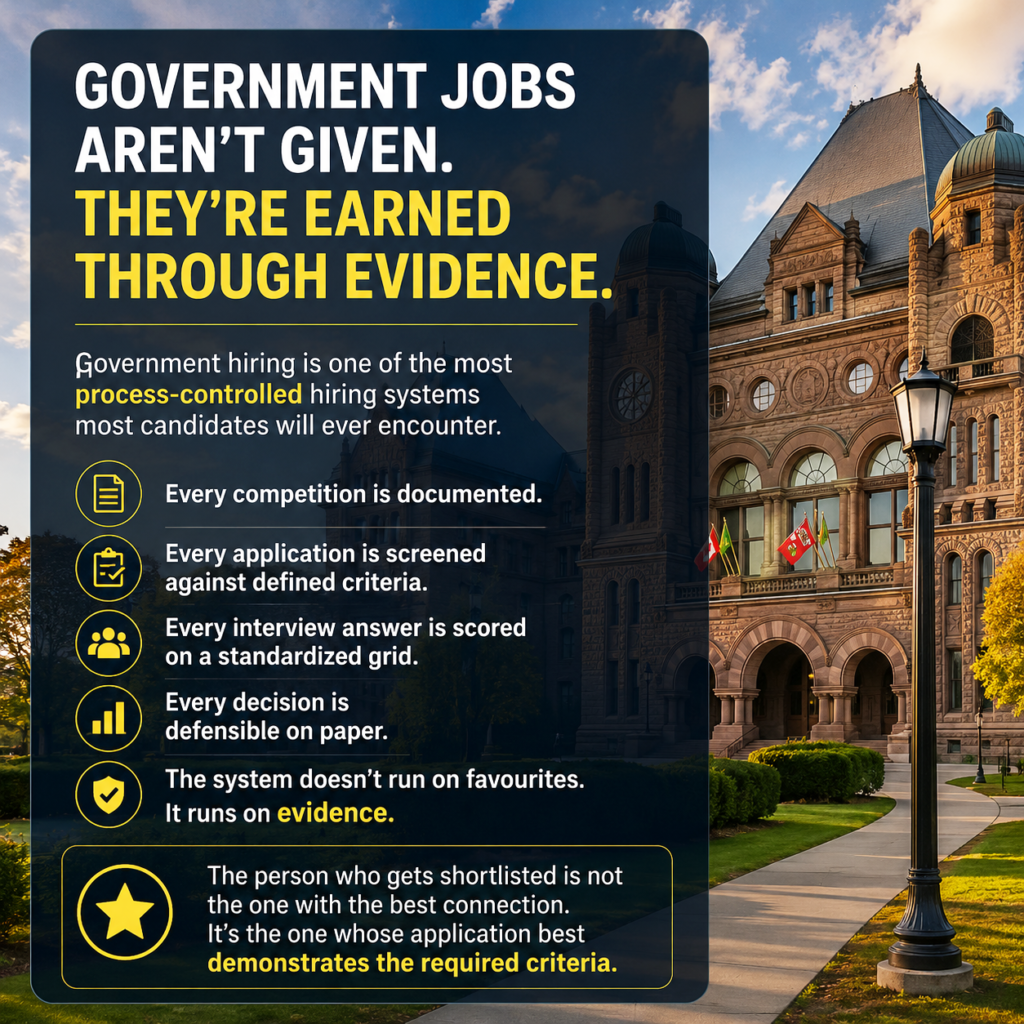
Structured hiring means the organization is usually working from posted requirements, screening criteria, qualifications, competencies, interview questions, assessment methods, and documented decisions.
The process may include:
Application screening.
Resume review.
Screening questions.
Written tests.
Assignments.
Structured interviews.
Panel scoring.
Reference checks.
Eligibility checks.
Security or background requirements.
Union or classification rules.
Competition documentation.
This is not perfect. No hiring system is perfect.
But it is not the same as a manager simply handing a job to a friend.
For federal roles, the Government of Canada explains how to apply for Government of Canada jobs and outlines process expectations for applicants. The existence of formal application steps should tell candidates something important: the posted process matters.
Your application has to work inside that process.
Internal Candidates Can Lose
One of the biggest misconceptions is that internal candidates always win.
They do not.
An internal candidate may know the organization but still fail to demonstrate the required qualifications clearly.
They may assume their internal experience is obvious.
They may write a weak resume.
They may perform poorly in the interview.
They may not answer the question directly.
They may lack a required qualification.
They may not have the right level of experience.
They may not score high enough.
They may be less prepared than an external candidate.
They may know the workplace but not know how to compete.
This happens more often than outsiders realize.
In structured hiring, familiarity helps only if the candidate can convert that familiarity into evidence.
A strong external candidate can compete if they understand the posting, show transferable experience clearly, and prepare properly for the process.
That is why dismissing every posting as “already given” is lazy cynicism.
It may feel smart, but it is not strategic.
Unionized Environments Still Require Competition
Many public-sector workplaces are unionized or operate under formal HR policies, collective agreements, classification systems, and documented staffing procedures.
That does not mean external applicants always have the same path as internal applicants. Internal posting rules can matter. Seniority may matter in some contexts. Collective agreement language can affect how positions are posted, filled, or considered.
But unionized and structured environments are not the same as informal backroom hiring.
When a competition is posted externally, applicants should take the posting seriously.
The existence of internal rules does not make the competition fake.
It means the process has rules.
Candidates need to understand the rules, follow the instructions, and make the evidence clear.
For many applicants, the problem is not that the system is impossible. The problem is that they approach it with private-sector habits.
They submit a broad resume.
They try to impress.
They focus on personality.
They assume a general summary is enough.
They do not understand that the posting is the blueprint.
Then they blame the process.
The more useful move is to learn the process.
Why People Believe the Myth
People believe the “already given” myth because it explains rejection without requiring further work.
That is human.
If you apply and hear nothing, you want an explanation. If the explanation is “the system is fake,” then the rejection is no longer connected to your resume, role targeting, application strategy, or interview preparation.
That can feel comforting.
But it also removes your control.
If the job was already given, why improve your resume?
Why study the posting?
Why apply again?
Why prepare for structured interviews?
Why learn screening criteria?
Why build better examples?
Why apply to more suitable roles?
The myth gives emotional relief but kills action.
A better explanation is more demanding but more useful:
Maybe the role was highly competitive.
Maybe an internal candidate scored better.
Maybe your resume did not show the criteria clearly.
Maybe your background fits a different level or stream.
Maybe you applied too broadly.
Maybe your examples were too vague.
Maybe the posting required experience you did not have.
Maybe the application instructions were not followed closely.
Maybe the process takes longer than expected.
Maybe you need more applications, better targeting, and stronger tailoring.
That explanation is less comfortable.
But it gives you something to work on.
The Posting Is the Starting Point
If you are applying to government jobs, the posting is not just an announcement.
It is the starting point for your entire application.
Read it carefully.
Look at the required qualifications.
Look at the experience requirements.
Look at the education section.
Look at the duties.
Look at the knowledge and skills.
Look at assets.
Look at conditions of employment.
Look at application instructions.
Look at the language used.
Then ask:
Can my resume show evidence against these requirements?
Can the screener find that evidence quickly?
Am I applying to the right level?
Do I have the required qualifications?
Am I showing similar duties?
Am I showing similar setting?
Am I showing similar clients, stakeholders, systems, documents, procedures, volume, pressure, rules, and responsibilities?
Does my resume make the match obvious?
This is where government resume tailoring matters.
Not keyword stuffing.
Not copying the posting.
Not making the resume sound fancy.
Real tailoring means showing your actual background in a way that fits the posted criteria.
Do Not Use the Same Resume Everywhere
One generic resume is usually not enough for government job applications.
This is one of the biggest differences between private-sector and public-sector job search.
In the private sector, people often create a strong resume and send it broadly. That approach is already limited, but it can sometimes work when recruiters are skimming for general fit.
In government hiring, each posting may have different criteria.
Two administrative jobs may not ask for the same evidence.
Two policy jobs may emphasize different skills.
Two municipal jobs may involve different service areas.
Two project coordinator roles may require different systems, stakeholders, documents, or technical knowledge.
Two public service competitions may assess different competencies.
If the posting changes, the resume should usually change.
That does not mean rewriting everything from zero.
It means adjusting the structure, emphasis, examples, and wording so the resume answers the posting.
If you apply to Government of Canada job opportunities, municipal roles, Ontario Public Service roles, agencies, hospitals, universities, or other public-sector employers, the same principle applies: the application must show the match against the specific role.
External Applicants Need to Show Transferable Evidence
Many external candidates have relevant experience but do not describe it properly.
A person from private-sector administration may have experience with records, scheduling, correspondence, client service, document control, reporting, data entry, internal coordination, and confidential information.
A customer service worker may have experience dealing with the public, resolving issues, explaining procedures, documenting interactions, handling volume, using systems, and working under pressure.
A sales professional may have experience with client communication, follow-up, CRM systems, targets, problem solving, documentation, stakeholder management, and service recovery.
A project coordinator may have experience with timelines, deliverables, meetings, reporting, vendors, tracking, risk, budgets, and documentation.
All of that can be relevant to public-sector roles, depending on the posting.
But if the resume only says “handled customers,” “supported operations,” or “managed tasks,” the screener may not see the match.
The resume has to translate the experience into the language of the posting.
That is not manipulation.
That is clarity.
Why Applying Is Still Worth It
Government job applications take effort.
They can be slow.
They can be competitive.
They can be frustrating.
They can require repeated applications.
They can require careful tailoring.
They can involve long timelines.
They can involve tests, interviews, and documentation.
But for many people, the effort is worth it.
Public sector jobs can offer stability, structure, benefits, pension, predictable rules, career progression, internal competitions, and meaningful work.
Not every role is perfect.
Not every workplace is ideal.
Not every process feels smooth.
But for many candidates, public service careers offer something they do not find in unstable private-sector environments.
That is why people should not let cynicism remove the option.
If you want a government job, the answer is not to believe every posting is fake.
The answer is to learn how the system works and apply properly.
When the Myth Has a Grain of Truth
A credible discussion needs nuance.
There are situations where a competition may have a strong internal candidate.
There may be acting employees already performing the work.
There may be temporary staff competing for permanent roles.
There may be internal candidates with direct experience.
There may be roles where internal knowledge is highly relevant.
There may be processes where an external applicant is technically allowed but not realistically competitive unless they have very strong matching experience.
That happens.
The lesson is not “never apply.”
The lesson is to assess postings intelligently.
If the posting is extremely specific to internal systems, internal program knowledge, internal procedures, or a very narrow background you do not have, maybe it is not your strongest target.
But if the posting describes experience you genuinely have, and the role is open externally, do not automatically self-reject.
Apply properly.
That means selecting better postings, not avoiding all postings.
How to Judge Whether a Posting Is Worth Your Effort
Before applying, ask practical questions.
Do I meet the required education or equivalent criteria?
Do I meet the required experience?
Can I show similar duties?
Can I show similar work setting?
Can I show similar clients, public contact, stakeholders, systems, documents, procedures, or rules?
Is the role level realistic?
Is the location realistic?
Are there mandatory language, licensing, security, or availability requirements?
Can I tailor my resume clearly to the posting?
Do I understand what the role likely does?
If the answer is mostly yes, the posting may be worth applying to.
If the answer is mostly no, the issue may not be internal candidates. The issue may be poor targeting.
Good government job search is not random.
It is not applying to anything with “government” in the title.
It is selecting roles where your background can be shown clearly against the requirements.
The Interview Stage Also Requires Evidence
The same myth often appears after interviews.
People say, “They already knew who they wanted.”
Maybe sometimes they did.
But many candidates also lose interviews because their answers do not score well.
Structured interviews are not casual conversations. They often assess competencies, experience, judgment, communication, problem solving, technical knowledge, and role-specific scenarios.
A polished answer is not enough.
The panel needs evidence.
A strong interview answer should show:
The situation and context.
What was at stake.
What rules, procedures, clients, systems, documents, or constraints were involved.
What you personally did.
How you made decisions.
What changed because of your actions.
Why the example is relevant to the role.
If your interview answer sounds generic, memorized, or AI-written, it may not score well.
Again, the issue may not be that the competition was fake.
The issue may be that the answer did not give the panel enough evidence to score.
This is why interview preparation matters just as much as resume tailoring.
Do Not Let Cynicism Become Strategy
Cynicism feels intelligent.
It says:
“The system is rigged.”
“The jobs are already taken.”
“There is no point applying.”
“It is all internal.”
“Nobody gets in without connections.”
That sounds protective, but it is usually not useful.
Even if a few competitions are difficult for external applicants, that does not mean all government job applications are pointless.
Cynicism gives you certainty without evidence.
Strategy gives you action.
A strategic candidate says:
Which postings are realistic for my background?
What level should I target?
What requirements do I meet?
What evidence can I show?
How should I structure my resume?
What does the posting emphasize?
What screening criteria are likely being assessed?
How can I prepare better for structured interviews?
How many suitable applications can I submit consistently?
That mindset produces progress.
The cynical mindset produces excuses.
Final Thought
Posted does not mean already given.
It means there is a process.
Sometimes there may be internal candidates.
Sometimes they may be strong.
Sometimes an external candidate may have a difficult path.
Sometimes the competition may not go your way.
But across government and public-sector hiring, there are real vacancies, real retirements, real resignations, real relocations, real program changes, real population growth, and real staffing needs.
External postings exist for a reason.
The better question is not:
“Is this already given to someone?”
The better question is:
“Can I clearly show that my background matches this posting?”
That is where the work starts.
Read the posting.
Choose realistic roles.
Tailor the resume.
Show evidence.
Prepare for structured interviews.
Apply consistently.
Government hiring is not about sending one polished resume everywhere and hoping someone notices.
It is about making the match obvious in a structured, merit-based hiring process.
If you are applying for government jobs in Canada, Ontario, Toronto, the GTA, Ottawa, federal government jobs, provincial government jobs, municipal jobs, or broader public sector jobs, do not let a lazy myth stop you before you start.
If you have questions about public-sector hiring, government job applications, resume tailoring, screening criteria, structured interviews, interview preparation, or how to position your background for public service careers, you can contact GOVCAREER.ca for guidance.